
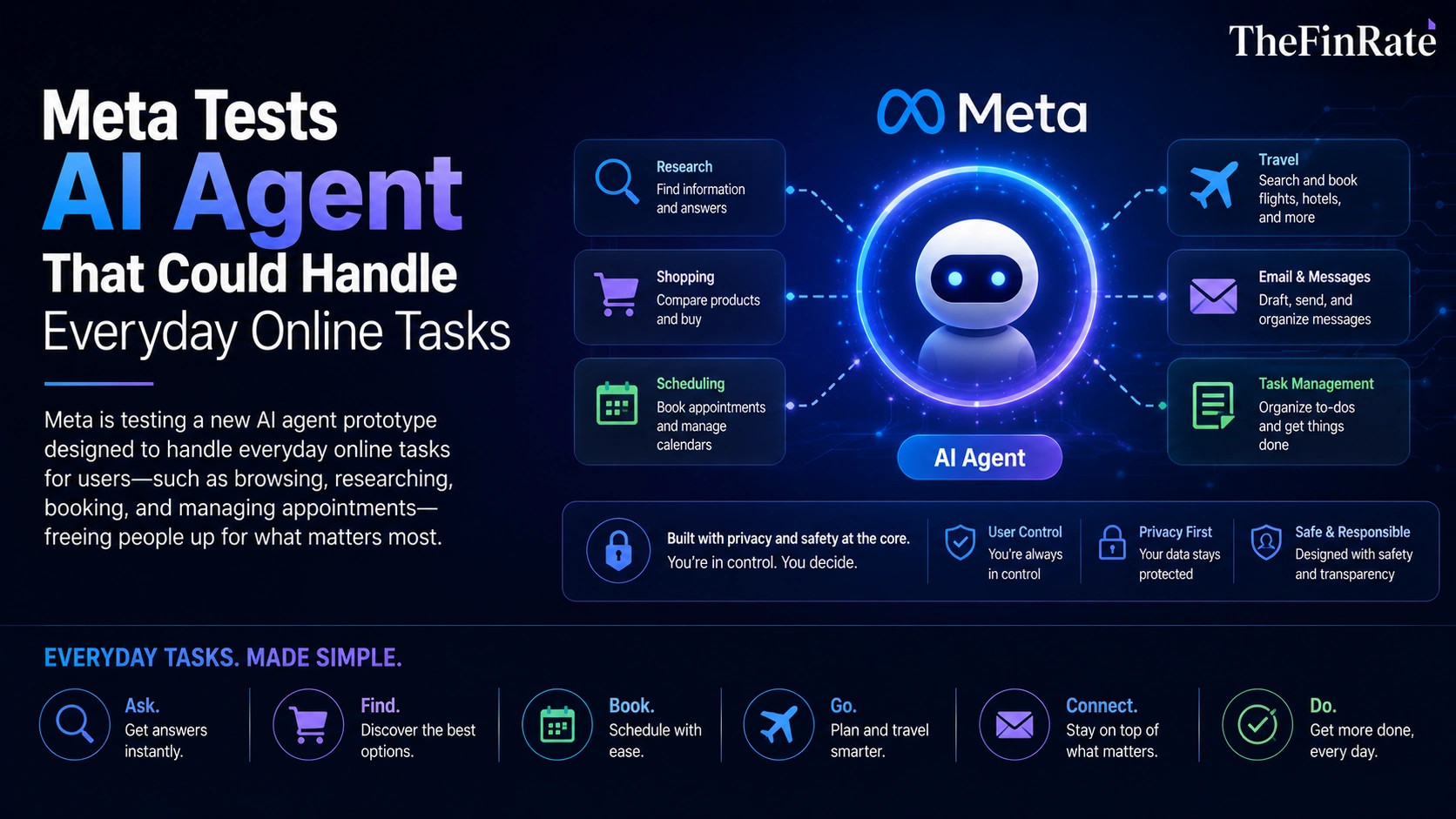
Meta Tests AI Agent That Could Handle Everyday Online Tasks
Meta is testing a new Meta AI agent that could perform everyday online tasks on behalf of users. The project, reportedly known internally as Project Hatch, is designed to move beyond traditional chatbot functions and take actions across websites and applications.
According to an internal company memo reported by Business Insider and Finextra, the agent could fill out forms, make purchases, post on social media and conduct research. It could also eventually assist users with areas such as personal finances.
The reported development highlights a wider shift in artificial intelligence. Technology companies are increasingly building agents that can act on instructions rather than simply respond to questions.
Meta has not confirmed a consumer launch date for Project Hatch.
Meta’s AI agent moves toward autonomous tasks
Most consumer AI tools still operate mainly as conversational assistants. A user asks a question, provides an instruction, or requests content. The system then produces an answer.
Project Hatch reportedly takes a different approach.
Instead of stopping at recommendations, the agent is designed to complete tasks. It could interact with websites and applications and carry out actions that normally require several manual steps.
The reported capabilities include online shopping, form completion, appointment scheduling and social media activity. Deep research is also listed among the potential uses.
That creates a significant change in how consumers could interact with the internet.
Rather than opening several apps to complete a task, users could eventually give an AI agent a goal. The system would then handle the individual steps.
Project Hatch could work across multiple services
The reported scope of Meta’s project extends beyond the company’s own platforms.
According to the reporting, the AI system has been trained to work with commonly used applications and websites. Examples mentioned include Outlook, DoorDash, Etsy, Reddit and Yelp.
Such integrations could allow an agent to operate across different parts of a user’s digital life.
For instance, a consumer might ask the system to research restaurants and make a reservation. Another request could involve finding a product and completing a purchase.
The key difference is execution.
Traditional AI provides information that the user must act on. An autonomous agent attempts to complete the requested action itself.
Meta reportedly wants users to shape their agents
Personalization appears to be another part of the Project Hatch concept.
The internal memo reportedly describes an AI assistant that users can customize. People could name their agent, influence how it communicates and decide what information it should pay attention to.
The system could also reportedly adjust when users tell it that something went wrong.
This points toward a more persistent form of AI assistance. Instead of interacting with a new chatbot session each time, consumers could have an agent that remembers preferences and adapts to their needs.
The memo also reportedly says Hatch can remain active even when the application is not open.
That capability would be important if Meta wants the agent to operate continuously. It could allow the system to monitor tasks and respond when action is needed.
User approval could remain an important safeguard
Giving an AI the ability to act online introduces risks that do not exist with a simple chatbot.
A system that recommends a product can make a mistake without directly causing a transaction. An agent that purchases the product can create a financial or legal consequence.
Meta therefore appears to be considering user controls as part of the experience.
According to the reported memo, users can approve actions before the agent performs them. Such approval mechanisms could help prevent unwanted purchases, incorrect submissions or other unintended activity.
The challenge will be finding the right balance.
Too many approval requests could make an autonomous agent frustrating to use. Too little oversight could increase the risk of costly mistakes.
Why Meta’s AI agent matters to fintech
The development has a particularly interesting angle for financial services.
Project Hatch is reportedly intended to help with personal finances. That puts Meta alongside a growing group of companies exploring how AI agents could move from financial advice toward financial action.
Personal finance apps have traditionally helped users understand their money. They track spending, organize transactions and provide recommendations.
Agentic AI could change that model.
A future financial agent could potentially compare products, manage recurring expenses, complete applications or help users carry out routine financial tasks.
Such capabilities could reduce friction for consumers. However, financial services require stronger controls than ordinary online activities.
An agent handling money would need reliable identity verification, clear authorization and strong security. Financial institutions would also need detailed records of what the agent did and why.
Trust could become the biggest test
The success of consumer AI agents will depend heavily on trust.
Users may be comfortable asking an AI to summarize an article. They may be less comfortable allowing the same system to access their email, purchase products or manage financial information.
Security will become even more important as agents gain access to multiple services.
A compromised AI agent could potentially expose personal information or perform unauthorized actions. Developers therefore need to protect credentials, permissions and sensitive user data.
Accuracy is another challenge.
Websites change their layouts. Online forms contain unusual fields. Products can sell out. Prices can change. An agent needs to recognize these situations instead of blindly continuing.
For financial applications, the consequences of an error can be much greater.
Meta could be building a new AI business
Project Hatch could also give Meta another way to monetize its large AI investment.
The company has been competing aggressively in the consumer AI market. An agent capable of completing tasks could provide a different value proposition from conventional chatbots.
Reports have suggested that Meta may consider a subscription priced at $199.99 per month for a consumer AI agent. That figure should be treated as reported information rather than a confirmed final price for Project Hatch.
A premium subscription would place the product in a higher-value segment of the AI market.
For consumers, the question will be whether the time saved by an autonomous agent justifies the cost. Meta would also need to demonstrate that the system can perform useful tasks reliably.
Agentic AI could change how consumers use the internet
The emergence of projects such as Hatch suggests that AI competition is moving into a new phase.
The focus is shifting from what AI can generate to what AI can accomplish.
That change could affect websites, online marketplaces and financial platforms. Businesses may increasingly need to design their services for interactions with AI agents as well as human users.
Search could also change.
Instead of searching for information and visiting several websites, a consumer could eventually ask an agent to find the best option and complete the process.
For companies such as Meta, that creates a major opportunity. Their AI systems could become a new interface between consumers and the wider internet.
Regulatory questions will follow
Greater autonomy will also attract regulatory attention.
An AI agent that purchases products or handles financial transactions raises questions about consent and responsibility. Companies may need to demonstrate that users clearly authorized specific actions.
Privacy will be another major concern.
A persistent personal agent could potentially have access to large amounts of information. That could include communications, purchase histories, preferences and financial details.
Clear data controls will therefore be essential.
The financial sector faces an even higher bar. Regulators and financial institutions are likely to scrutinize how autonomous systems authenticate users, execute transactions and handle sensitive information.
Meta’s next step could be important for fintech
Project Hatch remains a reported and developing initiative rather than a confirmed consumer product with a public launch date.
Still, the direction is significant.
Meta is reportedly testing an AI system designed to operate across the internet and perform tasks for consumers. That is a step beyond the traditional chatbot model.
For fintech, the implications could be substantial.
AI agents may eventually sit between consumers and financial services. They could help people discover products, manage payments and complete routine financial tasks.
The companies that succeed will need more than powerful AI models. They will need strong security, transparent permissions and reliable controls.
The future of consumer AI may therefore be less about having a conversation with a machine.
It may be about giving the machine a job — and trusting it to get that job done.
Meta tests consumer-based AI agent for everyday online tasks
Comments
No comments yet. Be the first to share your thoughts.
Leave a comment