
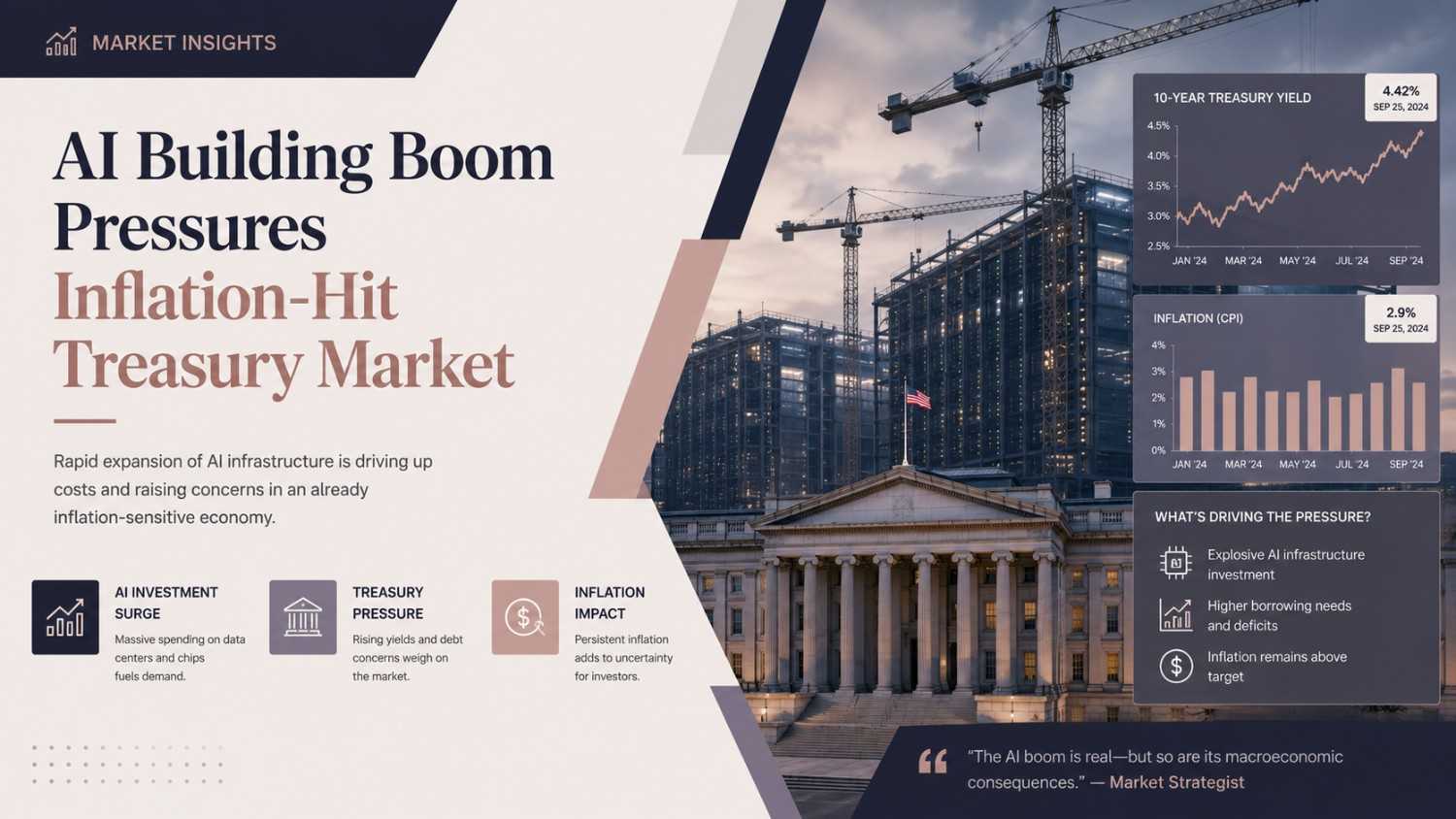
AI building boom impacts Treasury market sentiment
The AI building boom is creating new pressure across global bond markets as demand for artificial intelligence infrastructure continues to rise even during an inflation-sensitive environment.
Moreover, investors are closely watching how heavy spending on AI data centers, chips, and digital infrastructure affects interest rates and government bond yields. As a result, the Treasury market is seeing increased volatility.
Furthermore, inflation concerns continue to shape investor behaviour. Consequently, the AI-driven investment cycle is adding a new layer of complexity to fixed-income markets.
AI building boom drives large-scale capital spending
The rapid expansion of the AI building boom reflects massive investment in technology infrastructure.
In addition, companies are spending heavily on:
- Data centers
- AI chips and hardware
- Cloud infrastructure
- Energy systems
- Network expansion
Moreover, this surge in capital spending requires large-scale funding. Because of this, investors are reallocating capital across equity and bond markets.
Furthermore, technology firms continue to raise debt and equity to support long-term AI expansion.
Treasury market reacts to inflation pressures
The inflation-hit Treasury market is responding to shifting expectations caused by the AI building boom.
Moreover, rising investment activity increases concerns about sustained demand in the economy. Because strong capital spending can keep inflation elevated, bond yields often react upward.
In addition, investors reassess interest rate expectations based on future growth and inflation outlook.
Furthermore, Treasury prices become more sensitive when macroeconomic signals change quickly.
As a result, volatility in government bond markets has increased.
AI infrastructure demand reshapes financial flows
The AI building boom is also changing how global capital moves across markets.
Moreover, investors are shifting funds toward technology-driven assets. Because AI projects require long-term financing, capital flows are moving into infrastructure and growth sectors.
In addition, bond investors are adjusting portfolios to balance risk and return.
Furthermore, higher demand for funding can influence credit markets and borrowing costs.
Consequently, financial markets are experiencing a structural shift driven by AI investment cycles.
Inflation concerns remain central for investors
Inflation continues to play a key role in shaping reactions to the AI building boom.
Moreover, strong spending in technology sectors can support economic growth but may also increase price pressures. Because of this, central banks remain cautious about interest rate decisions.
In addition, investors monitor inflation data closely to adjust expectations for future policy moves.
Furthermore, Treasury markets react quickly to any change in inflation outlook.
As a result, bond trading has become more sensitive to economic signals.
AI investment cycle strengthens market volatility
The AI building boom is contributing to higher volatility across financial markets.
Moreover, rapid growth in AI-related industries leads to frequent changes in investor sentiment. Because of this, markets often move sharply based on new data or corporate announcements.
In addition, bond markets react to both growth expectations and inflation risks.
Furthermore, uncertainty around interest rate direction adds further pressure.
Consequently, volatility remains elevated in both equity and fixed-income segments.
Comparison between traditional and AI-driven investment cycles
| Feature | Traditional Cycle | AI Building Boom Cycle |
|---|---|---|
| Capital speed | Moderate | Rapid |
| Infrastructure demand | Stable | High |
| Inflation impact | Limited | Higher |
| Market volatility | Lower | Higher |
| Funding needs | Predictable | Expanding |
Moreover, this comparison shows how AI investment cycles differ from traditional economic patterns.
Treasury market faces shifting investor behaviour
The inflation-hit Treasury market is adjusting to changing investor strategies influenced by the AI building boom.
Moreover, investors are balancing safe-haven assets with high-growth opportunities. Because AI investments offer strong potential returns, some capital is moving away from bonds.
In addition, shifting risk appetite affects demand for government securities.
Furthermore, bond pricing becomes more sensitive when large capital shifts occur.
As a result, Treasury yields continue to fluctuate.
Global funding environment becomes more complex
The AI building boom is making the global funding environment more complex for policymakers and investors.
Moreover, governments and corporations both compete for available capital. Because AI projects require massive funding, borrowing needs continue rising.
In addition, central banks must balance inflation control with economic growth support.
Furthermore, financial institutions adjust strategies to manage changing market risks.
Consequently, coordination between fiscal and monetary policy becomes more important.
Energy and infrastructure add further pressure
The expansion of the AI building boom also increases demand for energy and infrastructure.
Moreover, AI data centers require large amounts of electricity and cooling systems. Because of this, energy markets are also affected by rising demand.
In addition, infrastructure spending adds long-term pressure to financial systems.
Furthermore, these requirements contribute to broader inflation concerns.
As a result, multiple sectors are now interconnected through AI-driven growth.
Future outlook for AI building boom
The future of the AI building boom depends on technology adoption, funding availability, and macroeconomic stability.
Moreover, continued AI expansion is expected to support long-term growth in digital infrastructure. Because of this, capital demand is likely to remain strong.
In addition, Treasury markets may continue reacting to inflation signals and investment cycles.
Furthermore, policymakers will closely monitor financial stability risks.
As a result, market volatility may remain elevated in the near term.
Final Thoughts
The AI building boom is reshaping global financial markets by increasing capital demand and influencing inflation expectations.
Moreover, its impact on the Treasury market highlights the growing connection between technology investment and macroeconomic conditions. As a result, investors face a more complex environment.
Ultimately, the AI building boom continues to drive both opportunity and uncertainty across global financial systems.
AI building boom ripples through inflation-hit Treasury market | Reuters
Comments
No comments yet. Be the first to share your thoughts.
Leave a comment