
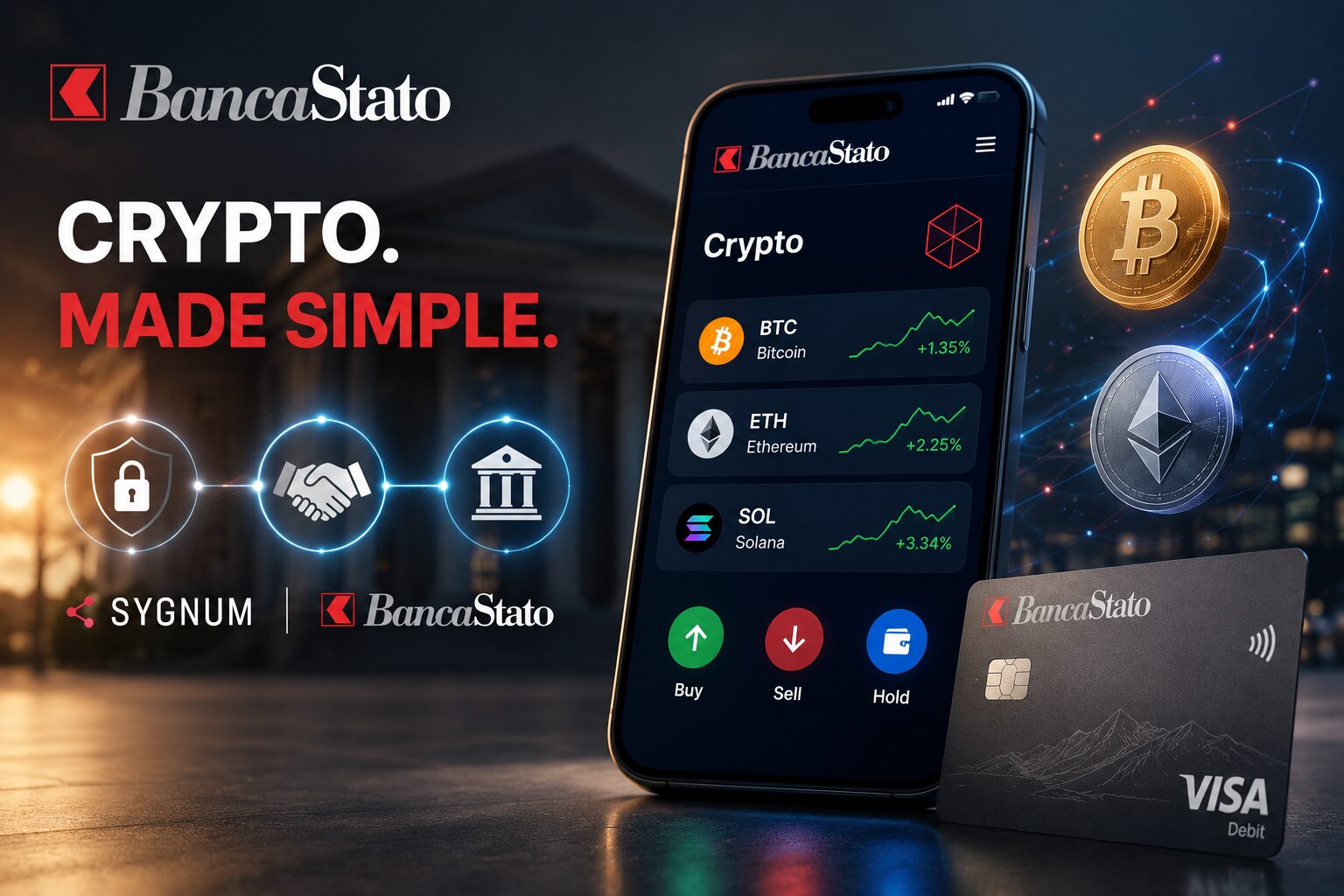
BancaStato Brings Crypto to Everyday Banking with Sygnum Partnership
The move signals a new era where buying Bitcoin could become as simple as checking your bank balance.
For years, crypto and traditional banking have existed in separate worlds. Investors typically needed to open accounts with dedicated exchanges, manage separate wallets, and navigate unfamiliar platforms before buying their first digital asset.
That divide is starting to disappear.
Swiss cantonal bank BancaStato has launched regulated cryptocurrency trading through a strategic partnership with Sygnum and banking technology provider Avaloq. Customers can now buy, sell, and securely hold selected cryptocurrencies directly from the same online and mobile banking platform they already use for everyday financial services.
While the announcement may appear to be another product launch, it reflects a much larger shift taking place across global finance. Banks are no longer asking whether digital assets belong in traditional banking—they are figuring out the safest and most efficient way to deliver them.
A New Chapter for Digital Banking
BancaStato, which serves Switzerland’s Italian-speaking Ticino region, has integrated Sygnum’s regulated digital asset platform into its existing banking infrastructure.
Instead of asking customers to create separate exchange accounts, the bank has embedded crypto services directly into its digital banking experience.
At launch, customers can trade and custody:
- Bitcoin (BTC)
- Ethereum (ETH)
- Litecoin (LTC)
- Solana (SOL)
Transactions take place inside BancaStato’s familiar banking environment, while Sygnum provides institutional-grade execution and custody services. Avaloq powers the core banking infrastructure that connects everything together.
The result is simple but significant: customers gain access to digital assets without leaving their trusted banking app.
Why This Partnership Matters
The biggest obstacle to crypto adoption has never been demand—it has been trust and complexity.
Traditional crypto investing often requires users to:
- Register with a separate exchange
- Complete another identity verification process
- Learn a new trading interface
- Transfer funds between bank accounts and exchanges
- Manage private wallets or third-party custodians
Every additional step increases friction.
BancaStato removes much of that complexity by placing crypto inside an environment customers already know and trust.
For retail investors, digital assets become another investment option rather than a separate financial ecosystem.
That shift could prove more important than launching another standalone crypto platform.
How the Technology Works
One of the most interesting aspects of the rollout is what BancaStato didn’t build.
Instead of investing years developing its own crypto infrastructure, the bank adopted a modular Banking-as-a-Service approach.
Here’s how the ecosystem works:
BancaStato manages the customer relationship and banking interface.
Sygnum provides regulated crypto trading, execution, and institutional-grade custody.
Avaloq connects the crypto services with the bank’s existing core banking systems.
Because the integration is API-based, customers experience everything as a single banking service—even though multiple specialized providers operate behind the scenes.
This approach dramatically reduces development costs while maintaining regulatory standards and operational security.
Why Banks Are Choosing Partnerships Over Building Their Own Platforms
Building a crypto platform from scratch is expensive.
Banks would need to develop:
- Trading infrastructure
- Digital asset custody
- Blockchain connectivity
- Security architecture
- Compliance monitoring
- AML and sanctions controls
- Regulatory reporting
Each layer requires specialist expertise and ongoing investment.
Partnering with regulated providers like Sygnum allows banks to launch digital asset services much faster while reducing operational complexity and regulatory risk.
Rather than reinventing the wheel, banks can focus on what they already do best—serving customers.
The Bigger Trend: Crypto Is Becoming Banking Infrastructure
BancaStato’s announcement reflects a broader industry transformation.
Digital assets are gradually moving away from standalone exchanges and into mainstream financial institutions.
Several forces are driving this shift.
Regulation Is Becoming Clearer
Europe’s Markets in Crypto-Assets (MiCA) framework is creating a clearer regulatory environment for digital asset services.
Greater regulatory certainty gives banks more confidence to expand into crypto through licensed providers rather than waiting on the sidelines.
Customers Want Simplicity
Most retail investors don’t want multiple financial apps.
They prefer managing payments, savings, investments, and increasingly crypto from one secure platform.
Banks that offer an integrated experience are likely to strengthen customer loyalty while attracting younger, digitally native investors.
APIs Are Reshaping Financial Services
Modern banking is becoming increasingly modular.
Instead of building every service internally, banks are connecting specialized providers through APIs to deliver new products faster.
Crypto trading is simply the latest capability to become plug-and-play.
What Customers Gain
For BancaStato customers, the benefits extend well beyond convenience.
They can now:
- Buy and sell digital assets directly from their banking app
- Hold crypto within a regulated custody environment
- Manage traditional and digital assets from one account
- Avoid maintaining separate exchange relationships
- Access institutional-grade security backed by regulated providers
The experience becomes much closer to investing in stocks or mutual funds than navigating traditional crypto exchanges.
That familiarity could significantly lower the barrier to wider adoption.
Why This Is Strategically Important for Banks
The rollout also highlights how traditional financial institutions are redefining their role.
Instead of viewing crypto companies as competitors, banks increasingly see digital assets as another service clients expect.
For regional banks like BancaStato, partnerships create a practical way to stay competitive without making billion-dollar technology investments.
Meanwhile, providers like Sygnum benefit by powering crypto services behind the scenes for multiple institutions.
This platform model is already gaining traction, with Sygnum’s B2B banking platform supporting more than 25 financial institutions.
As more banks adopt similar partnerships, crypto services may become as common as mobile payments or online investing.
The Challenges Still Ahead
While integration removes much of the complexity, it does not eliminate the risks.
Banks offering digital assets must continue to manage:
Operational Risk
Crypto trading requires strong infrastructure, continuous system availability, and secure custody arrangements.
Compliance Risk
Banks remain responsible for anti-money laundering controls, sanctions screening, transaction monitoring, and regulatory reporting.
Customer Education
A regulated banking environment does not eliminate cryptocurrency volatility.
Banks must ensure customers clearly understand the investment risks alongside the convenience.
Building trust will depend not only on technology but also on transparency and investor education.
The Bigger Story Most People Miss
Many headlines frame announcements like this as banks becoming “crypto-friendly.”
That misses the deeper transformation.
The real story is that crypto is becoming another layer of banking infrastructure.
Instead of forcing customers to leave their trusted financial institution, banks are bringing regulated digital assets into the same ecosystem where people already save, spend, and invest.
The competitive advantage is no longer simply offering cryptocurrency.
It is offering it inside a secure, regulated, and familiar banking experience.
That subtle difference could determine which institutions lead the next phase of digital finance.
Looking Ahead
BancaStato’s partnership with Sygnum is unlikely to remain an isolated case.
As regulation becomes clearer and customer demand continues to grow, more banks are expected to adopt API-based crypto platforms rather than building their own infrastructure.
The result could fundamentally reshape how digital assets are distributed.
Instead of opening a crypto exchange account, future investors may simply log into their banking app.
That represents a major shift in how digital assets enter the financial mainstream.
Final Thoughts
BancaStato’s crypto rollout is about much more than adding Bitcoin to a banking app.
It reflects a broader transformation in financial services, where regulated digital assets are becoming part of everyday banking rather than existing on the industry’s edges.
For customers, the experience becomes simpler.
For banks, the business model becomes more competitive.
And for the wider financial industry, it offers a glimpse of a future where traditional banking and digital assets operate within the same trusted ecosystem.
The next wave of crypto adoption may not be driven by exchanges—it may be driven by the banks people already use every day.
BancaStato Launches Regulated Crypto Trading with Sygnumand Avaloq – Sygnum
Comments
No comments yet. Be the first to share your thoughts.
Leave a comment