
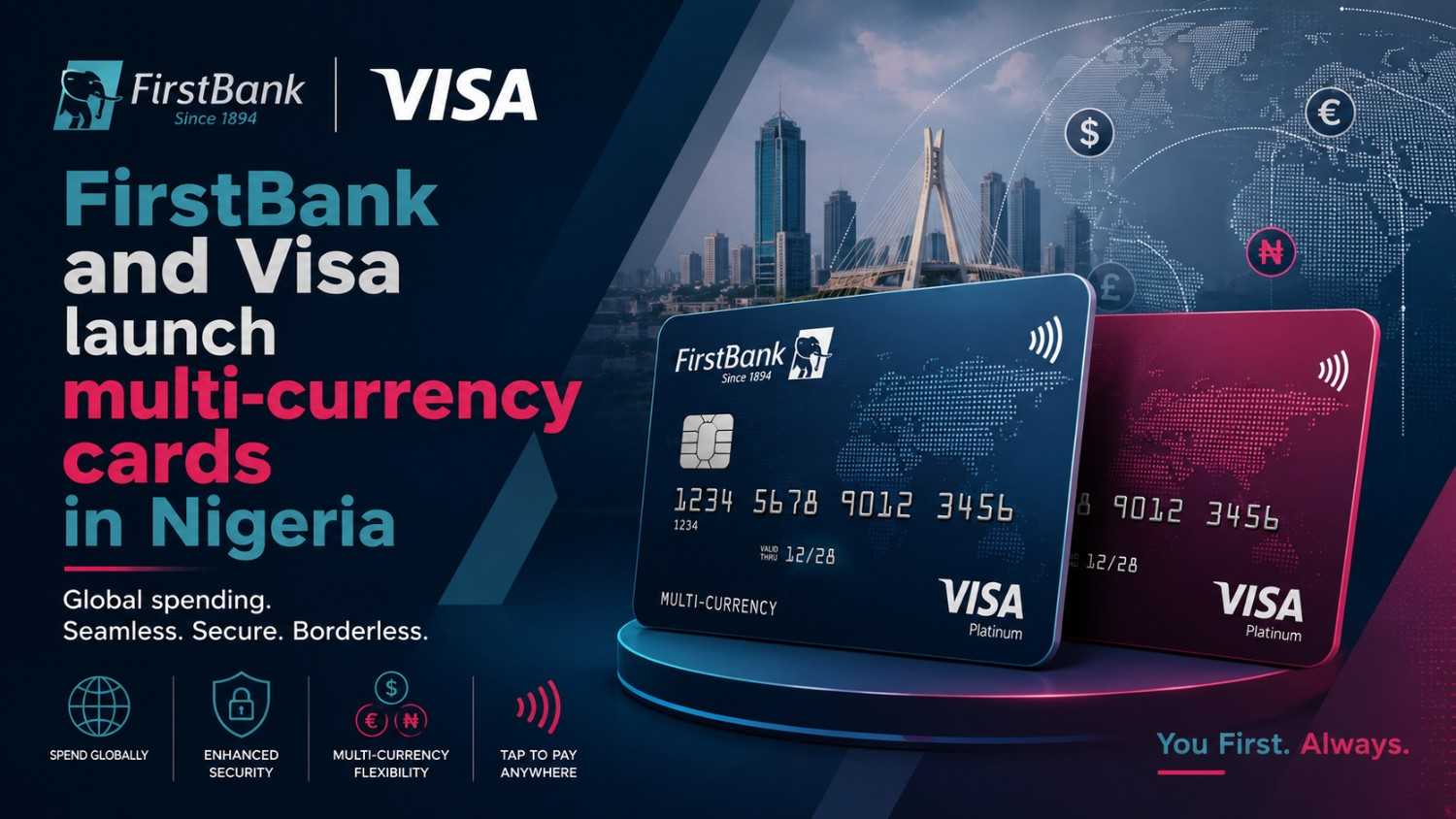
Visa multi-currency cards launch in Nigeria marks major fintech milestone
The launch of Visa multi-currency cards in Nigeria, in collaboration with FirstBank, represents a significant milestone in the country’s evolving digital payments landscape. Importantly, this development is not just a product launch; rather, it reflects a structural shift in how cross-border payments are executed in emerging markets.
Moreover, this innovation arrives at a time when Nigeria’s demand for global payment solutions is rapidly increasing. As international trade, freelancing, and e-commerce continue to expand, the need for flexible currency management has become more critical than ever.
In addition, the partnership between FirstBank and Visa strengthens Nigeria’s position within the global financial ecosystem. Consequently, this move is expected to reshape how individuals and businesses interact with foreign currencies.
What Visa multi-currency cards mean for Nigerian users
The introduction of Visa multi-currency cards allows users to store, manage, and spend multiple currencies using a single card. Previously, customers relied heavily on single-currency accounts, which often created friction in international transactions.
However, with this new system, users can now operate across currencies more efficiently.
Furthermore, the card is integrated into Visa’s global payment network, which ensures acceptance across millions of merchants worldwide. Therefore, users gain immediate global accessibility without needing multiple financial instruments.
Key features include:
- Multi-currency storage within a single account
- Seamless international transaction capability
- Reduced dependency on real-time FX conversion
- Enhanced global spending flexibility
As a result, users can now manage their financial activities more strategically when dealing with international payments.
FirstBank role in Visa multi-currency cards ecosystem
FirstBank plays a crucial role in the distribution and operational management of Visa multi-currency cards in Nigeria. Not only does it act as the issuing partner, but it also ensures that the product is fully integrated into the local banking infrastructure.
Additionally, FirstBank provides the necessary compliance framework required for FX and cross-border transactions.
Moreover, this partnership strengthens trust among users, since FirstBank is one of Nigeria’s most established financial institutions.
Therefore, the collaboration between FirstBank and Visa creates a strong foundation for long-term adoption of multi-currency banking solutions.
Why Visa multi-currency cards matter for Nigeria’s economy
Nigeria has long faced challenges related to foreign exchange accessibility and currency volatility. Consequently, international transactions often involve delays, high fees, and unpredictable exchange rates.
However, Visa multi-currency cards directly address these challenges by allowing users to pre-manage currency exposure.
In addition, this system reduces dependency on real-time currency conversion, which often leads to financial inefficiencies.
Economic advantages include:
- Improved global trade efficiency
- Reduced FX transaction pressure
- Enhanced financial inclusion
- Increased digital payment adoption
As a result, Nigeria’s financial system becomes more resilient and globally integrated.
How Visa multi-currency cards improve cross-border payments
One of the most significant benefits of Visa multi-currency cards is the improvement in cross-border payment efficiency.
Traditionally, international payments required multiple conversion steps. However, this new system simplifies the entire process.
Furthermore, transactions are now processed through a unified global payment network.
Traditional system vs Multi-currency system
| Feature | Traditional Cards | Visa Multi-Currency Cards |
|---|---|---|
| Currency handling | Single currency | Multiple currencies |
| FX conversion | Real-time | Pre-managed |
| Transaction speed | Slower | Faster |
| Cost efficiency | Lower | Higher |
| Transparency | Limited | High |
Consequently, users benefit from improved financial predictability and reduced costs.
Growing demand for multi-currency financial solutions
The rise of Visa multi-currency cards is closely linked to the increasing globalization of financial activities.
Firstly, more Nigerians are engaging in international freelancing. Secondly, cross-border e-commerce is growing rapidly. Thirdly, global travel and education payments continue to increase.
Therefore, traditional banking systems are no longer sufficient to meet modern financial demands.
Moreover, digital transformation in banking has accelerated adoption of FX-based financial tools.
As a result, multi-currency solutions are becoming a necessity rather than a luxury.
Benefits of Visa multi-currency cards for individuals
For individual users, Visa multi-currency cards offer several advantages that significantly improve financial convenience.
Key benefits:
- Easier international travel payments
- Reduced FX conversion losses
- Faster global transactions
- Greater spending control
In addition, users can now manage multiple currencies without needing separate accounts or cards.
Therefore, financial planning becomes more efficient and predictable.
Benefits for businesses and global merchants
Businesses also stand to gain significantly from Visa multi-currency cards.
Firstly, companies involved in import and export can now manage supplier payments more effectively.
Secondly, e-commerce merchants can accept international payments with reduced friction.
Business advantages include:
- Lower international transaction costs
- Improved supplier payment efficiency
- Better cash flow management
- Faster settlement cycles
Moreover, businesses can expand globally with fewer financial barriers.
Impact on freelancers and digital economy workers
The rise of the digital economy has created new income streams for freelancers and remote workers. However, payment inefficiencies have remained a challenge.
With Visa multi-currency cards, freelancers can now receive international payments more efficiently.
Furthermore, conversion losses are reduced, which increases net income.
As a result, Nigeria’s digital workforce becomes more globally competitive.
Risks and challenges of Visa multi-currency cards
Although highly beneficial, Visa multi-currency cards are not without challenges.
For example, currency volatility may still impact stored balances.
Additionally, regulatory compliance requirements remain strict due to cross-border financial flows.
Key challenges:
- FX volatility exposure
- Regulatory compliance complexity
- User education requirements
- Dependence on global payment networks
However, these risks can be mitigated through proper banking controls and user awareness.
Regulatory implications in Nigeria
The introduction of Visa multi-currency cards also has regulatory significance.
Financial regulators will likely monitor:
- FX transaction flows
- Cross-border payment reporting
- Anti-money laundering compliance
- Digital banking transparency
Therefore, banks must ensure strong governance frameworks to maintain system integrity.
In addition, compliance will play a key role in scaling adoption.
Future of multi-currency banking in Africa
Looking ahead, Visa multi-currency cards could serve as a blueprint for other African countries.
As financial digitization continues, more banks are expected to adopt similar models.
Moreover, regional trade within Africa may benefit from simplified currency exchange systems.
Therefore, this innovation could accelerate financial integration across the continent.
Final Thoughts
In conclusion, Visa multi-currency cards launched by FirstBank and Visa represent a transformative development in Nigeria’s financial ecosystem.
Not only do they improve cross-border payments, but they also enhance FX flexibility and global financial accessibility.
Ultimately, this innovation marks a significant step toward borderless banking and modern financial inclusion.
Comments
No comments yet. Be the first to share your thoughts.
Leave a comment