
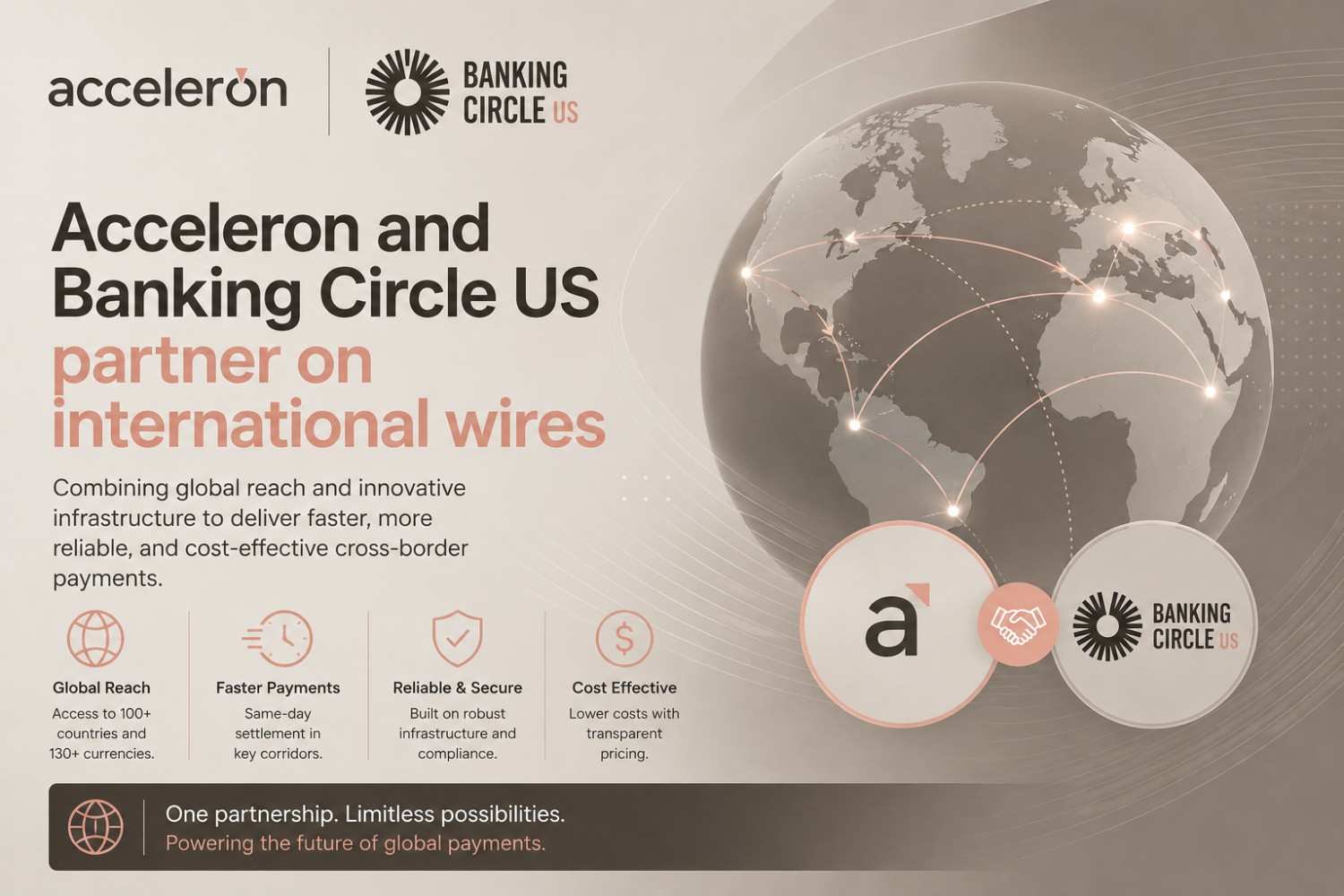
Acceleron and Banking Circle US have entered a new partnership focused on improving international wires and cross-border transaction infrastructure.
The collaboration reflects growing demand for faster and more efficient global payment systems as businesses increasingly operate across international markets.
Moreover, financial institutions are under pressure to modernise payment infrastructure while reducing delays and operational complexity linked to traditional wire transfers.
As a result, partnerships between fintech firms and banking infrastructure providers are becoming more important across the global payments industry.
Furthermore, the agreement highlights how cross-border payment innovation continues to reshape international financial services.
Why international wires remain important for global finance
Despite the growth of digital payment methods, international wires continue playing a critical role in global commerce.
Businesses rely on wire transfers for:
- International supplier payments
- Corporate treasury operations
- Global trade transactions
- Cross-border settlements
- Institutional banking services
However, traditional international payment systems often involve:
- Slow processing times
- High transaction fees
- Limited payment visibility
- Multiple intermediary banks
Consequently, financial institutions are increasingly investing in payment modernisation and fintech partnerships.
Acceleron and Banking Circle US target payment efficiency
The partnership between Acceleron and Banking Circle US aims to improve how international wire transfers are processed and managed.
In particular, the companies are expected to focus on:
- Faster transaction processing
- Improved payment routing
- Better operational efficiency
- Enhanced global payment connectivity
Moreover, businesses increasingly expect real-time visibility into international payments.
Therefore, fintech infrastructure providers are working to reduce friction in global transaction flows.
As a result, modern payment systems are becoming more automated and transparent.
International wires face modernisation pressure.
The global payments industry is rapidly changing as businesses demand faster and more reliable financial infrastructure.
Traditionally, international wires relied heavily on correspondent banking networks. However, those systems can create:
- Payment delays
- Higher costs
- Complex reconciliation
- Limited tracking capabilities
Because of this, fintech firms are building new infrastructure designed to improve payment speed and transaction transparency.
Furthermore, businesses operating internationally now expect payment systems to work with the same speed and convenience as domestic transfers.
Consequently, modernisation has become a major priority across the banking sector.
Banking Circle US expands cross-border payment infrastructure
Banking Circle US continues strengthening its position in cross-border banking infrastructure through partnerships and payment innovation initiatives.
The company focuses on helping financial institutions improve:
- International payment access
- Banking connectivity
- Transaction efficiency
- Multi-currency payment capabilities
As a result, the partnership with Acceleron may help expand global payment capabilities for enterprise and institutional clients.
Moreover, a stronger payment infrastructure may improve operational scalability for financial institutions serving international markets.
Cross-border payment demand continues rising.
Global businesses increasingly require efficient cross-border banking services.
Today, international commerce depends heavily on:
- Fast transaction settlement
- Currency conversion services
- Payment transparency
- Real-time financial reporting
Consequently, demand for modernised international wire infrastructure continues to grow.
Furthermore, digital commerce expansion is increasing pressure on financial institutions to improve payment efficiency.
Therefore, payment modernisation partnerships are becoming increasingly common across the fintech ecosystem.
Comparison between traditional wires and modern fintech payment systems
| Feature: Traditional | l International Wires Modern | n Fintech Payment Systems |
|---|---|---|
| Processing speed | Slower | Faster |
| Payment visibility | Limited | Real-time |
| Transaction costs | Higher | More efficient |
| Automation | Lower | Advanced |
| Customer experience | Complex | Simplified |
This comparison highlights why financial institutions are investing heavily in payment modernisation technologies.
International wires and compliance requirements
Although payment modernisation is accelerating, financial institutions must still comply with strict international regulations.
Cross-border payment providers are required to manage:
- AML compliance
- KYC verification
- Sanctions screening
- Fraud prevention controls
Because of this, payment infrastructure providers must balance speed with regulatory security.
Moreover, global regulators continue to increase oversight of international financial transactions.
As a result, compliance technology is becoming a critical part of modern payment infrastructure.
Fintech partnerships reshape global payment infrastructure
The Acceleron and Banking Circle US agreement reflects a larger trend across financial services.
Increasingly, fintech firms are partnering with banking infrastructure providers to improve:
- Payment speed
- Global transaction access
- Treasury operations
- Financial connectivity
Furthermore, embedded finance and API-based banking services are accelerating digital payment transformation.
Consequently, businesses now expect more flexible and integrated financial infrastructure.
Therefore, partnerships between fintech and banking providers are likely to continue expanding globally.
Risks linked to international payment modernisation
Although payment modernisation creates opportunities, financial institutions still face several challenges.
Key risks include:
- Cybersecurity threats
- Fraud exposure
- Regulatory complexity
- Payment network disruptions
Additionally, cross-border payment systems must manage currency fluctuations and operational risks across multiple jurisdictions.
Therefore, secure infrastructure and strong compliance systems remain essential for international payment providers.
Future outlook for international wires and cross-border payments
The future of international wires is expected to become increasingly digital, automated, and real-time.
Several trends are likely to shape the sector, including:
- API-driven banking services
- AI-powered fraud detection
- Faster payment networks
- Embedded global payments
Moreover, businesses will continue demanding greater payment transparency and operational efficiency.
As a result, financial institutions and fintech firms are expected to invest heavily in payment infrastructure modernisation.
Consequently, partnerships like the one between Acceleron and Banking Circle US may become more common.
Final Thoughts on Acceleron and Banking Circle US
The new partnership between Acceleron and Banking Circle US highlights the growing importance of modernised international wire infrastructure.
As businesses continue expanding globally, demand for faster and more transparent cross-border payments will likely increase.
Moreover, fintech-bank partnerships are helping reshape how global transactions are processed and managed.
Ultimately, payment modernisation may improve efficiency, reduce operational friction, and support the future growth of international commerce.
Comments
No comments yet. Be the first to share your thoughts.
Leave a comment