
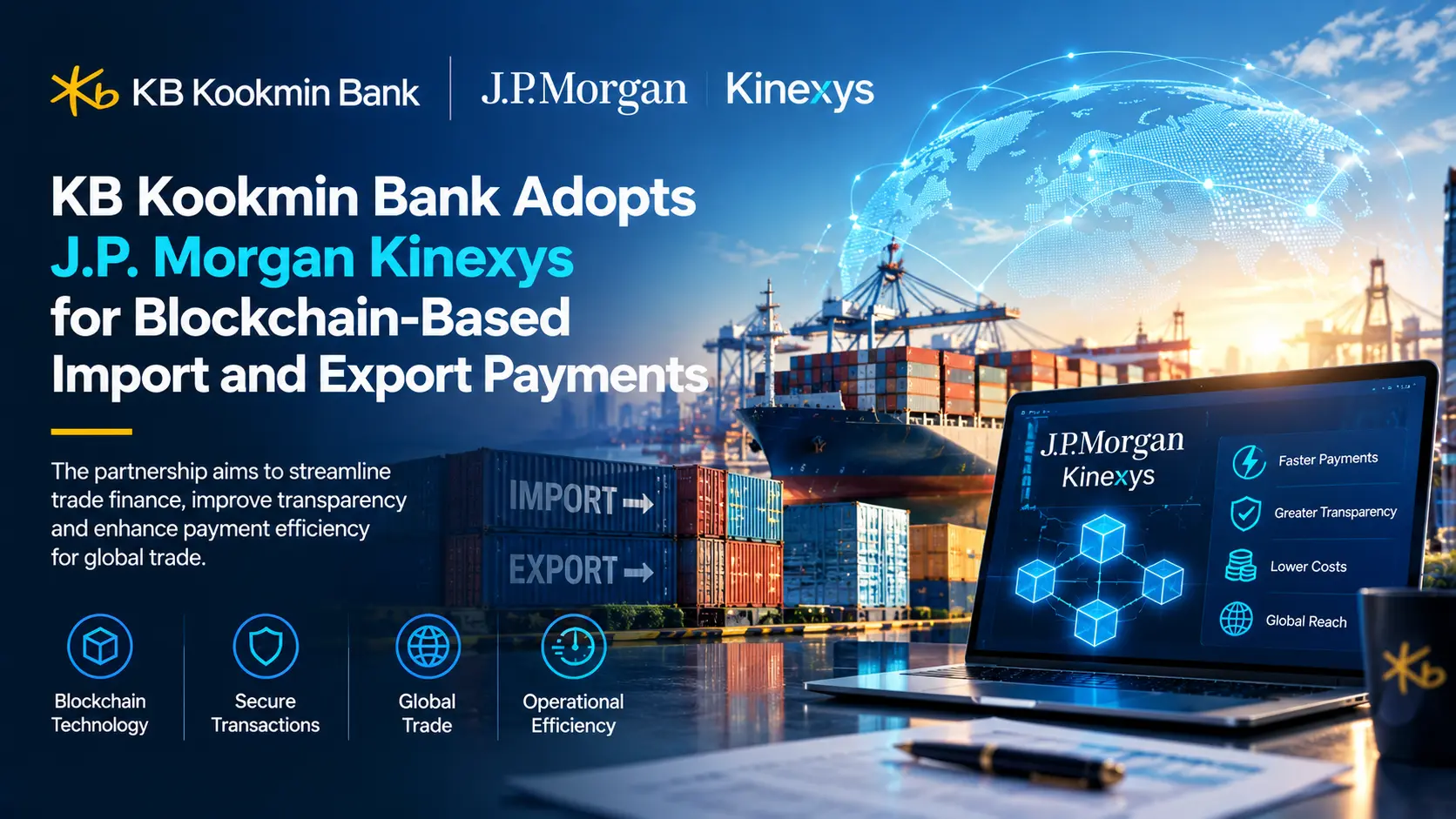
KB Kookmin Bank is becoming the first Korean financial institution to use J.P. Morgan’s Kinexys Blockchain Deposit Account network for corporate import and export payments, marking another step toward blockchain-based cross-border settlement in Asia.
The new service will allow Korean importers and exporters to make USD payments through the Kinexys Blockchain Deposit Account (BDA) network. The service will initially be available through KB Kookmin Bank’s domestic branches in Korea and its Singapore branch.
The initiative connects Korea’s corporate banking infrastructure with J.P. Morgan’s blockchain-based payments network and is designed to improve the speed and efficiency of cross-border settlement.
KB Kookmin Bank Brings Blockchain Payments to Corporate Banking
Under the new service, Korean companies involved in international trade will be able to use Kinexys to settle USD payments with financial institutions and companies participating in the network.
The service will initially support remittances involving 10 markets:
- United States
- Singapore
- Saudi Arabia
- India
- Thailand
- Qatar
- United Arab Emirates
- Bahrain
- South Africa
- South Korea
The initial focus will be on U.S. dollar transactions, with the service expected to help businesses manage international payments more efficiently.
For importers and exporters, payment timing can have a direct impact on working capital and cash-flow management. Traditional cross-border transactions can be affected by different time zones, banking hours, weekends and intermediary institutions.
Blockchain-based settlement provides an opportunity to reduce some of these frictions.
Why Kinexys Matters for Korean Importers and Exporters
The partnership is particularly relevant for Korean companies doing business with the United States and Middle Eastern markets.
Differences in time zones and banking schedules can delay the movement of funds between counterparties.
With Kinexys’ blockchain-based infrastructure, participating institutions can support 24/7 near-real-time cross-border settlement.
For exporters, faster settlement could mean quicker access to trade proceeds.
For importers, improved payment speed could help businesses manage supplier payments and working capital more efficiently.
The potential benefits include:
- Faster cross-border settlement
- Improved cash-flow visibility
- More efficient treasury management
- Reduced settlement delays
- 24/7 payment capabilities
- Greater automation of corporate payments
The significance goes beyond speed. The initiative shows how blockchain infrastructure is increasingly moving from experimentation toward practical use in mainstream banking.
Kinexys Expands Its Corporate Payments Network
Kinexys is J.P. Morgan’s blockchain business unit and operates as part of J.P. Morgan Payments.
According to J.P. Morgan, the platform has processed more than $4 trillion in cumulative transactions and handles approximately $7 billion in transactions per day.
The network supports blockchain-based settlement and programmable payment capabilities, allowing financial institutions to explore new approaches to cross-border payments and treasury management.
The KB Kookmin Bank initiative adds another major financial institution to this ecosystem.
More importantly, it demonstrates how blockchain-based deposit infrastructure can be connected directly to established corporate banking services.
From Blockchain Pilots to Real-World Payments
For years, blockchain in financial services was dominated by proof-of-concepts and experimental projects.
That picture is changing.
Banks are increasingly looking at distributed ledger technology for specific use cases where it can solve practical problems.
Cross-border payments are one of the clearest examples.
Traditional international payments often involve multiple institutions, messaging systems, settlement windows and reconciliation processes.
Blockchain-based networks can potentially simplify parts of this infrastructure by creating a shared transaction environment between participating institutions.
However, the real value is not simply putting payments on a blockchain.
The bigger opportunity is creating infrastructure that allows banks to move money more quickly while preserving the regulatory controls, security and commercial banking relationships required by large businesses.
What the KB Kookmin and Kinexys Partnership Means for Trade Finance
International trade depends heavily on predictable payments.
A Korean exporter may ship goods to a customer overseas while waiting for payment to arrive through the banking system. Any delay can affect working capital and the ability to finance the next transaction.
Faster settlement could therefore have a broader economic impact.
The KB Kookmin service may help businesses:
Improve liquidity: Faster access to incoming funds can reduce the time capital remains in transit.
Strengthen treasury management: Companies can gain greater visibility over when international payments are settled.
Reduce operational friction: Faster settlement can simplify certain reconciliation and payment processes.
Support international expansion: More efficient cross-border payments can make it easier for companies to operate across multiple markets.
These benefits are particularly important for businesses operating across Asia, the Middle East and North America.
Korea’s Cross-Border Payments Infrastructure Evolves
South Korea is one of Asia’s most important technology and trade economies, with companies operating extensive international supply chains.
As Korean businesses become increasingly global, demand for faster and more efficient financial infrastructure is also growing.
KB Kookmin Bank’s decision to introduce Kinexys-based payments reflects this changing environment.
Rather than creating a completely separate digital asset payment system, the initiative connects blockchain infrastructure with an established commercial bank.
That distinction is important.
For blockchain-based financial services to reach meaningful scale, they need to work within existing financial ecosystems rather than operate entirely outside them.
Blockchain and the Future of Treasury Management
The development also highlights a broader transformation taking place in corporate treasury.
Treasurers are increasingly looking for payment systems that provide:
- Faster settlement
- Better liquidity management
- Greater transaction visibility
- Automated workflows
- Programmable payments
- Around-the-clock availability
Blockchain networks can potentially address several of these requirements.
Programmable payments, in particular, could eventually allow businesses to automate transactions based on predefined conditions.
For example, payments could potentially be linked to contractual milestones, shipment events or other verified business conditions.
While these applications will require appropriate regulatory and operational frameworks, they demonstrate why financial institutions are investing in blockchain infrastructure beyond cryptocurrency.
Kinexys Shows the Institutional Blockchain Shift
J.P. Morgan’s Kinexys strategy is part of a larger movement among major banks toward tokenized deposits and blockchain-based financial infrastructure.
The focus is increasingly shifting away from speculative digital assets and toward applications involving real-world financial activity.
Tokenized deposits can potentially combine some of the benefits of blockchain technology with the structure of commercial bank money.
That makes them particularly relevant for corporate payments and institutional financial services.
The KB Kookmin initiative provides another example of this transition.
A major Korean bank is connecting its corporate clients to blockchain-based settlement infrastructure for actual import and export payments.
What Comes Next?
The initial rollout focuses on USD payments across 10 markets, but the infrastructure could eventually support broader use cases as adoption grows.
Future opportunities could include additional currencies, more participating financial institutions, automated treasury workflows and expanded programmable payment functionality.
The success of the initiative will ultimately depend on adoption by businesses and financial institutions.
Technology alone will not transform cross-border payments.
Banks need to demonstrate that blockchain-based settlement can deliver measurable improvements in speed, reliability, compliance and cost while fitting into existing corporate workflows.
KB Kookmin Bank’s rollout is therefore significant because it moves blockchain payments one step closer to everyday corporate banking.
The bigger question is whether initiatives like this can help blockchain become a standard layer of global corporate payments rather than remaining a technology used mainly in financial-market experiments.
KB Kookmin Bank leverages Kinexys by J.P. Morgan for import/export payments
Comments
No comments yet. Be the first to share your thoughts.
Leave a comment