
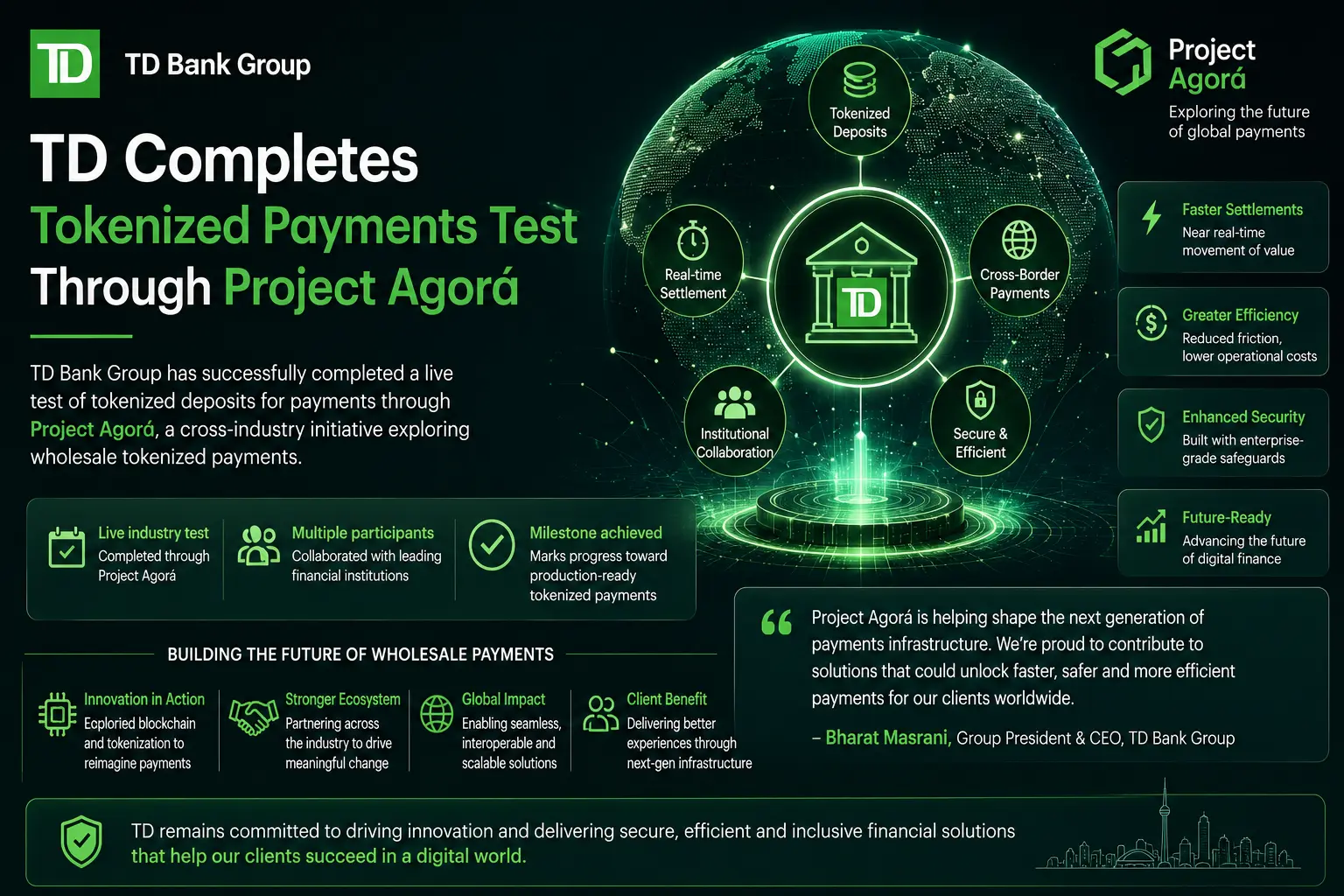
TD Completes Tokenized Payments Test Through Project Agorá
TD has completed a real-value test of tokenised payments through Project Agorá. marking a significant step in the development of blockchain-based infrastructure for wholesale cross-border transactions.
The bank moved real U.S. dollar funds between two domestic TD entities using the Project Agorá platform. TD carried out the transaction with BNY acting as the clearing bank and intermediary.
The test forms part of Project Agorá’s broader effort to examine how tokenized commercial bank deposits and central bank reserves could make wholesale payments faster, more transparent, and more efficient.
TD Advances Tokenized Payments Through Project Agorá
The transaction represents an important practical test for tokenized money.
Rather than simply demonstrating a theoretical use case, TD moved real funds under operating conditions designed to reflect the challenges financial institutions face when implementing new payment infrastructure.
The successful transaction demonstrated several capabilities, including:
- Tokenized money issuance
- Instant movement of funds
- Atomic settlement
- Distributed ledger technology
- Bank-to-bank payment connectivity
- Digital payment infrastructure
As a result, the test provides another indication that financial institutions are moving beyond experimentation and toward practical applications of tokenization.
Project Agorá Targets Cross-Border Payment Challenges
Project Agorá brings together the public and private sectors to explore improvements in wholesale cross-border payments.
The initiative, led by the Bank for International Settlements (BIS) and the Institute of International Finance, examines how existing forms of money can work with emerging payment technologies.
Today, cross-border payments can involve several institutions, messaging systems, and reconciliation processes. Consequently, transactions may take time to complete, and participants may have limited visibility throughout the payment journey.
Project Agorá explores whether a shared programmable platform could reduce some of these challenges.
The platform can support tokenized commercial bank deposits and central bank reserves while allowing participating central banks to retain control over their respective currencies and operations.
Real-Value Testing Puts Tokenized Payments to the Test
Project Agorá’s latest testing involved 28 central banks and financial institutions across Asia, Europe, and North America.
Together, participants completed transactions in selected currencies worth approximately CHF 800,000.
The program covered 17 transaction scenarios, while individual transactions ranged from approximately CHF 9,000 to CHF 125,000 or the equivalent amount in local currencies.
This testing matters because financial institutions need to evaluate more than transaction speed before adopting new payment infrastructure.
They must also consider operational resilience, technology, governance, legal requirements, and settlement risk.
Therefore, real-value testing provides a more meaningful assessment of whether tokenized payment systems can operate effectively in real-world environments.
Atomic Settlement Could Reduce Payment Risk
One of the most important concepts explored through Project Agorá is atomic settlement.
Under an atomic settlement model, linked components of a transaction settle together or do not settle at all.
That approach can reduce settlement risk and provide greater certainty when transactions involve multiple institutions or currencies.
For cross-border payments, the potential benefits are significant.
A more synchronized settlement process could reduce delays and improve the reliability of transactions. At the same time, institutions could gain greater visibility into payment status.
However, technology alone will not resolve every challenge.
Legal finality, regulatory requirements, interoperability, and governance will also determine how quickly tokenized payment infrastructure can move into broader production.
TD and BNY Highlight the Institutional Opportunity
TD’s participation shows how established banks are exploring practical applications for distributed ledger technology.
Jo Jagadish, Head of Digital & Payments and Consumer Deposits at TD Bank U.S., said the project demonstrates what public- and private-sector collaboration can achieve in developing faster and more efficient global money movement.
BNY also participated in the transaction as the clearing bank and intermediary.
The collaboration highlights an important feature of the emerging tokenized payments market: banks do not necessarily need to replace existing financial infrastructure. Instead, new digital systems may connect with established banking institutions and settlement mechanisms.
That could make gradual adoption more realistic.
Traditional Payments vs Tokenized Payment Infrastructure
| Feature | Traditional Cross-Border Payments | Tokenized Payment Infrastructure |
|---|---|---|
| Processing | Multiple steps | More automated |
| Settlement | Can involve delays | Potentially near-instant |
| Visibility | Often fragmented | Greater transparency |
| Reconciliation | More manual processes | More programmable |
| Settlement Risk | Higher in some structures | Potentially reduced |
| Availability | Limited by operating systems | Designed for broader availability |
The comparison does not mean tokenized payments will immediately replace traditional systems.
Instead, it highlights why banks continue investigating distributed ledger technology as a potential complement to existing infrastructure.
Tokenized Deposits Become a Bigger Banking Focus
Project Agorá also highlights the growing interest in tokenized commercial bank deposits.
Tokenized deposits represent digital versions of commercial bank money. They can potentially move across programmable financial infrastructure while remaining connected to the banking system.
That distinction matters.
Financial institutions are increasingly exploring tokenization without necessarily abandoning the existing role of commercial banks.
For banks, tokenized deposits could eventually support faster settlement, automated transactions and new cross-border payment models.
Meanwhile, central bank reserves could provide the foundation for settlement between participating institutions.
Why TD’s Test Matters for Cross-Border Payments
The importance of TD’s transaction extends beyond a single payment.
First, it demonstrates that financial institutions can use tokenized money in a controlled real-value environment.
Second, it shows how distributed ledger technology can connect different participants within the banking ecosystem.
Finally, it adds practical evidence to the broader discussion about modernizing wholesale payment infrastructure.
Cross-border payments remain one of the most important areas for financial innovation because businesses operate across multiple jurisdictions and currencies.
Therefore, improvements in speed, transparency, and settlement certainty could create meaningful benefits for banks and their corporate customers.
Project Agorá Pushes Payment Innovation Forward
Project Agorá is part of a broader movement toward programmable and tokenized financial infrastructure.
Banks, central banks, and financial technology companies are testing different approaches to tokenized deposits, stablecoins, central bank money, and blockchain-based settlement.
At the same time, regulators are examining how these systems can operate without compromising financial stability, privacy, or regulatory oversight.
That balance will remain critical.
Successful payment infrastructure must deliver efficiency without sacrificing trust.
What Comes Next for Tokenized Payments?
TD’s successful test does not mean tokenized cross-border payments are ready to replace traditional systems at scale.
However, it provides another real-world example of how banks can test the technology with actual value.
The next stage will likely focus on interoperability, regulatory frameworks, scalability, and integration with existing payment networks.
If those challenges can be addressed, tokenized payment infrastructure could gradually become an important part of wholesale financial markets.
The biggest opportunity may not come from replacing today’s banking system overnight.
Instead, tokenization could create a new digital layer that makes existing financial infrastructure more programmable, connected, and available around the clock.
Final Thoughts
TD’s successful tokenized payments test through Project Agorá marks an important milestone in the development of next-generation payment infrastructure.
The transaction showed that real funds can move through a distributed ledger environment while supporting instant movement and atomic settlement.
More importantly, the project demonstrates how banks, central banks and financial infrastructure providers can work together to test new models without abandoning the foundations of the existing financial system.
As cross-border commerce continues to grow, the pressure to make international payments faster and more transparent will only increase.
Project Agorá suggests that tokenization could become one of the technologies helping banks meet that demand.
TD Successfully Completes Testing of Tokenized Payments Through Project Agorá
Comments
No comments yet. Be the first to share your thoughts.
Leave a comment