
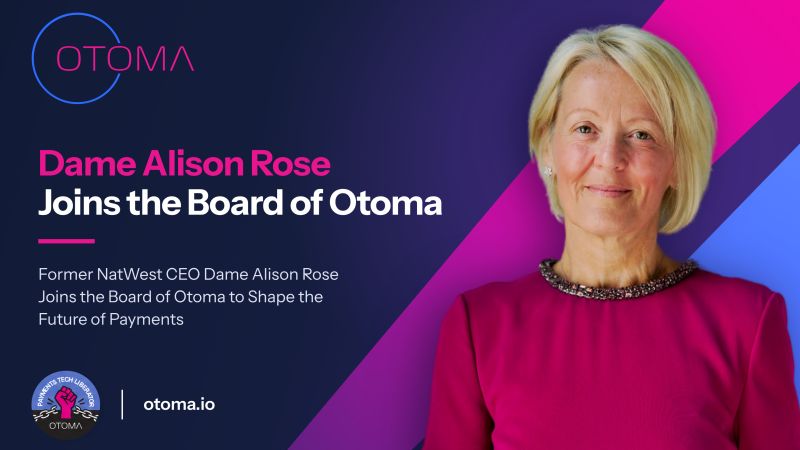
Rose brings experience in commercial and private banking, as well as senior leadership across NatWest’s international operations. She became chief executive of NatWest Group in 2019 and held the position until July 2023.
Her departure followed controversy surrounding the disclosure of information about former customer Nigel Farage’s banking relationship with Coutts, NatWest’s private banking subsidiary. Rose acknowledged a serious error of judgement in discussing the matter with a BBC journalist. NatWest later confirmed that it had made no finding of misconduct against her.
Since leaving NatWest, Rose has taken on several senior advisory and board roles. Her appointment at Otoma adds another position focused on financial services and technology.
For Otoma, her experience could help connect its technology strategy with the priorities of large financial institutions. Banks must balance modernization with operational resilience, regulatory requirements, and the need to maintain uninterrupted payment services.
Otoma Wants to Move Banks Beyond Legacy Payment Hubs
Otoma is developing an AI-native global payments infrastructure for banks. The company says its platform can help financial institutions build, test, and deploy payment capabilities with less dependence on external technology vendors.
Its offering combines an end-to-end payments infrastructure with a no-code development environment. The company’s Innovation Suite includes a Payments Visualizer, continuous integrated testing, and Any2Any data transformation.
These tools are designed to address a persistent challenge for banks: changing payment systems can involve lengthy development cycles, complex integrations, and significant vendor dependence.
Traditional payment hubs often sit at the center of a bank’s payment operations. They connect different payment rails, process instructions, and support clearing and settlement workflows. However, older platforms can make it difficult to introduce new services or respond quickly to changing market requirements.
Otoma argues that banks need a more flexible technology foundation. Its platform is intended to let teams design and adapt payment flows without relying on lengthy, vendor-led development projects.
The company also describes AI as an orchestration layer across the payment technology lifecycle. This includes assistance with system design, testing, monitoring, and operational optimization.
However, the company has not disclosed independent performance benchmarks in the announcement. Claims about reducing implementation time, costs, and complexity should therefore be understood as Otoma’s stated product proposition rather than independently verified outcomes.
Fundtech Experience Shapes Otoma’s Ambitions
Otoma’s leadership team has a history in the payments technology market.
The company was founded by executives associated with Fundtech, a payments technology provider that built payment hubs for banks around the world. D+H acquired Fundtech in 2015. D+H later combined with Misys, with the resulting business becoming Finastra.
Otoma’s founders believe the experience gained during the development of an earlier generation of payment hubs gives the team an understanding of the challenges banks face today.
The company now wants to support what it describes as the next generation of payments infrastructure. Its approach focuses on greater flexibility, embedded AI, and reduced dependence on traditional vendor delivery models.
That background is central to Rose’s comments about the appointment. She highlighted the team’s previous experience and said its understanding of banking technology challenges could help it develop solutions for practical adoption.
Why the Appointment Matters for the Payments Industry
The appointment reflects a wider shift in the payments technology market. Banks are under pressure to modernize infrastructure while supporting real-time payments, cross-border services, and new digital payment models.
At the same time, financial institutions must manage legacy systems that remain critical to daily operations. Replacing them can create substantial technical and operational risks.
This makes the transition more complex than simply adopting new software. Banks need technology that can integrate with existing systems, support regulatory obligations, and maintain service reliability.
AI-native and no-code platforms are emerging as potential ways to simplify parts of this process. They may help technology teams design workflows, automate testing, and respond faster to business requirements. Yet banks will still need strong controls, auditability, and human oversight, especially when AI influences critical payment operations.
Rose’s banking experience could help Otoma understand these institutional requirements as it develops its market strategy. Her board role also gives the company access to senior-level experience in managing large-scale financial services organizations.
Peter Reynolds, Otoma’s chief executive, said Rose’s strategic perspective and operational experience would be valuable as the company helps banks move away from legacy infrastructure.
What Comes Next for Otoma?
Rose joins the board as Otoma seeks to expand its position in the global payments technology market. The company’s challenge will be to demonstrate that its platform can deliver measurable benefits in complex banking environments.
Banks will want evidence of successful implementations, reliable integrations, and lower operating costs. They will also assess how a new platform supports security, compliance, and resilience requirements.
The next phase of Otoma’s growth will therefore depend on more than its AI-native positioning. Commercial adoption and measurable results will be important indicators of whether its approach can gain traction.
For the wider industry, the appointment highlights the growing importance of experienced banking leadership in fintech infrastructure. As payment technology evolves, companies building new platforms will need to understand both the possibilities of innovation and the realities of operating inside regulated banks.
The FinRate Takeaway: Alison Rose’s appointment gives Otoma a high-profile banking perspective as it targets the legacy systems challenge. The bigger test will be whether its AI-native payments hub can translate its promise of faster innovation into proven results for banks.
Comments
No comments yet. Be the first to share your thoughts.
Leave a comment