
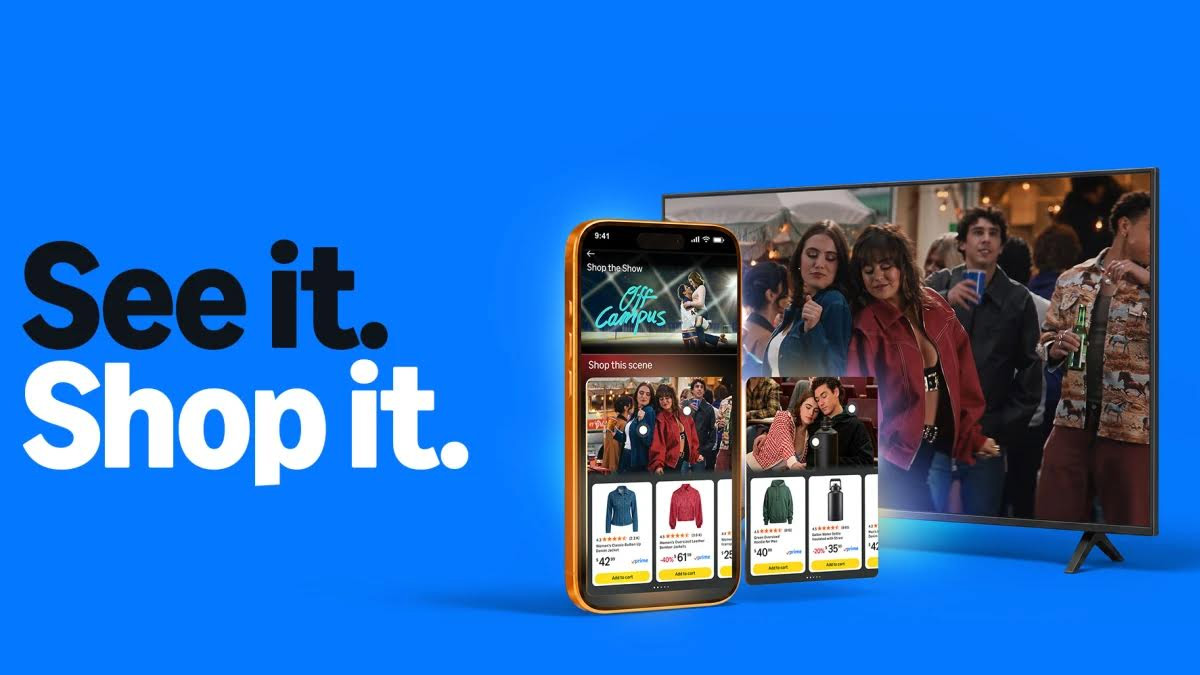
Amazon is expanding the shopping experience inside Prime Video, bringing new tools that allow viewers to discover products inspired by what they see on screen.
The update adds a new Shop tab within Prime Video’s X-Ray feature, introduces Shop the Scene, a visual-search tool powered by Amazon Lens, and significantly expands the existing Shop the Show service.
The changes strengthen Amazon’s connection between entertainment and e-commerce. Instead of leaving a program to search for a product, viewers can now move from watching a scene to discovering and purchasing related items with fewer steps.
Amazon announced the expanded experience on September 10, saying Shop the Show will now cover more than 8,000 titles in the US, compared with 1,300 previously. Shop the Scene is launching across more than 600 titles on iOS and Android in the US.
Amazon Builds Shopping Into Prime Video
The new experience starts with Prime Video’s X-Ray feature, which has traditionally provided viewers with information about actors, characters, music, and other details while they watch.
Amazon is now adding a Shop tab alongside those existing features.
On supported devices in the US, viewers can press the up button on their remote to open X-Ray and select Shop. They can then browse products related to the show, film, or live sporting event they are watching.
The shopping journey then moves to the Amazon Shopping app.
When the viewer opens the app, it can recognize the title currently playing and take the customer directly to a feed connected to that program. The feed is also synced to the moment being watched, allowing customers to discover relevant products without manually searching for the title.
Amazon says the living-room device and mobile app need to be signed into the same account for automatic syncing to work.
Customers can also access the experience through an on-screen QR code or by searching for Shop the Show within the Amazon Shopping app.
The change removes several steps from Amazon’s original Shop the Show experience.
Shop the Scene Turns TV Screens Into Searchable Catalogues
One of the most notable additions is Shop the Scene.
The feature uses Amazon Lens, the company’s visual-search technology, to identify products inspired by items appearing on screen.
That includes clothing worn by characters, home décor, and other products visible within a scene.
A viewer watching a program might see a sweater worn by a character and want something similar. With Shop the Scene, the viewer can open the Amazon Shopping app, select the image, and use Lens to find matching or similar products.
Amazon demonstrated the concept using Off Campus, where a viewer can identify a sweater worn by character Hannah and receive similar products through Amazon Lens.
There is an important limitation.
The tool does not promise to identify the exact product shown on screen every time. Productions can use custom-made costumes, high-end fashion items, or products that are not sold through Amazon or its marketplace.
Amazon therefore positions Shop the Scene as a discovery tool rather than an exact product-recognition guarantee.
That distinction is important because screen productions frequently contain products that were specially made for a character or sourced from retailers outside Amazon’s ecosystem.
Shop the Show Expands to More Than 8,000 Titles
Amazon is also making its existing Shop the Show feature significantly larger.
The service is expanding from 1,300 titles to more than 8,000 titles in the US, covering Prime Originals, licensed content, and live sports.
The scale of the expansion matters because Amazon is not treating shoppable entertainment as a niche experiment.
The company first introduced Shop the Show in April 2025, allowing US customers to discover products associated with films, television shows, and live sports through the Amazon Shopping app. At launch, the service covered 1,300 titles.
The new rollout substantially broadens the amount of content that can generate a shopping interaction.
That means Amazon is moving closer to making commerce a standard layer of the Prime Video experience rather than a separate feature customers have to seek out.
Prime Video and Amazon Shopping Become More Connected
The strategy also makes sense from Amazon’s perspective because the company already controls both sides of the experience.
Prime Video owns the entertainment relationship. Amazon Shopping owns the retail transaction.
Connecting the two allows Amazon to shorten the distance between inspiration and purchase.
A viewer does not necessarily begin watching a show with the intention of buying something.
Instead, a product seen in a particular scene can create an impulse to search for it. Amazon’s new tools are designed to capture that moment.
That is a potentially valuable shift.
Traditional advertising asks viewers to remember a brand or product and search for it later. Shoppable entertainment attempts to make the purchasing opportunity available while the viewer is still engaged with the content.
The result is a more direct connection between content, product discovery, and commerce.
The Second-Screen Experience Gets Simpler
The smartphone remains an important part of Amazon’s design.
The TV screen is primarily used for entertainment, while the Amazon Shopping app handles product discovery and checkout.
Amazon’s latest update makes that second-screen process less cumbersome.
Previously, customers using Shop the Show had to open the Amazon Shopping app and manually search for the phrase “shop the show” to reach relevant products.
Under the new experience, opening the app while a supported Prime Video title is playing can take the viewer directly to that title’s storefront.
That may appear to be a small change, but reducing friction is critical in commerce.
The longer a consumer has to search, navigate menus, or remember a product, the more likely the buying impulse disappears.
Amazon is effectively trying to make the shopping journey feel like an extension of the viewing experience.
A Bigger Bet on Shoppable Entertainment
Amazon’s move is part of a wider shift in the media industry.
Streaming platforms, connected-TV companies, and social-video services are increasingly experimenting with ways to turn entertainment into a commercial channel.
The underlying idea is straightforward: viewers are already influenced by what they see.
Fashion, furniture, electronics, food, and other consumer products frequently appear naturally in entertainment content. Technology can potentially turn that exposure into measurable product discovery and purchasing.
Amazon has an unusual advantage because it combines a major streaming platform with one of the world’s largest e-commerce marketplaces.
That gives the company a chance to connect content directly with inventory and checkout.
Instead of simply showing a product placement, Amazon can potentially offer viewers a route to something similar within seconds.
Amazon Lens Extends Visual Commerce
Shop the Scene also highlights the growing importance of visual search in online commerce.
Traditional e-commerce usually begins with words.
A customer types a product name into a search bar and then browses results.
Visual search reverses that process.
The customer starts with an image or object and asks technology to find something comparable.
That approach can be especially useful in entertainment, where viewers may know what an item looks like but have no idea what it is called.
A handbag, chair, jacket, or piece of home décor can be difficult to search for using words. Visual recognition removes some of that problem.
Amazon’s integration of Lens with Prime Video therefore connects two technology trends: visual AI and shoppable media.
What This Means for Brands
The expansion could also create new opportunities for brands selling through Amazon.
More shoppable Prime Video content means more opportunities for products to appear in discovery feeds connected to entertainment.
For brands, the value is potentially greater than conventional advertising because the consumer is already expressing interest in a product category.
However, relevance will matter.
If recommendations do not closely match the products viewers are seeing, the experience could quickly become less useful.
Amazon’s decision to explain that Shop the Scene may surface similar rather than identical products suggests the company recognizes this challenge.
The success of the feature will depend on how accurately its technology can connect what is shown on screen with products that consumers actually want to buy.
The Bigger Commerce Strategy
Amazon’s Prime Video update reflects a broader evolution in digital commerce.
E-commerce is increasingly moving into places where people already spend their time.
Shopping no longer has to begin on a retailer’s website.
It can begin with a social media post, a creator video, a live sporting event, or now a scene in a television program.
That changes the role of entertainment platforms.
Prime Video is no longer simply a destination for content. With features such as Shop the Show and Shop the Scene, it is becoming another entry point into Amazon’s broader retail ecosystem.
For consumers, that could mean less friction between seeing something they like and finding a product.
For Amazon, it creates another opportunity to connect engagement with commerce.
TheFinRate Take
Amazon’s latest Prime Video update is less about adding a shopping button to a streaming service and more about bringing retail closer to the moment of inspiration.
The new X-Ray Shop tab makes product discovery accessible from the TV screen. Shop the Scene uses visual search to identify products from individual scenes. Meanwhile, expanding Shop the Show to more than 8,000 US titles gives Amazon a much larger content base on which to build shoppable entertainment.
The bigger question is whether viewers will embrace shopping while they watch.
Amazon already has the content, the technology, the customer accounts, and the marketplace. Its challenge now is making commerce feel natural enough that customers see these tools as useful rather than intrusive.
If Amazon gets that balance right, Prime Video could become more than a streaming platform.
It could become a new kind of retail storefront—one where the product catalogue appears inside the story itself.
Comments
No comments yet. Be the first to share your thoughts.
Leave a comment