
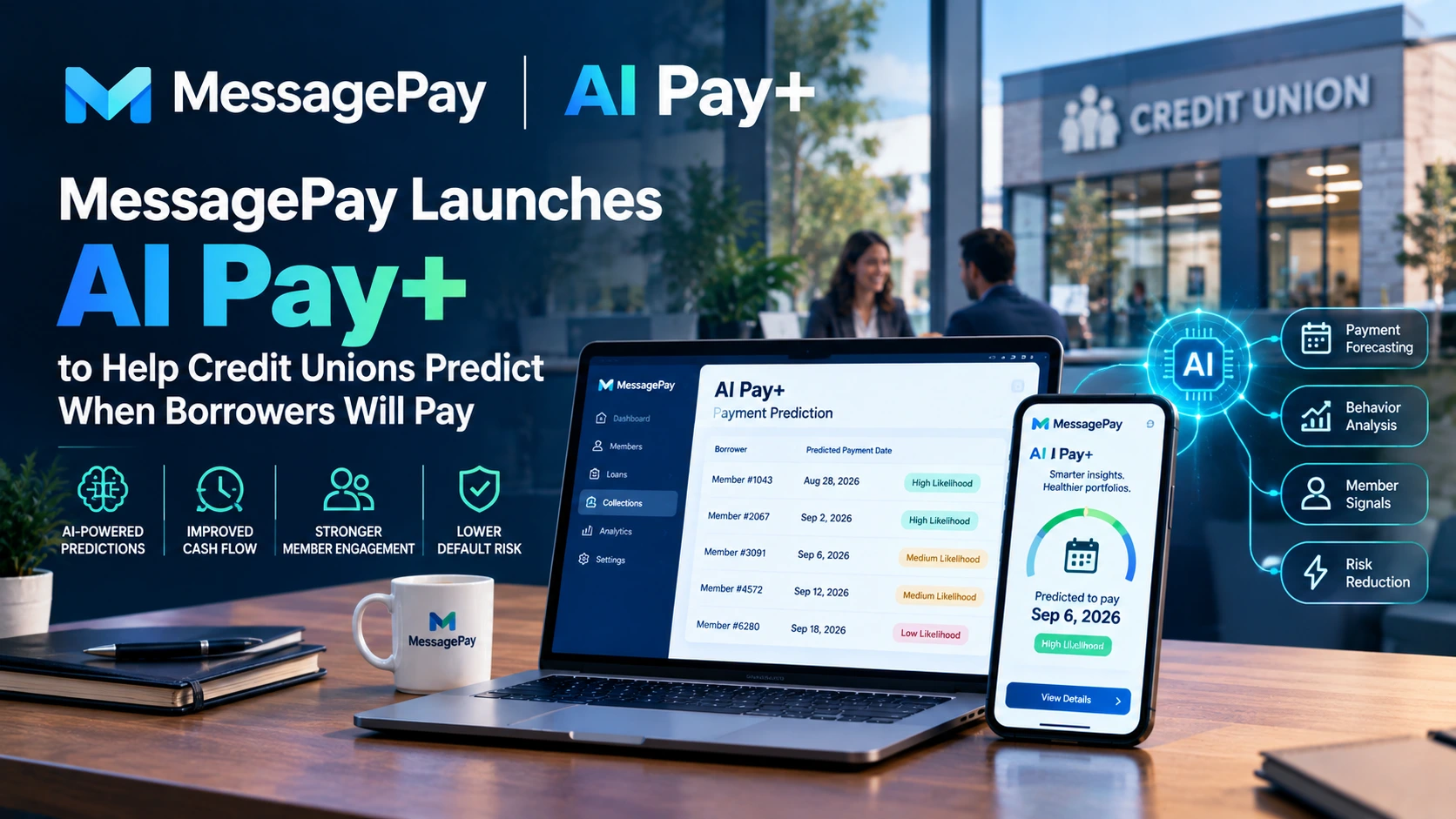
MessagePay has launched AI Pay+, a predictive analytics tool designed to help credit unions and community banks forecast borrower payment behavior and make collections outreach more precise.
The launch comes as the Utah-based digital payments and communications company reaches its 400th financial institution customer. MessagePay says it added 86 credit unions and community banks through August 2026 and is on pace to exceed $1.2 billion in payment volume this year.
Alongside AI Pay+, MessagePay has introduced MessagePay Direct, a two-way texting capability that gives financial institutions another channel for resolving payment issues directly with borrowers.
Together, the products point to a broader shift in how smaller financial institutions are approaching collections: moving from reactive delinquency management toward more personalized, digitally delivered borrower engagement.
MessagePay AI Pay+ Brings Predictive Analytics to Collections
Traditional collections operations often organize borrowers into broad delinquency categories. Those categories can tell a financial institution that an account is overdue, but they do not necessarily explain what is likely to happen next.
AI Pay+ is designed to address that gap.
According to MessagePay, the tool analyzes borrower behavior to forecast when and how a borrower is likely to make a payment. Collections teams can then use those predictions to segment their portfolios and decide which accounts require more direct intervention.
That changes the role of analytics in collections.
Instead of treating every delinquent account in broadly the same way, financial institutions can potentially prioritize their limited staff resources around accounts where human intervention is most valuable.
Brandon Alletto, SVP of Sales at MessagePay, said AI Pay+ and MessagePay Direct are intended to help teams distinguish between accounts that need a human touch and those that do not.
The distinction is important for credit unions and community banks, where collections teams may have fewer resources than larger financial institutions.
MessagePay Direct Adds Two-Way Borrower Communication
The AI launch is only one part of MessagePay’s latest product expansion.
The company has also expanded its communications capabilities through MessagePay Direct, allowing financial institutions to communicate with borrowers through two-way text messaging when resolving payment issues.
MessagePay’s existing platform allows borrowers to make payments through text, web, phone, and email.
A borrower can receive a secure payment link or respond directly within a text conversation without downloading a separate application or logging into online banking.
That model removes several steps from the traditional payment process.
For a borrower who is already engaging with a financial institution through their phone, completing a payment inside that communication channel can be considerably simpler than calling a collections department or navigating an online banking portal.
The company says this convenience is helping drive adoption among its financial institution customers.
From Payment Collection to Predictive Collections
The more interesting part of MessagePay’s strategy is how these capabilities fit together.
Digital payment collection solves one problem: making it easier for a borrower to pay.
Predictive analytics addresses another: helping the institution determine who to contact, when to contact them, and how much intervention may be necessary.
Together, those capabilities create a more data-driven collections workflow.
Imagine a portfolio containing thousands of accounts.
A traditional system might group accounts according to days past due. A predictive system can potentially introduce another layer of intelligence by identifying behavioral patterns associated with future payment activity.
That could allow collections teams to spend less time treating an entire delinquency bucket uniformly and more time focusing on individual borrower circumstances.
This does not mean AI replaces collections employees.
Instead, MessagePay is positioning AI Pay+ as a prioritization layer that helps human teams decide where their attention can have the greatest impact.
MessagePay Reaches 400 Financial Institution Customers
The AI Pay+ launch comes during a period of rapid customer growth for MessagePay.
The company announced that it had signed its 400th financial institution customer.
Through August, MessagePay had added 86 new credit unions and community banks during 2026, according to the company.
Its customer base spans a wide range of institutions.
MessagePay says it serves credit unions with approximately $10 million in assets as well as banks managing more than $20 billion.
The company’s geographic footprint extends from Hawaii to Florida.
That range is significant because the technology requirements of a small community institution can differ considerably from those of a large regional bank.
MessagePay’s growth suggests the company sees digital borrower communication and payments as a need that extends across institution sizes rather than as a niche tool for a particular segment.
More Than 30 Core and Third-Party Integrations
Integration is another important component of MessagePay’s expansion.
The company supports more than 30 core and third-party integrations, including connections with Fiserv, Jack Henry, Corelation, CU*Answers, and Flex.
In 2026, MessagePay expanded its Fiserv core integration, allowing community banks using Fiserv banking cores to connect with the platform.
For financial institutions, this type of connectivity can be just as important as the functionality itself.
A collections platform that requires extensive replacement of existing banking infrastructure creates a significant implementation barrier.
By connecting into established core systems, MessagePay can position its technology as an additional layer around existing infrastructure rather than another system that institutions need to build around.
The $1.2 Billion Payment Volume Target
MessagePay says it is on pace to exceed $1.2 billion in payment volume during 2026.
That projection provides useful context for the AI Pay+ launch.
The company is not introducing predictive analytics into an entirely new payments operation. It is adding analytics to a platform already focused on borrower communications and payment collection.
That creates a potentially valuable data loop.
As borrowers interact with payment links, text messages, and other communication channels, institutions can gain additional insight into payment behavior. Predictive analytics can then potentially use those patterns to make collections workflows more targeted.
The important question will be whether those predictions consistently translate into better repayment outcomes for financial institutions.
MessagePay’s announcement points to customer results such as lower delinquencies and higher payment volumes, but those statements are company claims rather than independently verified performance benchmarks.
Why Predictive Collections Matter for Credit Unions
Credit unions have a particularly strong reason to explore more targeted collections technology.
Their relationship with members is often more personal than a purely transactional banking relationship. At the same time, they still need effective processes for managing delinquent loans and controlling operational costs.
That creates a balancing act.
Too little intervention can allow accounts to deteriorate.
Too much intervention can consume staff resources and potentially create an unnecessarily aggressive borrower experience.
Predictive analytics could help institutions find a middle ground.
If a system can identify borrowers who are likely to pay without intensive intervention, collections teams can avoid spending unnecessary time on those accounts.
Conversely, accounts that show signals of needing additional support can receive earlier human attention.
The value, therefore, lies less in the word “AI” itself and more in how effectively the technology helps institutions allocate limited collections resources.
Digital Payments Are Changing the Borrower Experience
MessagePay’s expansion also reflects a larger transformation in financial services.
For years, collections have often been associated with phone calls, letters, and branch interactions.
The payment experience is increasingly moving toward digital channels.
Consumers already use messaging for everything from shopping to customer service. Financial institutions are now bringing that same communication behavior into loan repayment.
A secure payment link delivered through a text message can remove several points of friction.
The borrower does not necessarily need to open an app, remember a password or navigate through multiple banking screens.
That matters because payment friction can become a behavioral problem.
The easier it is to complete an intended payment, the less opportunity there is for the borrower to postpone it.
MessagePay’s Strategy Moves Beyond Payment Processing
The company’s latest products also show how MessagePay is positioning itself.
It is not simply offering another digital payment channel.
The platform increasingly combines communication, payment collection, and predictive analytics.
That combination gives MessagePay a broader role in the borrower lifecycle.
The first layer is communication.
The second is payment execution.
The third is intelligence around borrower behavior.
AI Pay+ adds the third layer to an ecosystem that already focuses on the first two.
That could make the platform more valuable to institutions looking for a unified collections workflow rather than separate tools for messaging, payments, and analytics.
What AI Pay+ Means for the Future of Collections
The launch of AI Pay+ arrives as financial institutions across the industry experiment with AI in lending, fraud detection, customer service, and risk management.
Collections may be one of the more practical areas for predictive AI.
The objective is not necessarily to automate every decision.
Instead, the opportunity is to help employees make better decisions with more information.
For a collections team, knowing that an account is 30 days overdue is useful.
Knowing that the borrower is statistically more likely to make a payment within a particular period, based on observed behavior, could be more actionable.
The challenge will be accuracy, transparency, and responsible use of borrower data.
Financial institutions will need confidence that predictive models are reliable and that their use does not create unfair treatment or inappropriate assumptions about individual borrowers.
Those considerations will become increasingly important as AI becomes embedded in everyday lending operations.
MessagePay’s Next Phase
MessagePay enters the next phase of its growth with a larger customer base, expanded communications capabilities, and a new predictive analytics product.
The 400-customer milestone, 86 new financial institution signings in 2026 through August, and projected $1.2 billion-plus payment volume demonstrate the company’s growing footprint, according to MessagePay.
But AI Pay+ could prove more strategically important than the headline customer milestone.
If predictive analytics can help credit unions and community banks identify the right borrower at the right time through the right communication channel, collections can become less dependent on broad delinquency categories.
That is the bigger opportunity.
MessagePay is effectively trying to turn collections from a reactive process into a more predictive and digitally connected one.
Conclusion
MessagePay AI Pay+ brings predictive analytics into the collections workflow for credit unions and community banks, while MessagePay Direct expands two-way borrower communication through text.
The combination reflects where financial services technology is heading: not simply making payments digital, but using data to make the entire payment and collections journey more targeted.
For community financial institutions, the attraction is clear. They can potentially make it easier for borrowers to pay while helping collections teams focus their attention where it matters most.
The next test will be whether AI Pay+ can turn that promise into measurable improvements in repayment rates, collections efficiency, and borrower outcomes at scale.
Comments
No comments yet. Be the first to share your thoughts.
Leave a comment