
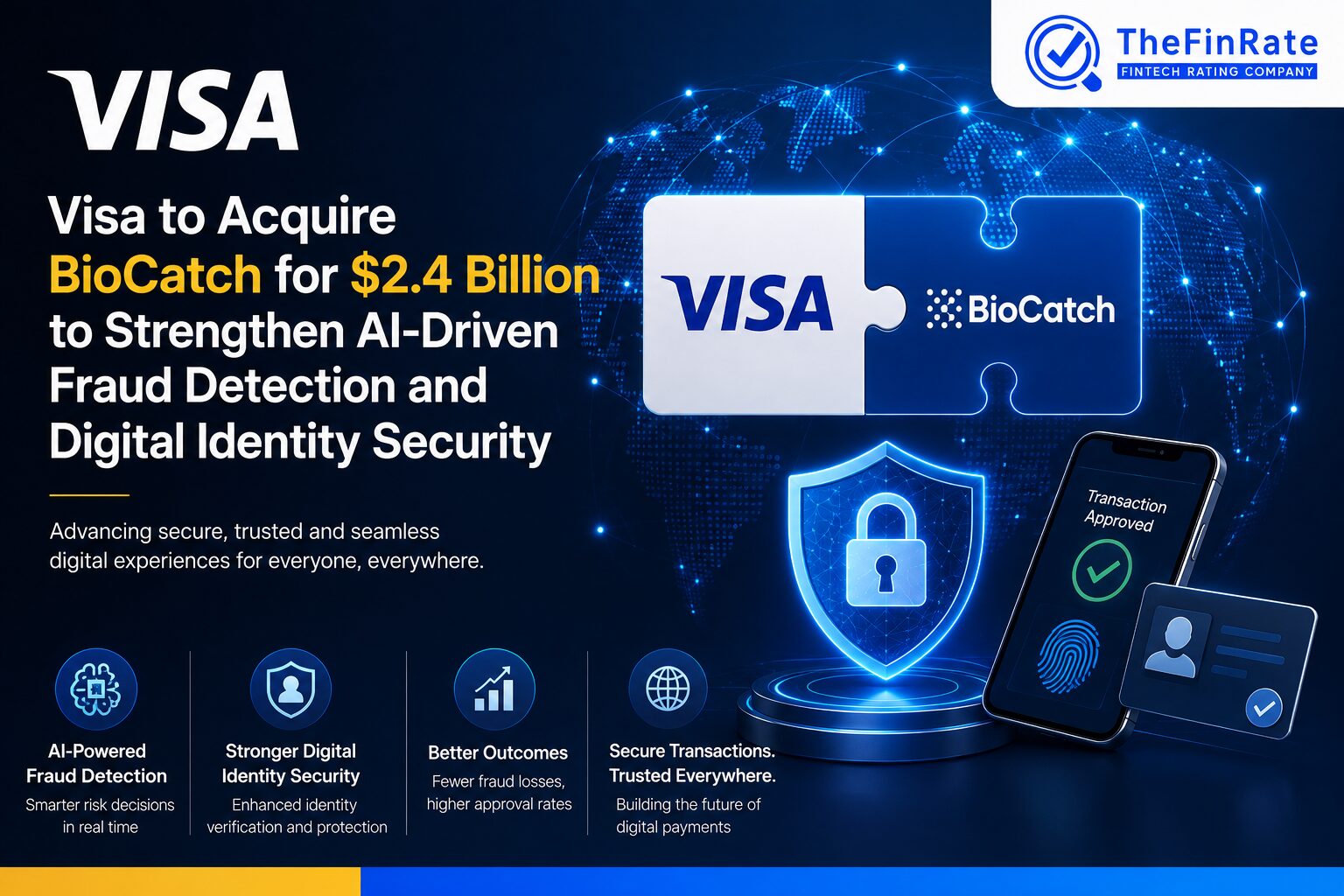
Visa to Acquire BioCatch for $2.4 Billion to Strengthen AI-Driven Fraud Detection and Digital Identity Security
Visa has agreed to acquire BioCatch, a global leader in behavioral-first fraud intelligence and digital identity technology, in a $2.4 billion all-cash deal. The acquisition marks one of Visa’s largest cybersecurity and fraud prevention investments in recent years and significantly expands its AI-powered fraud detection capabilities.
BioCatch helps financial institutions identify fraud by analyzing how users interact with devices and digital banking platforms. Its technology focuses on behavioral biometrics, multi-signal fraud intelligence, and identity verification, allowing banks to detect suspicious activity before a payment is even initiated.
The transaction is expected to close by the end of Visa’s fiscal second quarter of 2027, subject to regulatory approvals and other customary closing conditions.
A major expansion of Visa’s fraud and cyber capabilities
Visa said the acquisition will strengthen its portfolio of cyber, fraud, risk, and security solutions. The company aims to give banks and financial institutions more advanced tools to prevent increasingly sophisticated financial crime.
Unlike traditional fraud detection systems that often analyze transactions after they occur, BioCatch focuses on identifying fraudulent behavior during the customer interaction itself.
This approach allows institutions to detect risks earlier in the payment journey.
The acquisition will enhance Visa’s ability to combat:
- Account takeover fraud
- Digital scams
- Money mule networks
- Application fraud
- Identity-related financial crime
As fraud tactics become more complex, behavioral intelligence has become a critical layer of modern fraud prevention.
Why BioCatch matters
BioCatch has built one of the largest behavioral intelligence networks in global banking.
According to the company, its platform protects:
- 1.8 billion devices
- 760 million users
- More than 350 banking clients across 21 countries
Its customer base includes over 100 of the world’s largest banks, giving the company significant scale and data-driven fraud detection capabilities.
The platform uses artificial intelligence and machine learning to analyze thousands of behavioral signals, including typing patterns, mouse movements, navigation behavior, device interactions, and transaction context.
These signals help identify genuine customers while detecting fraudsters attempting to mimic legitimate users.
Fraud prevention moves earlier in the payment process
One of the most important aspects of the deal is Visa’s focus on pre-transaction fraud detection.
The payments industry has increasingly shifted from detecting fraud after authorization toward preventing fraud before a transaction occurs.
Behavioral biometrics can identify anomalies even when login credentials appear legitimate.
This is particularly important because account takeover attacks and authorized push payment scams have become major challenges for financial institutions worldwide.
By integrating BioCatch’s technology into its broader risk platform, Visa aims to improve fraud detection before payment authorization.
AI becomes central to financial security
The acquisition also reflects Visa’s broader strategy of investing heavily in artificial intelligence, cybersecurity, and digital identity infrastructure.
Over the past five years, Visa has invested more than $13 billion in technology and infrastructure.
Those investments have increasingly focused on AI-driven fraud prevention, network security, and payment intelligence.
Financial crime has evolved rapidly as fraudsters adopt automation, AI tools, synthetic identities, and coordinated scam operations.
As a result, payment networks are investing in predictive intelligence rather than relying solely on transaction monitoring.
Strategic fit with Visa’s network
BioCatch’s behavioral intelligence complements Visa’s global payments network and fraud detection ecosystem.
Visa processes billions of payment transactions each year across cards, digital wallets, and emerging payment rails.
Combining transaction intelligence with behavioral analytics could improve risk scoring, identity verification, and fraud prevention across multiple payment channels.
The acquisition may also strengthen Visa’s relationships with banks, fintech companies, digital wallet providers, and payment processors that increasingly demand more sophisticated fraud prevention tools.
What it means for banks and fintechs
For banks, the transaction could provide access to more advanced fraud detection capabilities without building large behavioral intelligence systems internally.
For fintech companies, it may improve identity verification and scam prevention across digital onboarding, payments, and account management.
Behavioral biometrics is becoming increasingly important as financial institutions face rising fraud losses, stricter regulatory expectations, and growing customer demand for secure digital experiences.
Market impact
For Visa, the $2.4 billion acquisition of BioCatch strengthens its position in the rapidly growing market for AI-powered fraud prevention and digital identity security.
For BioCatch, the deal provides access to Visa’s global payments infrastructure, financial institution network, and technology resources.
More broadly, the acquisition highlights a major shift in financial services.
The industry is increasingly moving toward behavioral intelligence, real-time risk assessment, and AI-driven fraud prevention as core components of payment infrastructure.
As digital payments continue to expand globally, institutions will need fraud detection systems that can identify criminal behavior before money moves.
Visa’s acquisition of BioCatch suggests that the next generation of payment security will depend not only on transaction data, but also on understanding human behavior, identity, and intent in real time.
That makes this transaction more than a cybersecurity acquisition.
It represents a strategic investment in the future architecture of digital trust across global financial services.
Comments
No comments yet. Be the first to share your thoughts.
Leave a comment