
Big Tech AI Spending Commitments Top $2 Trillion as Infrastructure Race Accelerates
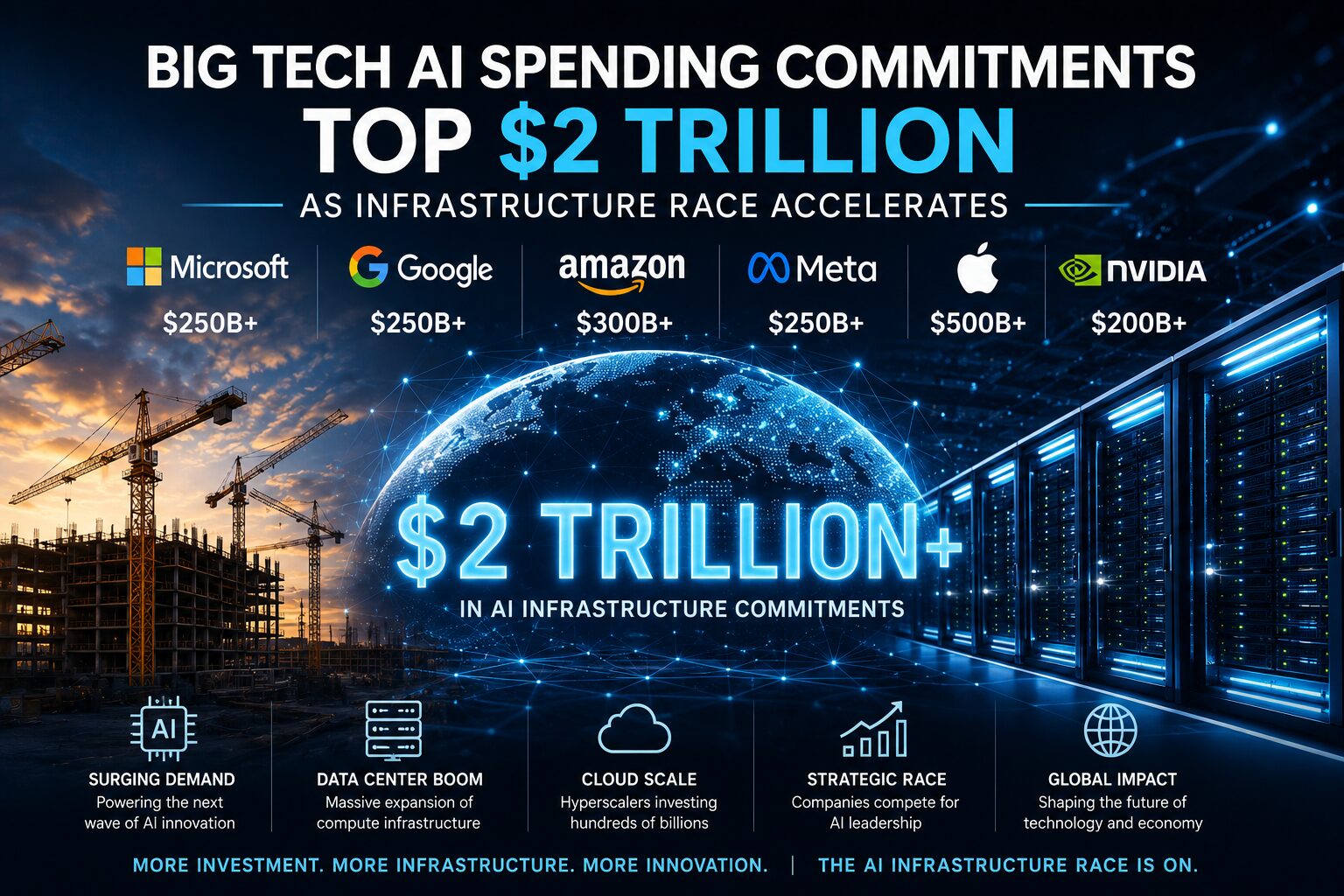
Microsoft, Alphabet, Amazon, and Meta are collectively driving one of the largest investment cycles in technology history, with future AI infrastructure spending commitments now exceeding $2 trillion. As artificial intelligence becomes the dominant capital allocation priority across the global technology industry, these companies are expanding data centers, cloud infrastructure, and computing capacity at an unprecedented pace.
A Bloomberg analysis published on 31 July 2026 found that the largest AI infrastructure companies have committed roughly $2.4 trillion in future spending tied to data centers, cloud infrastructure, AI computing capacity, semiconductor networks, and large-scale AI deployment.
Importantly, the figure does not represent a single official announcement. Instead, it reflects the combined impact of publicly disclosed capital expenditure plans, infrastructure commitments, and long-term investment strategies across the leading AI companies.
The biggest AI investment cycle in decades
The companies driving the spending surge are Microsoft, Alphabet, Amazon, and Meta Platforms.
Each company is expanding AI infrastructure aggressively as demand for generative AI, cloud computing, and advanced machine learning accelerates.
The investment focus includes:
- AI data centers,
- cloud infrastructure,
- GPU and AI computing capacity,
- networking infrastructure,
- large-scale AI model deployment,
- and long-term AI platform expansion.
Together, these projects represent one of the most significant infrastructure buildouts since the early expansion of global cloud computing. Moreover, they show that AI infrastructure has become a strategic priority rather than a secondary technology investment.
AI data centers are becoming strategic infrastructure
The largest share of spending is flowing into AI data centers.
Training and operating advanced AI models requires enormous computing power, specialized chips, high-speed networking equipment, and large amounts of electricity.
Therefore, technology companies are investing heavily in facilities designed specifically for AI workloads.
These data centers are becoming strategic assets that support cloud services, enterprise AI applications, consumer AI products, and next-generation computing platforms. As a result, the spending race is increasingly about securing long-term AI capacity rather than simply expanding traditional cloud infrastructure.
Microsoft is scaling AI infrastructure globally
Microsoft has significantly increased capital spending to support AI services across its Azure cloud platform.
The company’s investments are closely tied to expanding AI computing capacity, enterprise AI adoption, and large-scale model deployment.
In addition, Microsoft is investing heavily in data centers, advanced chips, networking systems, and global cloud infrastructure.
Consequently, AI infrastructure has become one of the company’s largest long-term capital priorities.
Alphabet is investing across AI and cloud
Alphabet is also expanding its AI infrastructure rapidly.
The company continues investing in data centers, custom AI chips, cloud computing, and AI research infrastructure.
Google Cloud has become a major beneficiary of enterprise AI demand. Meanwhile, the company’s broader AI ecosystem requires increasing computational capacity.
Alphabet’s spending reflects both defensive and offensive objectives. It must support growing AI workloads while competing aggressively in cloud infrastructure and AI services.
Amazon is expanding AI capacity through AWS
Amazon remains one of the world’s largest infrastructure investors through Amazon Web Services (AWS).
The company is expanding data center capacity, AI computing resources, and cloud infrastructure to support increasing enterprise demand for generative AI.
AWS customers require access to high-performance AI chips, large-scale model infrastructure, and advanced cloud services.
Therefore, Amazon continues investing heavily in facilities, networking infrastructure, and AI-related computing capacity.
Meta is making a long-term AI infrastructure bet
Meta has positioned AI as a central pillar of its future business strategy.
The company is investing aggressively in AI infrastructure to support recommendation systems, advertising technology, generative AI products, and advanced AI research.
Meta has repeatedly emphasized the need for massive computing capacity, including large GPU clusters and specialized AI infrastructure.
As a result, its capital spending reflects a long-term commitment to AI platform development rather than a short-term product cycle.
Why the spending boom matters
The AI investment surge extends beyond the technology sector.
Massive infrastructure spending is benefiting multiple industries, including:
- semiconductor manufacturers,
- networking equipment providers,
- power infrastructure companies,
- data center developers,
- cloud software vendors,
- and AI hardware suppliers.
Companies involved in GPUs, memory, cooling systems, fiber networks, and electricity infrastructure are increasingly tied to the AI capital expenditure cycle.
Consequently, AI infrastructure has become a major driver of industrial investment and corporate earnings growth.
The financial implications
The scale of planned spending raises important questions about returns on investment.
Building AI infrastructure requires enormous capital commitments.
Therefore, companies must generate sufficient revenue from AI services, cloud computing, enterprise software, and AI applications to justify these investments.
Investors are increasingly evaluating:
- AI monetization,
- cloud profitability,
- infrastructure utilization,
- pricing power,
- and long-term capital efficiency.
Ultimately, the key issue is whether AI revenue growth can match the unprecedented pace of infrastructure spending.
A new technology arms race
The broader story is that AI has become a strategic competition among the world’s largest technology companies.
Infrastructure capacity is increasingly viewed as a competitive advantage.
Companies with greater computing power can train larger models, deploy AI services faster, attract enterprise customers, and build stronger AI ecosystems.
Consequently, AI infrastructure has become the foundation of future technology competition.
This resembles a modern technology arms race centered on computing capacity, chips, networks, and data centers.
The risks investors should watch
The spending boom also creates significant risks.
The most important include:
- overbuilding data center capacity,
- slower AI monetization,
- rising electricity costs,
- semiconductor supply constraints,
- regulatory pressure,
- and increasing capital intensity.
However, if AI adoption slows or infrastructure utilization falls, returns on these investments could become more challenging.
On the other hand, if enterprise AI demand continues expanding rapidly, the current investment cycle could prove insufficient rather than excessive.
The bigger picture
The estimated $2.4 trillion in future AI spending commitments shows that artificial intelligence is no longer a research initiative.
Instead, it has become the dominant infrastructure investment theme across the global technology industry.
Microsoft, Alphabet, Amazon, and Meta are effectively rebuilding the digital foundation required for the next generation of computing.
The companies are investing not only in AI products but also in the physical infrastructure that powers the entire AI economy.
Bottom line
The AI infrastructure race has entered a new phase. Microsoft, Alphabet, Amazon, and Meta have collectively committed more than $2 trillion in future AI-related spending, according to a Bloomberg analysis of publicly disclosed investment plans.
The spending is reshaping data centers, cloud computing, semiconductor demand, and global digital infrastructure. Ultimately, while the capital requirements are enormous, these companies are betting that AI will become the largest computing platform opportunity in decades.
For investors, the key question is no longer whether AI spending is increasing. Instead, the question is whether the next generation of AI revenue can justify the largest technology infrastructure investment cycle in modern history.
Comments
No comments yet. Be the first to share your thoughts.
Leave a comment