
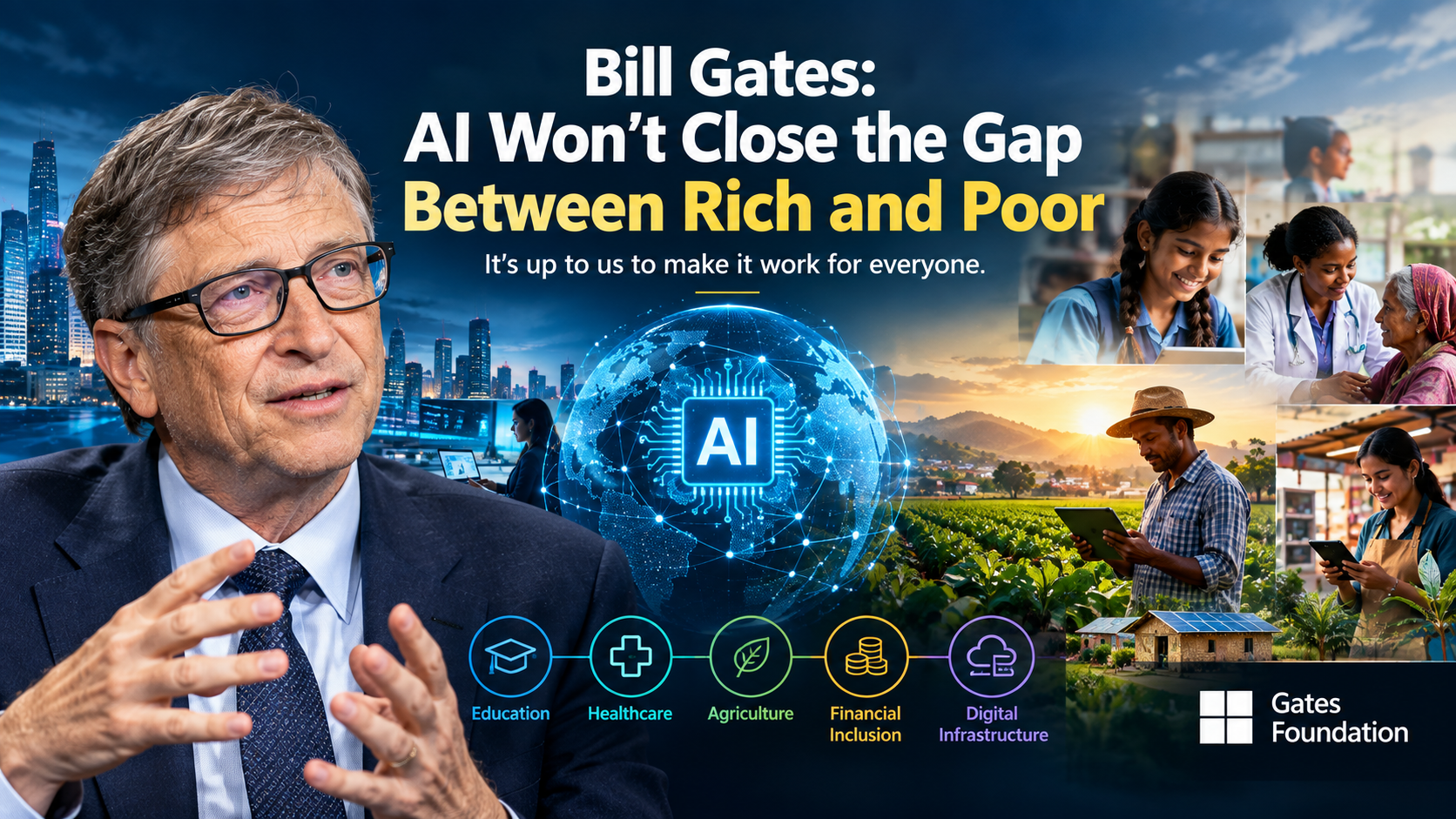
AI is moving faster than almost anything computing has seen before. But Bill Gates has a pretty simple point to make about that: fast doesn’t mean fair. Just because the technology is advancing quickly doesn’t mean everyone’s going to actually get to use it.
That’s the throughline of the Gates Foundation’s 2026 Goalkeepers Report, which puts AI and inequality right at the center of its annual look at global progress. Gates’ case is that AI could end up being one of the biggest equalizing forces we’ve seen or it could just as easily widen the gaps that already exist, depending entirely on who builds it and who gets left out.
Backing up that argument with actual money, the foundation has committed at least $1 billion over the next two years toward expanding access to AI, with the funding aimed at education, healthcare, agriculture, and the basic digital infrastructure that makes any of this usable in the first place.
This isn’t just an academic debate anymore. As AI moves out of the lab and into everyday economic life, it’s becoming a real question for businesses, governments, and financial institutions alike.
Which way this goes depends on choices, not the technology itself.
The report’s core argument is that AI’s impact isn’t predetermined—it hinges on how the technology actually gets built and rolled out.
Gates has framed it this way: the decisions being made right now, in these early years, are going to shape who ends up benefiting most from all of this. And that’s a bigger question than just “who has access to a chatbot.” It touches who’s actually building these systems, what data they’re trained on, which languages they work well in, which problems they’re designed to solve in the first place, and — bluntly — who can afford to use them at all.
That’s why the foundation’s report zeroes in on getting AI into the hands of communities that have historically been left behind by advanced technology.
What the $1 billion is actually going toward
The money’s being spread across a few areas.
Education is a big one AI-powered tutoring and similar tools are part of the plan. Healthcare gets serious attention too, with funding aimed at diagnostics, clinical decision support, and speeding up how new medicines and vaccines get developed. Agriculture is in the mix as well, with a focus on tools that actually help small-scale farmers rather than large agribusiness. And the rest goes toward the less glamorous stuff—the digital infrastructure that has to exist before any of the flashier applications can actually work.
The point isn’t just making AI technically available somewhere. It’s building things that solve real problems in places where resources and infrastructure are genuinely limited.
The language problem nobody talks about enough
One issue the report leans into is language, and it’s a bigger deal than it might sound.
Most of the data that trained early AI systems skews heavily toward English and a handful of other widely spoken languages. Which means an AI tool can technically be “available” in a country while still being pretty useless to a lot of the people who live there, simply because it doesn’t work well in the language they actually speak.
The 2026 report calls for AI tools that work in every language people actually use not just the ones that happened to dominate the training data. It also argues communities should have a real say in how their own data gets handled and protected, which matters a lot in emerging markets where AI adoption is picking up speed but local language support and infrastructure still lag behind.
Healthcare: huge potential, real risk of a two-tier system
Healthcare is one of the areas Gates seems most optimistic about AI helping doctors with diagnostics, supporting clinical decisions, and speeding up drug and vaccine development.
But there’s an obvious risk baked in. The most advanced medical AI tools are probably going to show up first in wealthy hospitals and well-funded health systems, simply because that’s where the money and infrastructure already exist. Left unchecked, that could create exactly the kind of two-tier healthcare system the report is worried about—one where cutting-edge AI helps patients in rich countries while everyone else waits.
The challenge isn’t just building powerful medical AI. It’s making sure the benefit actually reaches healthcare workers and patients who don’t have access to top-tier resources.
Agriculture faces the same fork in the road.
Small farmers deal with a lot unpredictable weather, crop disease, patchy market information, and limited access to expert advice that could actually help them.
AI could genuinely change that, giving farmers tools to interpret what’s happening with their crops or catch problems early—access to a kind of expertise that would otherwise cost more than most small farms could ever afford. The Gates Foundation has flagged agriculture as one of the clearer opportunities here: a place where AI could meaningfully help people who don’t have big budgets or specialist support to fall back on.
What this means for financial services
There’s a financial inclusion angle here too, and it’s directly relevant to fintech.
Banks and financial companies are already leaning on AI for fraud detection, customer service, credit decisions, risk management, and financial education. Done right, that could make financial services genuinely easier to access for regular consumers and small businesses.
But it cuts both ways. If AI-driven financial products get built primarily with wealthy customers and sophisticated markets in mind, plenty of people could get left out entirely infrastructure, language, cost, and data availability all play into who actually benefits. On the flip side, the same technology could help banks finally reach customers who’ve always been expensive or difficult to serve—rural communities, small businesses, and people who’ve never had solid access to traditional banking.
Which outcome actually happens comes down to implementation, not the technology itself.
It’s not just about inequality—Gates is also worried about disruption.
Gates’ concerns don’t stop at access. In an essay he published back in August 2026, he described the shift into the AI era as a genuinely major economic and social transition one the world needs to actually prepare for rather than just react to as it happens.
Part of that is jobs. Gates has talked about AI potentially eliminating roles built around repetitive or purely information-based work. But he’s also pushed back on the idea that automation should be the default answer everywhere some work, he argues, should stay human because it depends on relationships, judgment, or forms of care that AI just isn’t built to replicate.
Which raises a real question for any organization thinking this through: how do you actually divide the work between people and increasingly capable AI systems? The answer probably isn’t wholesale automation—it’s more likely reshaping jobs so AI takes on certain tasks while people keep responsibility for the parts where judgment and human connection genuinely matter.
Inequality isn’t the only risk on the table.
Beyond the access question, Gates has flagged a handful of other risks tied to more capable AI—fraud, misinformation, deepfakes, and cyberattacks. As the technology gets better, bad actors get access to automation that used to require serious technical skill, which lowers the bar for causing real damage.
That means governance has to move alongside adoption, not trail behind it. For banks and fintechs especially, this isn’t abstract—fraud, identity theft, cybercrime, and misinformation already hit customers and financial systems directly. More capable AI cuts both ways here too: better defensive tools, but also new ways for attackers to cause harm.
The real question isn’t whether AI changes things—it’s who it changes things for.
Nobody’s debating whether AI is going to reshape how the world works. That’s already happening.
The harder question—the one the Goalkeepers Report keeps coming back to—is who actually benefits, and how widely those benefits get spread. AI can help doctors make sense of complex information, help teachers support struggling students, help farmers access expertise they’d otherwise never get, and help financial institutions reach customers more efficiently. But none of that happens automatically just because the models get more powerful. It takes real access, working infrastructure, relevant data, language support, education, and actual safeguards for the people most likely to get left behind.
The billion-dollar commitment from the Gates Foundation is one attempt to close some of those gaps funneling money toward health, education, agriculture, and the basic groundwork that equitable AI access actually requires.
What comes next probably isn’t about raw power anymore.
The first stretch of the AI race has mostly been about building bigger, more capable models. The next stretch might be less about that and more about access, affordability, safety, and whether any of it actually solves real problems for real people.
For businesses, governments, and financial institutions, that shifts the questions worth asking. Who can actually use this technology? What languages does it work in? Who controls the underlying data? How are the most vulnerable users protected? And does any of it genuinely help people who’ve had the least access to advanced tools up until now?
That’s the debate Gates is trying to put front and center. AI might be moving faster than any technology shift before it but how much good it does in the long run probably depends less on how powerful it bbecomes andmore on how deliberately the world actually chooses to roll it out.
Bill Gates Warns AI Will Be Designed ‘By And For The Richest’ Without Regulation
Comments
No comments yet. Be the first to share your thoughts.
Leave a comment