
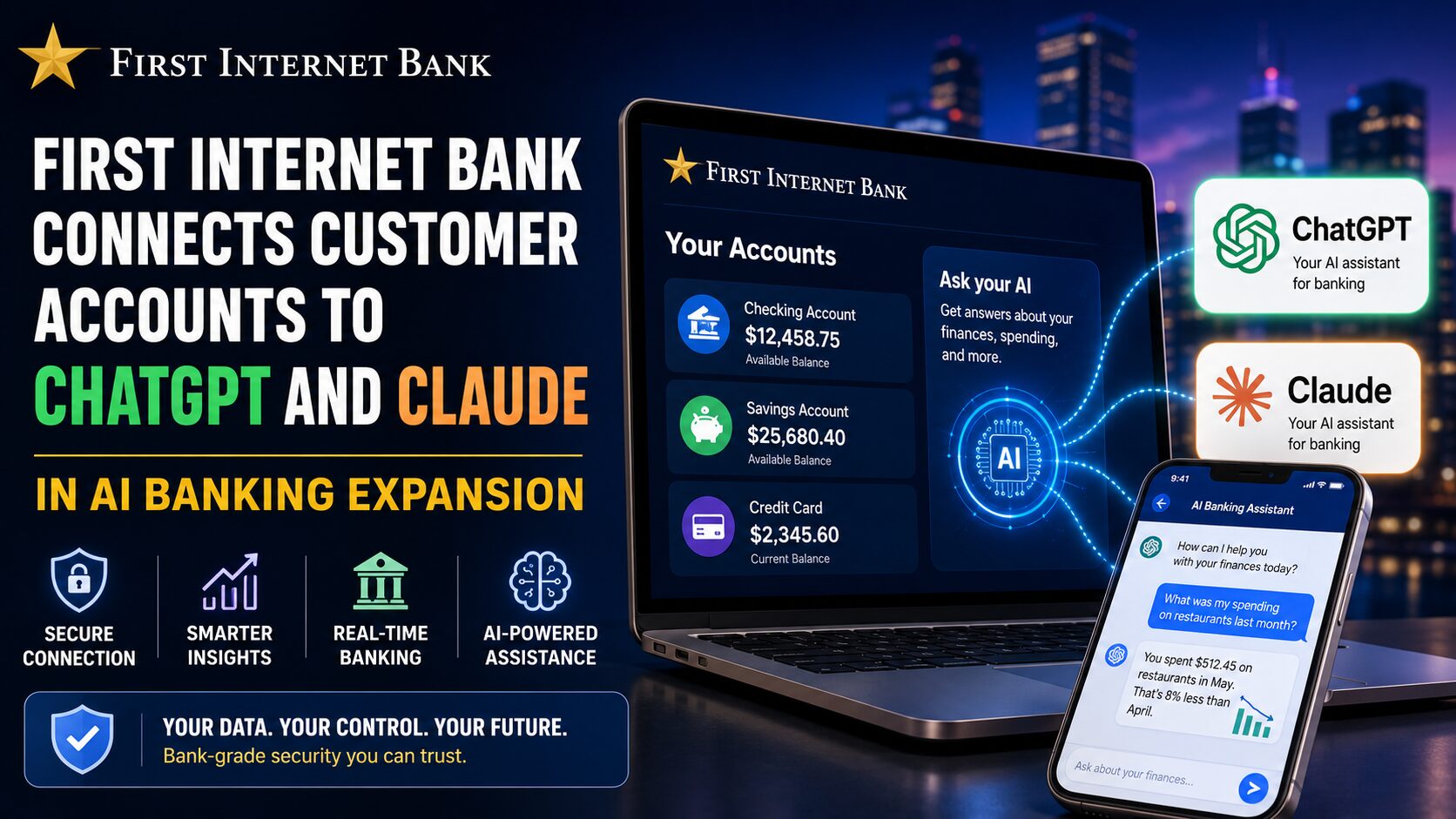
First Internet Bank Connects Customer Accounts to ChatGPT and Claude in AI Banking Expansion
First Internet Bank has become one of the first U.S. banks to allow customers to securely connect their financial accounts to OpenAI’s ChatGPT and Anthropic’s Claude, marking a significant step toward AI-powered banking and conversational finance.
The new capability enables customers to use generative AI assistants to analyze their banking data, track spending, review transactions, monitor cash flow, and receive personalized financial insights through natural language conversations.
The move reflects a broader transformation across financial services, where banks increasingly integrate artificial intelligence into customer experiences rather than limiting AI to internal operations and automation.
AI assistants gain direct access to financial data
Through the integration, customers can securely connect eligible First Internet Bank accounts to AI platforms.
Once connected, ChatGPT and Claude can help users understand their financial activity in a conversational format.
Customers can ask questions such as:
- How much did I spend on travel this month?
- Which subscriptions have increased in cost?
- What is my average monthly cash flow?
- How can I reduce discretionary spending?
- Are there unusual transactions in my account?
The AI platforms provide analysis based on the customer’s connected financial data, allowing for more personalized financial guidance than traditional budgeting tools.
A shift toward conversational banking
The announcement highlights the growing importance of conversational finance, where customers interact with banking information through AI assistants instead of traditional dashboards and spreadsheets.
Rather than manually reviewing account statements, users can ask questions in plain English and receive summarized insights.
This approach can simplify budgeting, expense tracking, and financial planning, especially for customers who want faster and more intuitive access to financial information.
Security and customer control remain central
The integration uses secure financial data connectivity infrastructure and requires customer authorization before account access is granted.
Importantly, the AI assistants can analyze financial information but cannot move money, make payments, or execute transactions.
Customers maintain control over which accounts they connect, and they can disconnect access when they choose.
The accounts provide read-only access, which reduces operational risk while enabling financial analysis and personalized insights.
Why banks are embracing AI integrations
The launch comes as major AI platforms rapidly expand their financial capabilities.
OpenAI recently introduced financial account connectivity for eligible ChatGPT users through secure banking integrations, while Anthropic has expanded Claude’s enterprise capabilities across financial services.
Banks increasingly view AI assistants as a new customer interaction layer rather than a competing financial platform.
Consequently, financial institutions are exploring ways to make banking data available through trusted AI interfaces while maintaining regulatory compliance and security standards.
The broader AI banking trend
Financial institutions are investing heavily in AI across multiple areas.
Current banking AI initiatives include:
- Personalized financial insights
- Budgeting assistance
- Fraud detection
- Customer service automation
- Financial planning
- Cash-flow forecasting
- Spending analysis
- Small business financial management
The next phase of AI banking focuses on context-aware financial assistance, where AI understands a customer’s financial history, goals, and behavior patterns.
Opportunities and privacy considerations
AI-powered financial analysis offers several potential benefits.
Customers can receive faster insights, identify spending trends, and better understand their financial position without manually analyzing transaction data.
However, the integration also raises important questions about data privacy, consent management, and AI governance.
Financial information is among the most sensitive categories of personal data. Therefore, banks and AI providers must ensure transparent data handling practices, strong encryption, and clear customer controls.
Industry observers increasingly expect AI banking services to include robust consent frameworks, limited data retention policies, and enhanced security protections.
Market impact
For First Internet Bank, the integration strengthens its digital banking positioning and differentiates its customer experience through AI-enabled financial services.
For OpenAI and Anthropic, partnerships with financial institutions expand the role of AI assistants from productivity tools into everyday financial decision-making platforms.
More broadly, the announcement signals that AI assistants are becoming a new interface for banking, where customers manage money through conversations rather than traditional banking menus.
As generative AI becomes more integrated into financial services, banks that successfully combine secure account connectivity, personalized AI insights, and strong privacy protections could gain a significant advantage in the next generation of digital banking.
The First Internet Bank initiative suggests that conversational AI may soon become a standard feature of personal financial management, bringing ChatGPT and Claude closer to the core of everyday banking experiences.
Comments
No comments yet. Be the first to share your thoughts.
Leave a comment