
TL;DR
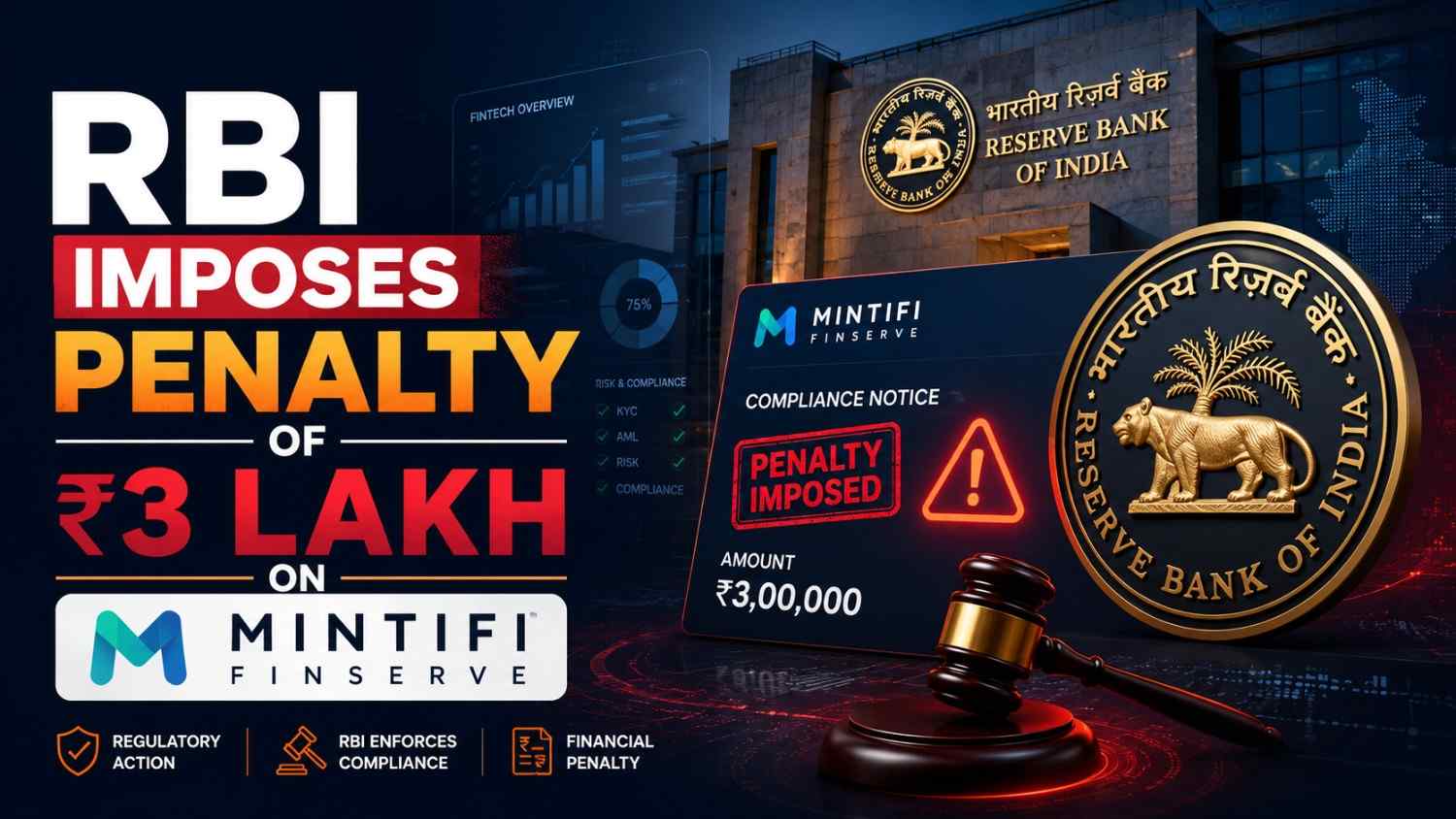
The RBI has imposed a Rs 3 lakh penalty on Mintifi Finserve due to KYC reporting delays. Consequently, the move highlights stricter enforcement of fintech compliance norms in India.
The Reserve Bank of India (RBI) has imposed a penalty of Rs 3 lakh on Mintifi Finserve Private Limited. Specifically, the action was taken due to delays in uploading customer KYC records to the Central KYC Registry (CKYCR). Moreover, this enforcement highlights RBI’s increasing focus on ensuring strict compliance with KYC and AML guidelines across India’s fintech lending ecosystem.
RBI imposes penalty on Mintifi Finserve over KYC compliance lapse
The RBI imposes penalty on Mintifi Finserve has once again underscored India’s increasingly strict regulatory environment for fintech lenders. Notably, the Reserve Bank of India imposed a monetary penalty of Rs 3 lakh on Mintifi Finserve Private Limited due to non-compliance with KYC reporting requirements.
Furthermore, this action reflects a broader regulatory shift, where even procedural delays in compliance reporting are treated with seriousness. As a result, fintech NBFCs are now under stronger supervision than ever before.
In addition, this enforcement signals that regulatory discipline is becoming a core expectation rather than a secondary operational requirement.
RBI imposes penalty on Mintifi Finserve and its impact on fintech industry
The RBI imposes a penalty on Mintifi Finserve for lapses in KYC reporting obligations. Specifically, the company failed to upload certain customer KYC records to the Central KYC Records Registry (CKYCR) within the prescribed timelines.
Moreover, regulatory findings highlighted that:
- Certain KYC records were delayed in submission
- CKYCR updates were not completed on time
- Internal compliance monitoring systems were insufficient
Consequently, these gaps resulted in a formal monetary penalty.
However, it is important to note that no fraud or customer harm has been reported in this case.
RBI imposes penalty on Mintifi Finserve: Regulatory implications for India
The RBI imposes penalty on Mintifi Finserve is not an isolated enforcement. Instead, it forms part of a wider regulatory tightening cycle across India’s fintech ecosystem.
On one hand, fintech innovation continues to expand rapidly. On the other hand, RBI is simultaneously strengthening compliance enforcement to ensure systemic stability.
Therefore, this case becomes significant because:
- It reinforces strict adherence to KYC timelines
- It highlights rising regulatory expectations for NBFCs
- It shows that even minor compliance lapses attract penalties
- It signals stronger oversight of digital lending platforms
As a result, fintech firms must now prioritise compliance automation more than ever.
Understanding CKYCR and its regulatory importance
To fully understand the RBI’s imposition of a penalty on Mintifi Finserve, it is essential to examine the CKYCR framework.
The Central KYC Records Registry (CKYCR) was introduced to:
- Centralise customer identity records
- Reduce duplication in KYC verification
- Improve transparency across financial institutions
- Strengthen AML and fraud prevention systems
Additionally, CKYCR ensures that financial institutions operate on a shared, verified data ecosystem.
How CKYCR works in practice:
- First, financial institutions collect customer KYC documents
- Next, the data is verified and standardised
- After that, it is uploaded to CKYCR
- Finally, other institutions can access verified records
Therefore, any delay in this process can disrupt compliance integrity across the system.
Industry impact of RBI imposes a penalty on Mintifi Finserve
The RBI imposes penalty on Mintifi Finserve has wider implications for India’s fintech lending ecosystem.
1. Strengthened compliance expectations
Firstly, fintech NBFCs must now ensure:
- Real-time KYC uploads
- Automated CKYCR synchronisation
- Continuous compliance monitoring
2. Increased operational accountability
Secondly, banks and lending partners are likely to:
- Conduct deeper audits of fintech partners
- Strengthen onboarding due diligence
- Demand stricter compliance SLAs
3. Rising compliance costs
Moreover, companies may experience:
- Higher investment in compliance technology
- Increased audit and legal expenditure
- Expanded regulatory reporting infrastructure
4. Improved governance standards
However, on a positive note, this will improve:
- Transparency in lending operations
- Trust between fintechs and banks
- Long-term ecosystem stability
RBI’s broader regulatory tightening trend
The RBI imposes penalty on Mintifi Finserve is consistent with a broader regulatory pattern observed over recent years.
For instance, RBI has repeatedly focused on:
- Digital lending transparency
- Stronger KYC and AML compliance frameworks
- Outsourcing risk governance
- Data protection in financial services
In addition, the central bank has emphasised that innovation must not compromise compliance integrity.
Therefore, fintech companies are expected to balance growth with regulatory discipline.
Risks and challenges for fintech companies
Although the penalty appears small, the RBI’s imposition of a penalty on Mintifi Finserve highlights multiple operational risks.
Compliance risks
- Delayed regulatory reporting
- Incomplete KYC submissions
- Weak internal audit controls
Reputational risks
- Reduced investor confidence
- Negative market perception
- Increased regulatory scrutiny
Operational risks
- Dependency on manual compliance systems
- Higher probability of human error
- Inefficient data workflows
Regulatory risks
- More frequent inspections
- Stricter enforcement actions
- Potential tightening of fintech rules
Opportunities emerging from stricter RBI oversight
Nevertheless, the RBI imposes a penalty on Mintifi Finserve also creates new opportunities for compliant fintechs.
Key opportunities include:
- Growth of RegTech and compliance automation solutions
- Competitive advantage for well-governed fintech firms
- Improved investor trust in compliant institutions
- Expansion of AI-driven KYC verification systems
Consequently, companies that invest early in compliance infrastructure may gain a long-term strategic advantage.
Merchant and customer impact
From an operational standpoint, the enforcement indirectly impacts both merchants and customers.
For merchants:
- Faster onboarding depends on compliance efficiency
- Delays may occur due to stricter KYC checks
- Documentation requirements may increase
For customers:
- Stronger identity verification processes
- Reduced fraud risks
- Slight onboarding delays due to enhanced checks
However, in the long run, these measures improve system reliability and trust.
Future outlook after RBI imposes penalty on Mintifi Finserve
Looking ahead, the RBI imposes a penalty on Mintifi Finserve, suggesting several emerging trends:
- Increased frequency of minor compliance penalties
- Stronger reliance on automated compliance systems
- Expansion of CKYCR enforcement scope
- Higher regulatory expectations for NBFC fintechs
Ultimately, the Indian fintech ecosystem is transitioning toward a mature compliance-first framework.
Final Thoughts
In conclusion, the RBI imposes penalty on Mintifi Finserve is not merely a financial penalty case. Instead, it represents a broader regulatory message emphasising discipline, transparency, and operational accuracy.
Therefore, fintech companies must prioritise compliance infrastructure alongside innovation. Otherwise, even minor delays in regulatory reporting could result in enforcement actions in the future.
Comments
No comments yet. Be the first to share your thoughts.
Leave a comment