
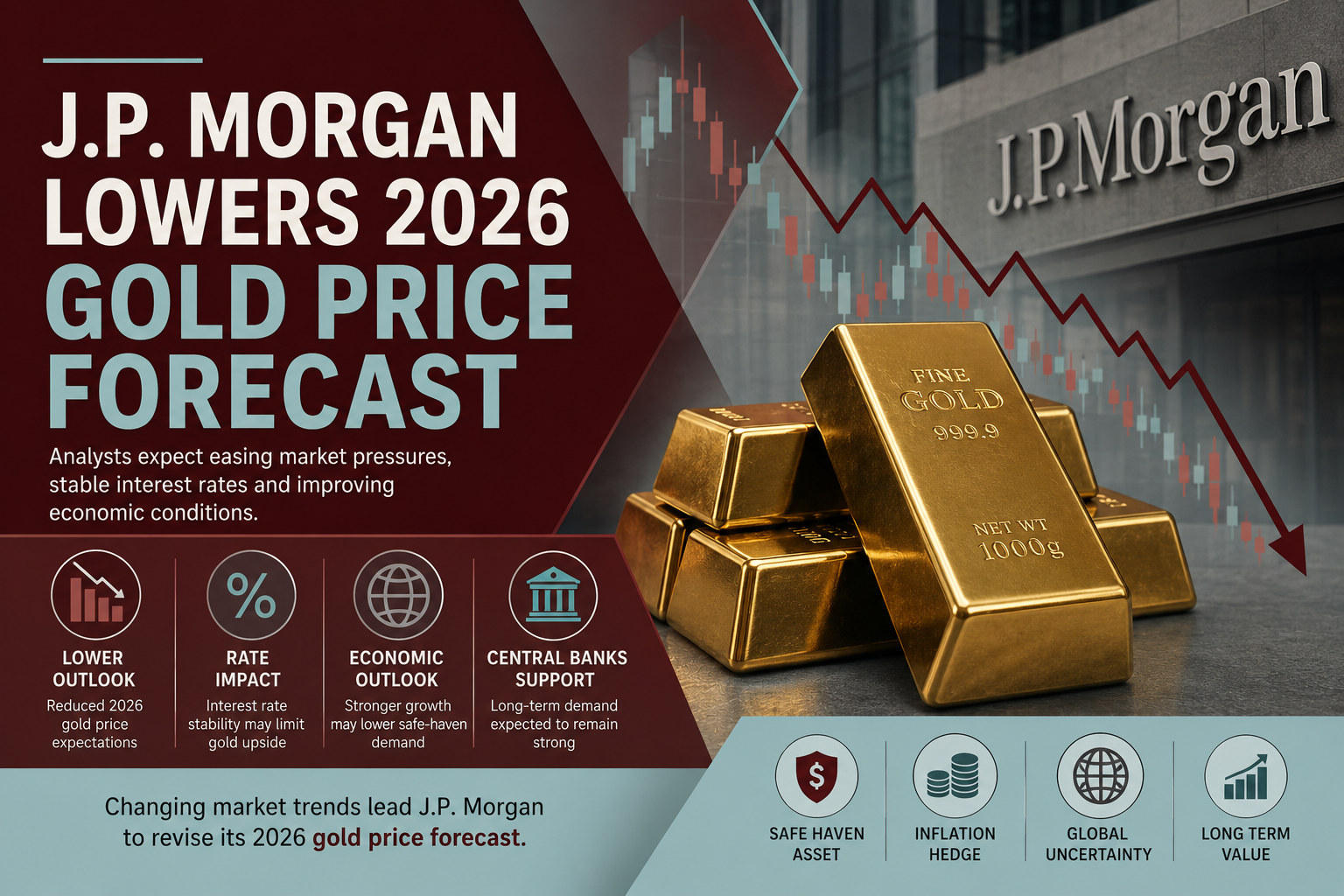
JPMorgan Chase has lowered its 2026 gold price forecast as analysts expect easing market pressures, changing interest rate trends, and improving economic conditions over the next two years. Moreover, analysts now expect gold prices to face slower growth after the recent strong performance in global markets.
Investors continue watching inflation, central bank policies, geopolitical tensions, and global economic activity closely. Therefore, J.P. Morgan’s revised gold price forecast has attracted major attention across commodity and financial markets.
Why the gold price forecast changed
J.P. Morgan adjusted its gold price forecast due to several economic and market factors.
Firstly, analysts expect central banks to gradually stabilise interest rate policies in the coming years. As a result, pressure on safe-haven assets like gold could ease.
Secondly, improving economic growth in major economies may reduce investor demand for defensive assets. Consequently, gold prices may experience slower momentum compared to recent years.
In addition, stronger financial market performance and rising confidence in equities may encourage investors to move capital away from precious metals.
Gold outlook remains important for investors.
Despite the lower outlook, the gold price forecast continues to play an important role in global financial markets. Investors often buy gold during periods of uncertainty, inflation concerns, or geopolitical instability.
Over the past few years, gold prices benefited from:
- High inflation levels
- Global economic uncertainty
- Central bank gold purchases
- Banking sector concerns
- Geopolitical tensions
As a result, gold remained one of the most closely watched commodities in international markets.
Interest rates impact gold markets
Interest rates remain one of the biggest factors influencing gold markets.
When interest rates rise, investors often prefer interest-bearing assets such as bonds and savings instruments. Consequently, demand for gold may weaken because gold does not generate a regular income.
However, when central banks reduce rates, gold often becomes more attractive as a store of value. Therefore, investors continue monitoring signals from the U.S. Federal Reserve and other major central banks.
J.P. Morgan analysts believe future rate stability could limit major price spikes in gold markets through 2026.
Investor reaction to revised gold outlook
Market participants responded carefully to the revised gold price forecast.
Some investors view the lower forecast as a sign that economic conditions may improve over time. Meanwhile, others believe global uncertainty could still support gold demand in the long term.
In addition, many portfolio managers continue using gold as a hedge against inflation and market volatility. Therefore, even with a weaker outlook, gold remains an important diversification asset for institutional and retail investors.
Central banks continue supporting gold demand.
Central banks worldwide have increased gold purchases in recent years. Many countries continue expanding gold reserves to strengthen financial stability and reduce dependence on foreign currencies.
As a result, central bank buying has provided important long-term support for global gold demand.
Furthermore, analysts expect emerging market economies to continue increasing reserve diversification strategies. Consequently, official sector demand may help prevent sharp declines in gold prices despite the revised gold price forecast.
Challenges facing gold markets
Although gold remains a major investment asset, the market still faces several important challenges.
Stronger U.S. dollar
A stronger dollar often puts pressure on gold prices because the metal becomes more expensive for international buyers.
Higher bond yields
Rising bond yields may attract investors away from non-yielding assets like gold.
Economic recovery
If global economic growth improves steadily, investors may shift capital toward equities and riskier assets.
Changing investor sentiment
Market confidence and reduced uncertainty can weaken safe-haven demand for gold.
Therefore, analysts continue monitoring macroeconomic trends closely.
Future of the gold price forecast
Looking ahead, the gold price forecast will likely remain influenced by inflation, interest rates, global growth, and geopolitical developments.
Several trends could shape the market through 2026:
- Central bank monetary policy changes
- Global inflation movements
- Economic growth trends
- Currency market volatility
- Geopolitical risks
Consequently, while J.P. Morgan expects slower price growth, gold will likely remain an important part of global investment strategies.
Conclusion
J.P. Morgan’s decision to lower its 2026 gold price forecast reflects changing expectations around economic growth, interest rates, and investor sentiment. Although analysts expect reduced momentum in gold prices, the metal continues to hold strong importance in global financial markets.
As investors navigate uncertainty, inflation concerns, and shifting central bank policies, the gold price forecast will likely remain a key focus for portfolio diversification and long-term risk management.
Comments
No comments yet. Be the first to share your thoughts.
Leave a comment