
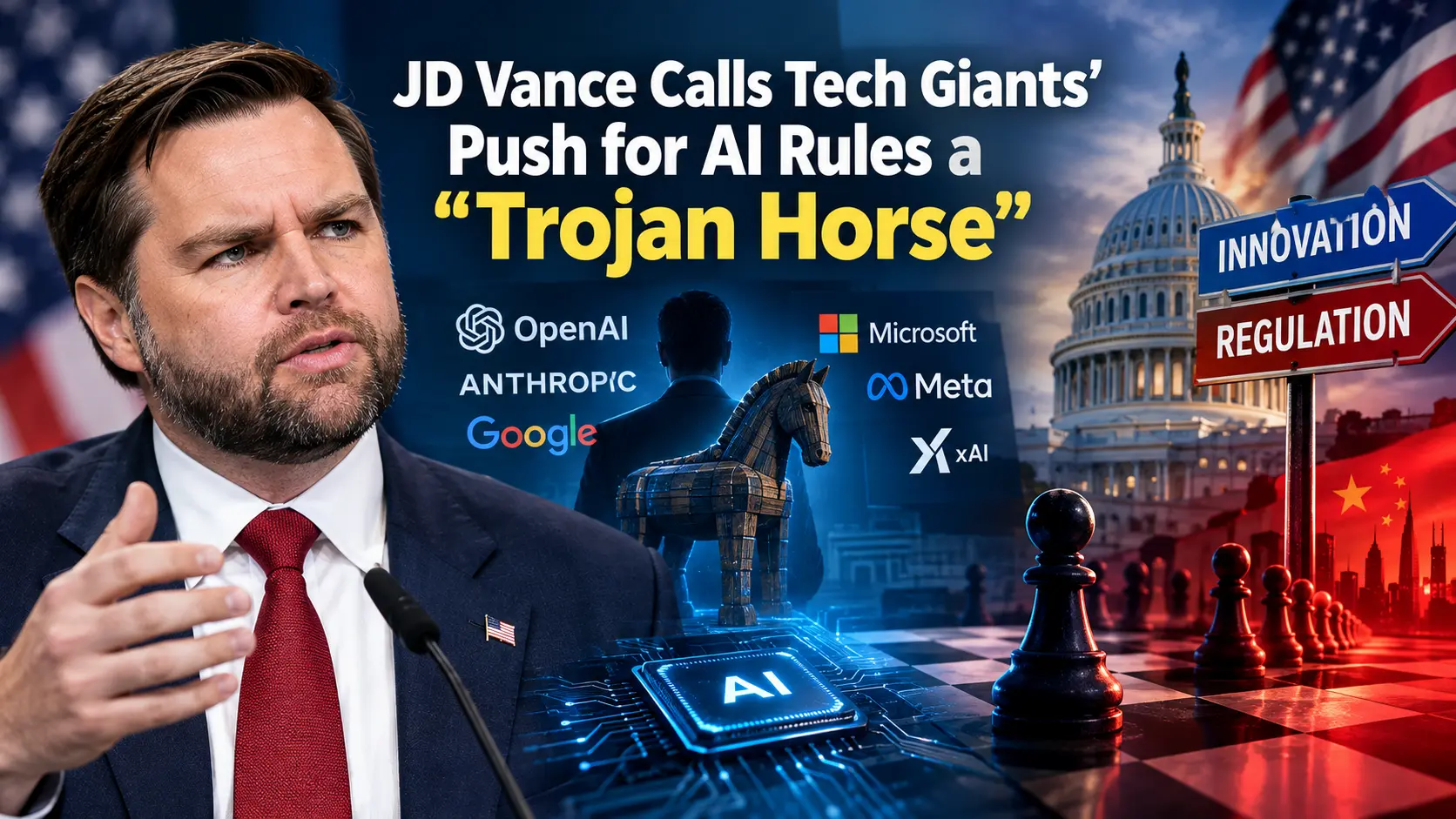
Vice President JD Vance isn’t buying it. When some of the biggest names in AI started asking Washington to step in and regulate the industry more heavily, Vance’s reaction wasn’t relief it was suspicion.
Talking to reporters on September 14, he admitted the whole thing struck him as “a little bit weird”—frontier AI companies lobbying the government to regulate them. His phrase for it: a bit of a Trojan horse. His message to policymakers, essentially, was don’t take these requests at face value.
That comment landed just a day after President Trump made his own position pretty clear, rejecting any talk of slowing AI development and framing it as a competitiveness issue with China. He’s argued the U.S. can build in safeguards without handing away its lead—the priority, in his framing, is staying ahead, full stop.
Why AI leaders started asking for guardrails in the first place
This whole fight kicked off after Anthropic CEO Dario Amodei published an essay calling for more coordination and stronger safety measures around the most advanced AI systems being built.
What made it notable wasn’t just what Amodei said—it was who agreed with him. OpenAI’s Sam Altman and xAI’s Elon Musk both backed the general idea, which is unusual given these three companies are otherwise racing each other for the same customers and the same compute.
The specific asks have generally centered on a handful of things: pacing development of the most powerful models more deliberately, bringing in independent audits and evaluations, hardening systems against misuse and cyberattacks, coordinating safety standards across countries, and finding ways for competing companies to talk about safety without it turning into anticompetitive coordination.
Microsoft’s Satya Nadella has echoed some of this too he’s spoken in favor of deliberate pacing and embedded evaluators, though he’s also been clear that enterprise customers need to stay in control of their own sensitive data throughout.
A widening split in Washington
What’s emerged is a real fault line in how the government thinks about this stuff.
The Trump administration has leaned toward speed and a lighter regulatory touch, worried that too much oversight hands China room to catch up. Trump himself has waved off a lot of the recent AI-risk warnings, arguing the U.S. already has tools to deal with misuse and that piling on more rules just slows everyone down.
Vance’s skepticism fits into that same worldview, but with a sharper edge his concern isn’t just that regulation might slow innovation, it’s that the companies asking for it might have more self-interested reasons for wanting it. Critics elsewhere have raised a similar point: that safety requirements, dressed up as public-interest measures, could end up functioning as a moat that keeps smaller competitors out.
This isn’t just a tech policy fight anymore.
It’s bled into geopolitics at this point.
Trump has increasingly talked about AI leadership as a matter of national power—economic, military, strategic, all of it—and his team has warned repeatedly that any slowdown risks letting China close the gap.
Meanwhile, the people actually building this technology are arguing the opposite: that as these systems get more capable, informal, voluntary safety commitments won’t be enough to manage the risk on their own. Some industry figures have floated the idea of shared testing standards between the U.S. and China specifically. Altman, for his part, has suggested that if Trump and Xi Jinping could find common ground on AI safety, it could be a genuinely significant moment.
China hasn’t exactly welcomed that framing, though officials there have pushed back on the idea that their AI progress poses some kind of existential danger, calling much of the rhetoric fearmongering and pushing instead for cooperation over confrontation.
Domestic politics are getting messy too.
All of this is playing out while ordinary concerns about AI’s effect on jobs, education, cybersecurity, and social stability keep growing louder.
Democrats have been increasingly critical of the administration’s hands-off stance. Some Republicans, meanwhile, have shown more openness to narrower safety rules tied to national security. House Speaker Mike Johnson, for instance, has argued AI companies carry a basic corporate responsibility to make sure their products are actually safe.
There’s a harder policy puzzle buried in here too: how do you get companies to genuinely cooperate on safety without letting that cooperation slide into something that quietly locks out smaller competitors? That question gets trickier given how much of the capital, computing power, and data needed to build frontier AI already sits with a handful of firms.
Markets are paying attention.
Investors have noticed the fight, too. AI-linked stocks dipped as markets weighed whether a slower, more cautious development pace could mean less near-term demand for chips, data centers, and the rest of the infrastructure buildout. Nvidia and other companies tied closely to the AI boom felt some of that pressure directly.
Nobody really knows how this shakes out long-term. Slower, more careful development probably means higher costs and delayed launches in the short run. But it could also mean fewer catastrophic failures and more trust down the line—which matters a lot if AI is going to get adopted seriously across regulated industries like finance and healthcare.
Where this leaves things
Vance’s “Trojan horse” line captures the real tension running through all of this: the companies building the most powerful AI systems are asking governments to help manage the risk, and the people in charge of that government are asking, reasonably, whether those requests might also just protect the companies already on top.
The Trump administration’s priorities haven’t wavered—stay ahead of China, avoid rules that slow things down. The open question is whether AI safety and competitiveness can actually be pursued at the same time, or whether, in practice, Washington ends up treating them as a trade-off.
Vance Says AI Leaders Urging Slowdown Feels Like A ‘Trojan Horse’
Comments
No comments yet. Be the first to share your thoughts.
Leave a comment