
Gravis Robotics Raises $200 Million From SoftBank to Scale AI-Powered Construction Autonomy
Swiss robotics company Gravis Robotics has raised $200 million in Series A funding from SoftBank to accelerate the deployment of autonomous heavy machinery across construction sites worldwide. The investment gives the ETH Zurich spinout a reported $1 billion post-money valuation and marks one of the biggest funding rounds yet for construction robotics.
Construction is facing a difficult combination of rising infrastructure demand, labor shortages and persistent productivity challenges. Gravis Robotics believes autonomous machinery can address part of that gap by bringing artificial intelligence directly into the equipment already used on jobsites.
The company’s latest funding provides significant capital to pursue that goal.
SoftBank Invests $200 Million in Gravis Robotics
SoftBank is investing $200 million in Gravis Robotics’ Series A, becoming the sole investor in the round, according to the company and reporting from Inc.
Gravis describes the financing as the largest Series A in construction robotics history. Independent reports also place the company’s post-money valuation at approximately $1 billion, making Gravis one of Europe’s newest robotics unicorns.
The investment follows Gravis’ previous $23 million funding round in 2025, which was led by IQ Capital and Zacua Ventures. Holcim and other investors also participated in that financing.
SoftBank’s involvement now gives Gravis considerably more financial capacity to expand its technology and global deployments.
Gravis Is Bringing Physical AI to Construction
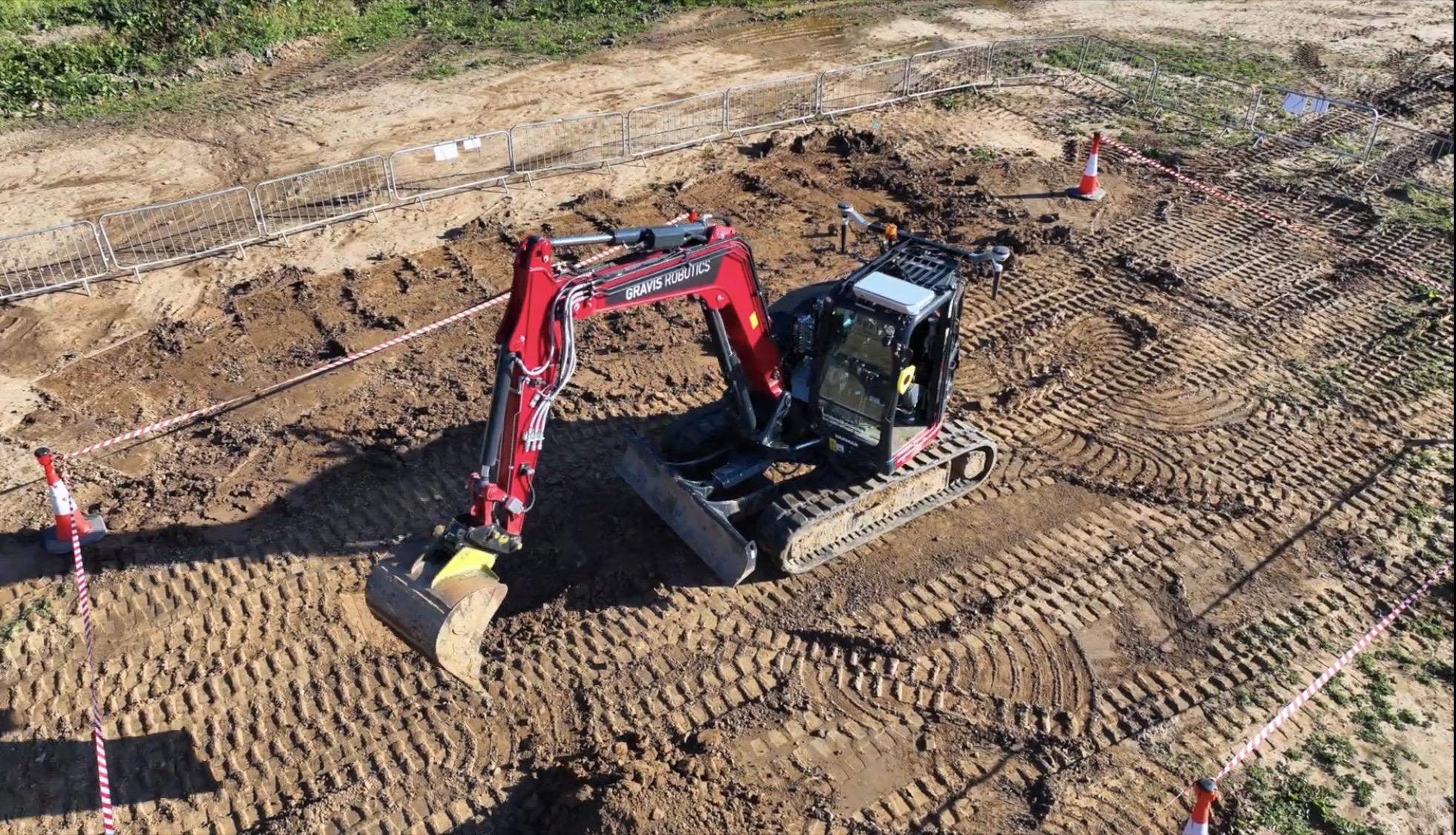
Gravis Robotics was founded in 2022 as a spinout from ETH Zurich’s Robotic Systems Lab. The company develops AI-based retrofit systems that turn conventional heavy construction machinery into autonomous robots.
That approach separates Gravis from robotics companies that build entirely new machines.
Instead, the company can add autonomy technology to equipment contractors already own.
Its system combines sensors, AI and machine-control technology to help heavy equipment understand its surroundings and respond to changing conditions. Gravis says its technology can increase excavation throughput by up to 30% while improving jobsite safety.
The company’s technology has already been deployed across multiple regions, including Europe, the United States, Latin America and Asia.
Existing Excavators Become Autonomous Machines
One of Gravis’ central ideas is that construction companies should not need to replace their existing fleets to adopt autonomy.
The company’s Gravis Rack provides an autonomous control system that can be installed on different types of heavy equipment. Its technology has been designed to work across machines from manufacturers including Caterpillar, Case, Develon, John Deere, JCB, Hitachi, Sumitomo, Yanmar and Volvo.
That mixed-fleet strategy could be important in a highly fragmented equipment market.
Contractors often have years of investment in machinery and established relationships with equipment manufacturers and dealers. A retrofit approach allows companies to add autonomous capabilities without abandoning those existing assets.
Gravis describes its technology as an operating layer for mixed fleets rather than a closed system tied to one equipment manufacturer.
AI Must Understand the Physical World
Construction presents a different challenge from many other forms of robotics.
A warehouse robot typically operates in a controlled environment. Autonomous vehicles are designed to navigate roads with established rules and relatively predictable surfaces.
Heavy construction equipment operates in environments that change constantly.
An excavator may encounter different soil types, rocks, slopes and underground conditions during a single project. The machine must also understand how its actions change the terrain around it.
Gravis says its AI models are trained using large-scale simulated environments designed to expose the system to different excavation conditions.
The company combines this simulated experience with real-world machine data. Its technology uses inputs from systems such as LiDAR, cameras, GNSS and hydraulic sensors to understand both the environment and the machine itself.
That combination is central to Gravis’ physical-AI approach.
From Driver Assistance to Full Autonomy
Gravis is not relying on a single level of automation.
Its technology can operate across a range of modes, from AI-assisted manual operation to greater levels of autonomous control.
With Gravis Copilot, operators can remain inside the cab while receiving real-time 3D guidance and hazard information.
When autonomous functions are enabled, operators can supervise machines from safer locations. The company also envisions supervisors managing multiple autonomous machines rather than controlling just one piece of equipment at a time.
This gradual approach could help contractors adopt autonomy without immediately changing their entire operating model.
Gravis has previously described this strategy as a way to deliver productivity improvements today while building toward higher levels of autonomy over time.
Construction Faces a Major Labor Challenge
The investment comes as construction companies face growing pressure to complete major infrastructure projects with limited skilled labor.
Demand is rising across several areas.
Data centers, energy infrastructure, transportation projects, housing and climate-resilient infrastructure all require significant amounts of earthmoving and construction work.
At the same time, experienced heavy-equipment operators are becoming harder to replace.
Automation could help contractors address part of this challenge by allowing machines to perform repetitive or dangerous tasks with less direct human exposure.
Gravis is therefore targeting a problem that extends beyond robotics.
The company’s larger opportunity is the modernization of an industry that still relies heavily on human operators and conventional machinery.
Productivity Is a Major Focus
Gravis is positioning productivity as one of the main reasons contractors should adopt its technology.
The company says its autonomous systems can deliver up to 30% higher throughput in suitable applications.
Previous deployments have also demonstrated productivity gains in tasks such as excavation, trenching and material handling.
The underlying technology can continuously collect information about the jobsite while machines work. That data can support surveying, mapping and hazard detection alongside the primary construction task.
As a result, autonomy can potentially provide more than machine control.
It can become part of a broader digital infrastructure for the jobsite.
Gravis Has Already Moved Beyond the Laboratory
The latest investment builds on commercial deployments rather than a purely experimental technology program.
Gravis said in 2025 that its systems were already operating in seven countries across the UK, Europe, the United States, Latin America and Asia. The company also announced partnerships with major industry players, including Holcim, Taylor Woodrow and HD Hyundai.
Holcim has also invested in Gravis through its MAQER Ventures corporate venture capital arm.
Following a UK pilot, Holcim said the technology could potentially expand from construction applications into quarry operations.
Those commercial relationships give Gravis an important foundation as it prepares for a larger rollout.
UK Government-Backed Project Adds Momentum
Gravis is also participating in a UK government-backed construction automation initiative.
The company was selected to lead an $8 million CAM Pathfinder project with Flannery Plant Hire, according to its funding announcement.
The project focuses on retrofitting excavators with autonomous technology and expanding access to autonomous machinery for contractors.
That type of partnership could help Gravis demonstrate its technology across larger infrastructure projects.
It also provides an example of how autonomous construction equipment could be introduced through existing equipment-rental networks.
Why SoftBank’s Investment Matters
SoftBank has built a reputation for making large bets on robotics and artificial intelligence.
Its investment in Gravis adds another significant physical-AI company to that broader technology strategy.
For Gravis, the capital could accelerate several areas at once.
The company can expand engineering teams, increase deployments, strengthen its technology platform and develop additional relationships with equipment manufacturers and contractors.
More importantly, the funding gives Gravis an opportunity to move from individual deployments toward fleet-scale adoption.
That is likely to be the critical test.
Construction autonomy will only become a major business if contractors can deploy it reliably across many machines and different jobsite conditions.
A Different Approach to Robotics
The construction robotics market is becoming increasingly competitive.
Several startups are developing autonomous excavators, loaders and other heavy machinery. Equipment manufacturers are also exploring greater automation and machine-control capabilities.
Gravis’ retrofit strategy gives it a distinct position.
Rather than asking contractors to purchase an entirely new robotic machine, the company can upgrade equipment already operating on construction sites.
That could reduce adoption barriers.
It also allows contractors to introduce autonomy gradually, beginning with individual machines before expanding across larger fleets.
The Road Ahead for Gravis Robotics
The $200 million investment provides Gravis with the resources to pursue a much larger commercial rollout.
The company wants its autonomous technology to operate across major construction and infrastructure projects worldwide.
Achieving that goal will require more than strong AI models.
Gravis will need to demonstrate reliability across different machines, soil conditions, weather environments and jobsite configurations. It will also need to maintain high safety standards as autonomous equipment becomes more common around workers.
Scaling the technology will therefore be as much an operational challenge as a technical one.
The company’s existing partnerships and deployments provide an important starting point.
Conclusion
Gravis Robotics’ $200 million Series A from SoftBank marks a major financing event for construction robotics and physical AI. The round values the Swiss startup at approximately $1 billion post-money, according to independent reporting.
More importantly, the investment signals growing investor confidence in the idea that AI can move beyond software and operate directly in the physical world.
Gravis is taking that concept into one of the most difficult environments possible: construction sites.
Its strategy of retrofitting existing excavators and other heavy machinery could give contractors a practical route toward autonomy. The company’s reported productivity gains, international deployments and growing industry partnerships provide an early foundation for that expansion.
The next stage will be about scale.
If Gravis can reliably deploy autonomous systems across mixed equipment fleets and complex jobsites, its technology could become an important part of the construction industry’s response to labor shortages and rising infrastructure demand.
Comments
No comments yet. Be the first to share your thoughts.
Leave a comment