
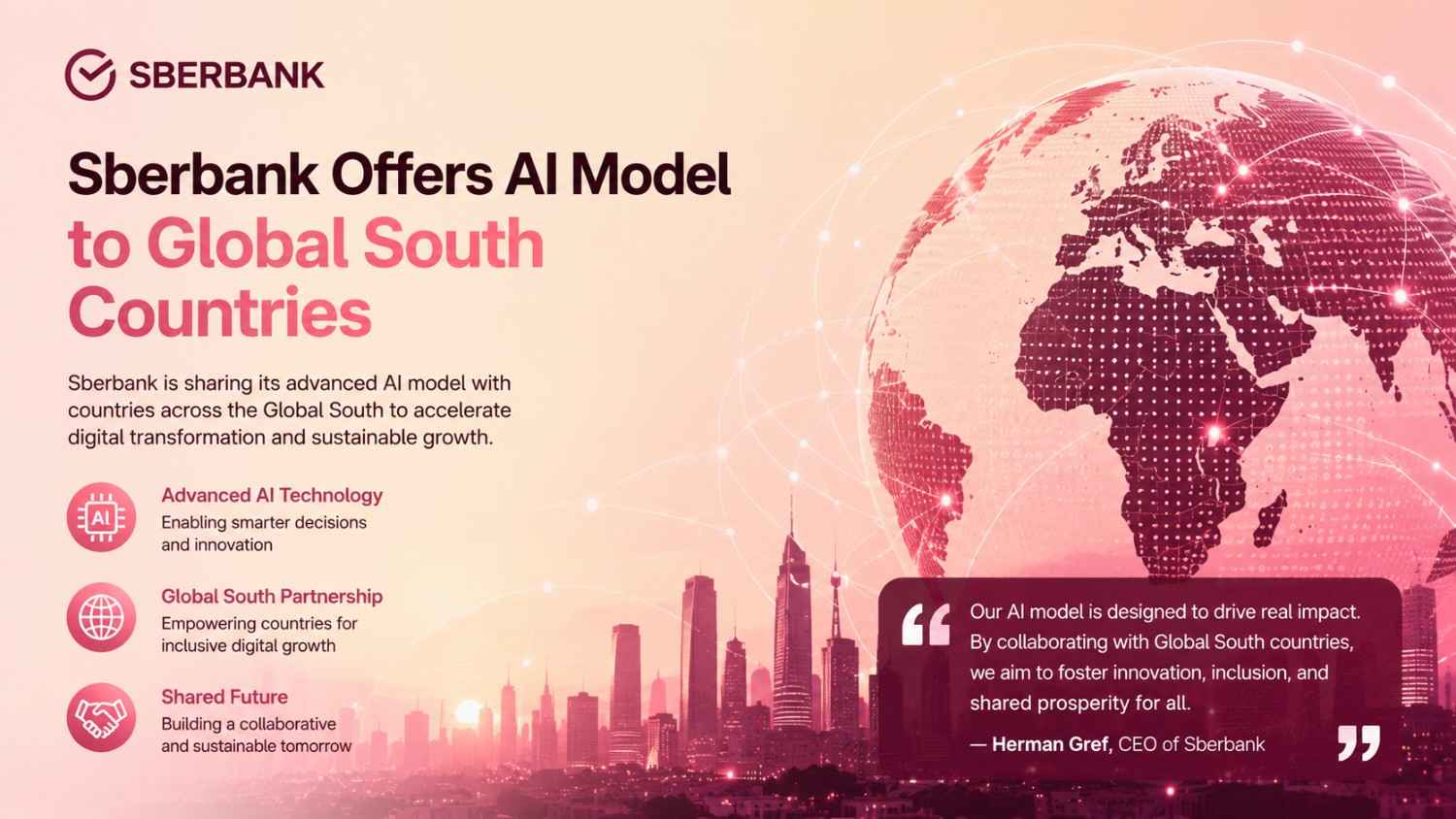
Sberbank offers AI model to Global South countries
Russia’s Sberbank has started offering its AI model to countries in the Global South that want to close the digital gap and develop local digital infrastructure.
Moreover, the bank is promoting its “sovereign AI” systems to regions across Africa, Asia, Latin America, and Oceania. As a result, developing countries are showing interest in alternative AI tools that do not rely only on Western platforms.
Furthermore, the move highlights growing global competition in artificial intelligence. Consequently, AI models are becoming a key part of international technology strategy.
Sberbank promotes sovereign AI strategy
The Sberbank AI model push focuses on “sovereign AI,” which means countries can run and control their own AI systems.
In addition, the company claims that local AI models can better match regional needs and language patterns. Therefore, governments may prefer models trained on domestic data.
Moreover, Sberbank highlights its GigaChat system as a cost-effective solution for developing markets. Because many countries face limited infrastructure, affordable AI tools are gaining demand.
Furthermore, the strategy targets governments that want digital independence.
Global South interest in AI expansion
Countries in the Global South continue exploring AI tools to improve public services and economic growth.
For example, governments are using AI in:
- Public administration
- Financial services
- Education systems
- Healthcare solutions
- Digital identity programs
Moreover, many developing nations want to reduce dependence on expensive foreign technology. As a result, they are looking for alternative AI providers.
In addition, rising internet access and mobile adoption are supporting AI growth. Therefore, demand for scalable AI systems continues increasing.
Digital divide drives demand for AI solutions
The Sberbank AI model offering connects directly with efforts to reduce the global digital divide.
Moreover, many developing regions still lack strong computing infrastructure and advanced AI systems. Because of this gap, governments seek affordable and easy-to-deploy solutions.
Furthermore, AI tools can help improve productivity in both public and private sectors. As a result, digital transformation is becoming a top priority.
In addition, international organizations continue supporting AI adoption programs in emerging economies.
Competition in global AI market intensifies
The global AI market is becoming highly competitive as more countries and companies develop their own systems.
Moreover, Russia, China, and the United States are all investing heavily in AI development. Because of this competition, countries are promoting their own AI ecosystems abroad.
Furthermore, sovereign AI has become a strategic tool in international technology policy. Consequently, AI is no longer just a commercial product but also a geopolitical asset.
In addition, partnerships between governments and technology firms are increasing worldwide.
Sberbank expands AI ecosystem
The Sberbank AI model initiative is part of a broader AI strategy that includes GigaChat and other digital tools.
Moreover, the bank has been expanding its artificial intelligence capabilities in areas such as:
- Natural language processing
- Financial automation
- Cloud computing services
- Enterprise AI tools
- Data analytics systems
Because of these developments, Sberbank is positioning itself as a major AI player in Russia and selected international markets.
Furthermore, the company continues to invest in research and model development.
AI adoption supports economic growth
Artificial intelligence is expected to play a major role in economic development across the Global South.
Moreover, AI systems can help businesses reduce costs and improve efficiency. Because of this, governments see AI as a tool for long-term growth.
Furthermore, sectors like banking, agriculture, and logistics can benefit from automation. As a result, productivity levels may increase in developing economies.
In addition, AI-driven systems can improve decision-making in public services.
Challenges in AI deployment
Despite growing interest, several challenges remain for the Sberbank AI model rollout.
Moreover, many developing countries face infrastructure limitations such as weak internet connectivity and limited computing power. Because of this, AI deployment can be difficult.
Furthermore, concerns around data privacy and regulation continue to grow. As a result, governments must carefully design AI policies.
In addition, training local talent remains an important requirement for long-term success.
Comparison between Western and sovereign AI models
| Feature | Western AI Models | Sovereign AI Models |
|---|---|---|
| Data control | Centralized | Local control |
| Cost | Higher | Lower |
| Customization | General purpose | Region-specific |
| Infrastructure need | High | Flexible |
| Policy alignment | Global standards | National rules |
Moreover, this comparison explains why some countries prefer sovereign AI systems.
Sberbank strengthens global AI positioning
The expansion of the Sberbank AI model reflects the company’s ambition to expand beyond traditional banking services.
Moreover, Sberbank has been investing in digital platforms, cloud infrastructure, and AI-based services. Because of this diversification, it now operates as both a financial and technology company.
Furthermore, the bank continues collaborating with international partners to improve its AI capabilities.
In addition, demand for localized AI solutions is expected to grow further.
Future outlook for Sberbank AI model
The future of the Sberbank AI model will depend on adoption rates in Global South countries and competition from global AI leaders.
Moreover, more nations are expected to explore sovereign AI strategies in the coming years. Because of this trend, demand for regional AI systems may increase.
Furthermore, improvements in model efficiency and cost reduction could support wider adoption. As a result, Sberbank may expand its AI footprint further.
In addition, global AI competition is expected to intensify.
Final Thoughts
The launch and promotion of the Sberbank AI model highlights the growing importance of artificial intelligence in global development strategies.
Moreover, countries in the Global South are increasingly seeking affordable and locally controlled AI systems. As a result, sovereign AI is becoming a major global trend.
Ultimately, Sberbank’s initiative reflects how AI is reshaping both technology access and international digital power structures.
Russia’s Sberbank offers AI model to Global South states keen to bridge digital divide | Reuters
Comments
No comments yet. Be the first to share your thoughts.
Leave a comment