
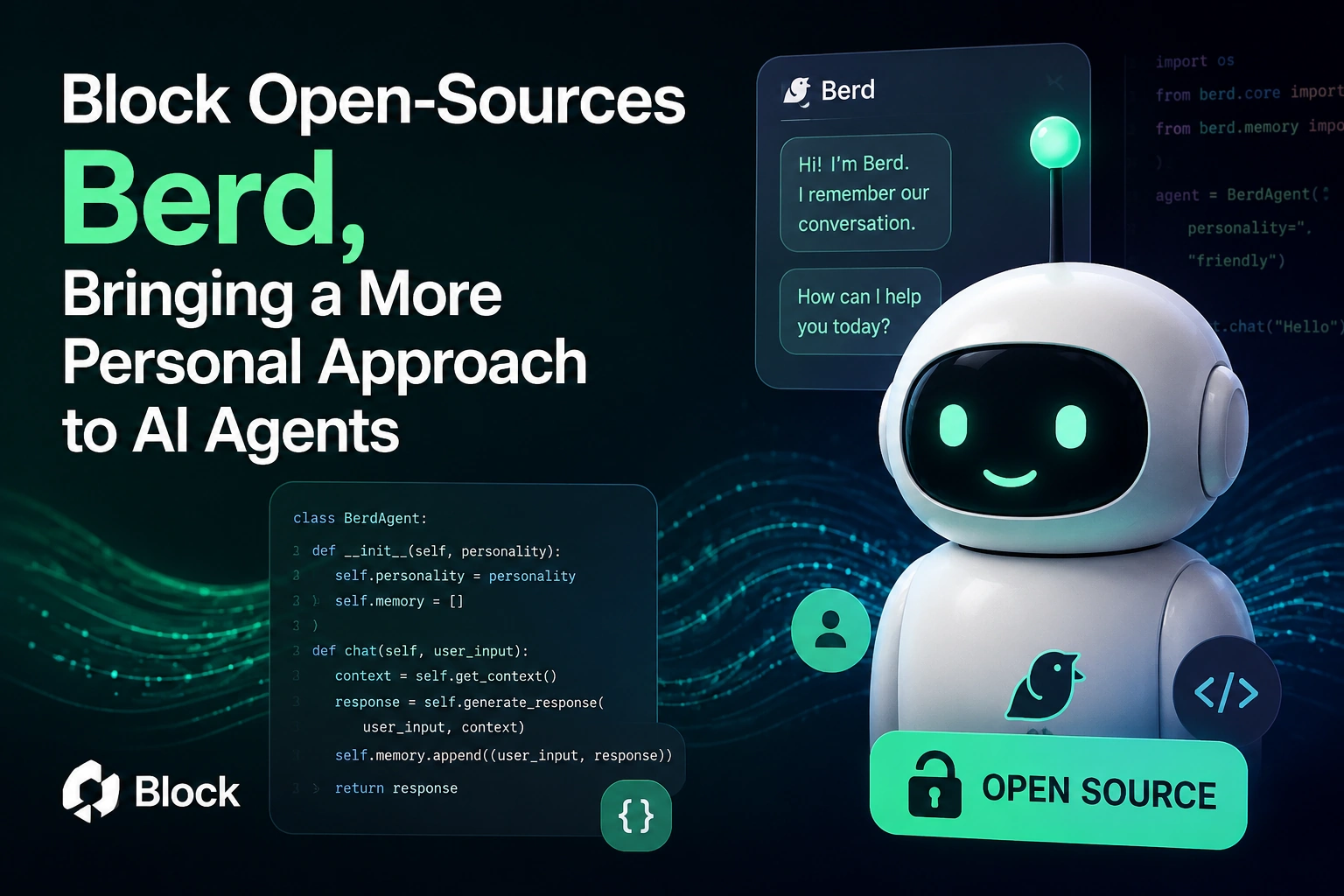
Block Open-Sources Berd, Bringing a More Personal Approach to AI Agents
Block has open-sourced Berd, a desktop application designed to help people work with AI agents, models, tools and projects from a single environment.
Block is taking a new approach to AI-agent design by giving users a more visual and personalized way to interact with autonomous AI tools.
The company has announced that Berd, an internal desktop application used by Block teams, is now open source. As a result, developers and businesses can inspect, use and adapt the application for their own AI workflows.
Block says Berd grew from a practical challenge inside the company. Its teams were already using AI tools such as goose, Claude Code and Codex, but each tool came with different interfaces, configurations and approaches to managing context.
To address this challenge, Berd was designed to bring those experiences together.
Berd Creates a Unified Workspace for AI Agents
Berd provides a desktop environment where users can work across different models and AI-agent systems.
The application brings together:
- AI conversations
- Files and folders
- Projects
- Instructions
- Agents
- Skills
- Tools
- Persistent context
As a result, users can return to ongoing projects without rebuilding the same context for every task.
Moreover, Block says the goal is to make agentic AI more accessible beyond engineering teams. Users can start with a simple conversation and gradually add context, tools and structure as their work becomes more complex.
Block Gives AI Agents a Visual Identity
One of Berd’s most distinctive ideas is its use of character and visual identity.
Many AI applications start with a blank prompt box. Consequently, users may find it difficult to understand what an agent can do, which tools it can access or how it differs from another agent.
Berd takes a different approach.
Block designed collections of animated characters, including its flagship “Gloopies,” to represent different AI agents. The company believes visual identity can make abstract AI configurations easier to recognize and understand.
Importantly, the characters are not simply decorative. Their roles, skills and available tools define what each agent can do.
Furthermore, Block says users can create custom agents through conversations and configure them for different tasks. These uses can range from professional workflows to everyday activities such as travel planning and shopping.
Berd Builds on Block’s Open-Source AI Work
Berd also builds on goose, Block’s open-source AI agent framework.
Block introduced goose as an open-source, on-machine AI agent designed to connect language models with tools and real-world actions. The company has previously described goose as a flexible platform that can work with different language models and be customized for different uses.
However, Berd and goose now have different roles.
Goose functions as the underlying agent framework and runtime, while Berd provides a desktop interface for projects, sessions, agents and configuration.
Block says Berd connects with goose through the Agent Client Protocol. This setup allows the desktop application to focus on the user experience while goose manages the underlying agent loop.
From Individual AI Work to Collaboration
Block’s AI work is also expanding beyond individual desktop workflows.
The company points to Buzz, an open-source workspace designed for people and AI agents to collaborate in shared rooms.
The concept connects private AI work with collaborative workflows. For example, a user might begin researching or experimenting alone in Berd before bringing a teammate, another agent or an artifact into a shared environment through Buzz.
In addition, Block says lessons from Berd will influence its continued development of Buzz. These lessons include persistent context, agent identities, reusable skills and visibility into an agent’s capabilities.
Block Continues Its Push Into Agentic AI
Berd represents another step in Block’s broader investment in AI agents.
The company’s previous work with goose has already formed part of its wider AI development strategy. At its 2025 Investor Day, Block described goose and its underlying agent technology as part of the company’s effort to accelerate software development and build AI-powered products across its ecosystem.
As AI agents move beyond simple chat interfaces, this strategy could become increasingly important. These systems are beginning to handle more complex, multi-step tasks.
For Block, however, the challenge is not only making AI agents more capable. Equally important is making them easier for people to understand, customize and use.
What Berd Means for the Future of AI Agents
The open-sourcing of Berd highlights a growing shift in AI product design.
As AI agents gain more tools and autonomy, users need clearer ways to understand what each agent can access, how it is configured and what role it is designed to perform.
Block’s approach combines persistent context, reusable skills, visual identities and configurable tools in a single environment. In turn, this could make agent-based workflows more approachable for a broader range of users.
The company is now inviting developers and users to experiment with Berd and provide feedback on how AI-agent experiences should evolve.
About Block
Block is a financial technology company behind products including Square, Cash App and Afterpay. The company has also invested heavily in open-source AI-agent technology through projects such as goose. Its broader AI strategy includes using agent technology to automate work and build new experiences across its products.
Comments
No comments yet. Be the first to share your thoughts.
Leave a comment