
Introduction
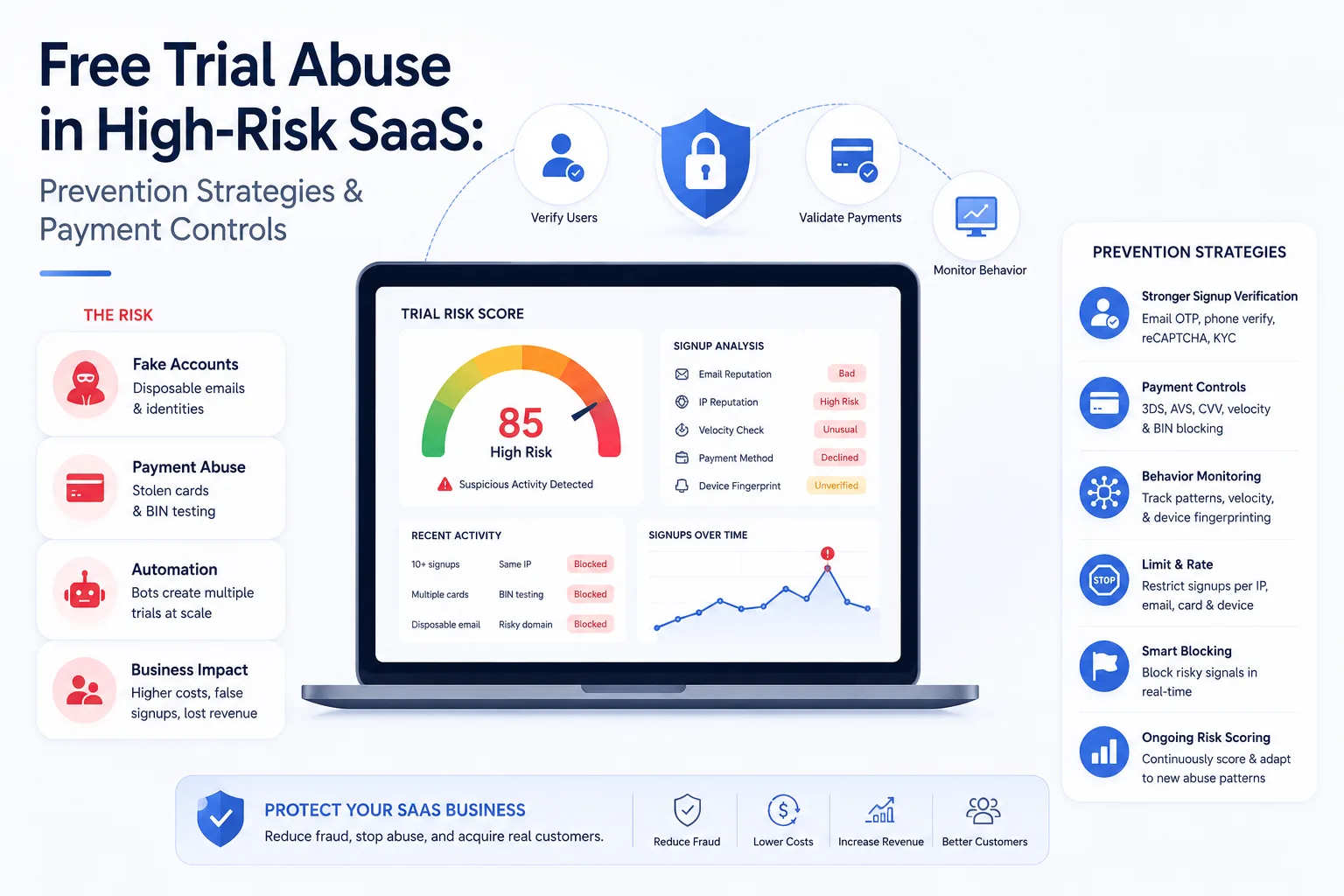
Free trials are the default growth mechanism for SaaS businesses, but for high-risk SaaS merchants, every unprotected trial is an open door for abuse. Fraudsters, serial trial-hoppers, and competitors spin up accounts at scale, consume infrastructure, and convert at zero.
The financial damage is measurable and growing. In 2026, stopping free trial abuse without killing legitimate conversion requires a specific combination of payment controls and behavioural intelligence, not a single tool, not a blanket restriction.
TL;DR
- Free trial abuse costs SaaS businesses an estimated $7.6 billion annually (Zuora Subscription Economy Index, 2025)
- 34% of free trial signups in high-risk SaaS verticals show one or more abuse indicators (Sift, 2025)
- High-risk SaaS merchants face 3.8x more trial abuse attempts than standard SaaS (Chargebacks911, 2025)
- 67% of free trial abusers use prepaid or virtual cards specifically to avoid trial-to-paid conversion charges
- Companies implementing card verification at trial signup reduce abuse rates by up to 68%
- 3DS2 authentication at trial entry reduces fraudulent signups by 72% with minimal friction for legitimate users (Worldline, 2025)
What Is Free Trial Abuse?
Free trial abuse is any pattern of behaviour where users access a SaaS product’s trial offer without any genuine intent to convert to a paid plan, and often with active strategies to avoid payment while extending access indefinitely.
It exists on a spectrum. At the low end, a user creates two accounts to extend a 14-day trial to 28 days. At the high end, organised abuse rings spin up thousands of accounts across proxied IPs and disposable email addresses to access infrastructure-heavy SaaS tools, AI platforms, cloud services, analytics tools, at zero cost.
For high-risk SaaS merchants, the problem is compounded by the same factors that drive elevated payment processing costs: a user base that includes a higher proportion of anonymised signups, cross-border sessions, and users with specific reasons to obscure their identity during signup.
The Scale of the Problem in 2026
The financial impact of free trial abuse on SaaS revenue is significant and consistently underestimated.
Zuora’s Subscription Economy Index estimated that free trial abuse costs SaaS businesses globally $7.6 billion annually, a figure that has grown 28% since 2023 as SaaS adoption accelerated and trial-to-paid models became the dominant acquisition strategy. That cost breaks down across three categories: direct infrastructure consumption by non-converting trial users, internal resource cost of managing abusive accounts, and the conversion rate dilution that comes from trial capacity being consumed by users who will never pay.
The abuse rate in high-risk SaaS verticals is significantly higher than in standard SaaS. Sift’s 2025 Digital Trust & Safety Report found that 34% of free trial signups in high-risk SaaS categories showed at least one abuse indicator at the point of signup, compared to 11% in standard SaaS verticals. Chargebacks911’s 2025 industry analysis placed the trial abuse multiplier for high-risk merchants at 3.8x the standard SaaS rate.
The average cost of a single fraudulent trial user, in compute, storage, and support overhead, runs $45–$120 depending on the SaaS product type, according to internal cost modelling from mid-market SaaS operators surveyed in TheFinRate’s 2025 merchant research. At scale, a platform receiving 10,000 trial signups per month with a 34% abuse rate is absorbing $153,000–$408,000 monthly in pure infrastructure cost from users who will never convert.
How Free Trial Abuse Actually Happens
Understanding the mechanics is essential before selecting prevention tools. Abuse takes five primary forms in high-risk SaaS environments.
Repeat Account Creation
The simplest form. A user creates a new account with a different email address when their trial expires. No technical sophistication required, just a new email. Disposable email services (Mailinator, Guerrilla Mail, temp-mail.org) enable this at scale. In 2025, approximately 23% of all new SaaS trial signups globally used a disposable or temporary email domain, per ZeroBounce’s 2025 Email Validation Report.
Prepaid and Virtual Card Cycling
Many SaaS trials require a credit card at signup to enable seamless trial-to-paid conversion. Abusers counter this with prepaid Visa/Mastercard gift cards or virtual card numbers that pass basic validation but carry zero balance, ensuring the trial-to-paid charge fails automatically. 67% of confirmed trial abusers use prepaid or virtual cards specifically for this purpose (Sift, 2025).
The cards pass Luhn algorithm validation and return a valid BIN lookup result. They fail only at the point of actual billing, by which point the trial period is over and the abuser has received full access.
Credential Sharing and Reselling
In some high-risk SaaS verticals, particularly AI tools, data intelligence platforms, and research tools, trial credentials are shared across communities or resold. A single trial signup is used by dozens of users simultaneously, circumventing per-user access restrictions through shared session tokens or credential forwarding.
Automated Account Factories
The most sophisticated form, typically targeting high-value SaaS platforms. Automated scripts create hundreds or thousands of trial accounts using rotating IPs, browser automation, and pre-generated email addresses. These are the same infrastructure patterns used in BIN attacks and credential stuffing, repurposed for SaaS trial extraction.
82% of automated trial abusers reuse the same device fingerprint across multiple account creation attempts within a rolling 30-day window (F5 Labs, 2025), making device intelligence one of the most effective detection layers against this pattern.
Competitor Intelligence Abuse
A specific form of abuse where competitor businesses systematically create trial accounts to reverse-engineer product features, pricing logic, and data outputs. Less financially damaging than infrastructure abuse but strategically significant and difficult to detect through payment controls alone.
Payment Controls That Stop Trial Abuse
Payment-layer controls are the most effective category of intervention for the prepaid card and repeat account patterns that dominate high-risk SaaS trial abuse.
$0 or $1 Micro-Authorization at Signup
Requiring a valid payment card at trial signup and running a $0 (card verification) or $1 (micro-authorization) check at the point of account creation is the highest-leverage single control available.
A $0 verification confirms the card is real and active without charging it. A $1 micro-authorization (refunded immediately) additionally confirms the card has available balance. Together, these controls eliminate the prepaid gift card pattern, cards with zero balance fail the micro-auth and cannot complete signup.
Companies implementing card verification at trial signup reduce abuse rates by an estimated 68% compared to email-only signups, according to Paddle’s 2025 SaaS Monetisation Report. The conversion rate impact is real but manageable: trials requiring card details at signup convert 8%–15% fewer initial signups, but those who do sign up are significantly more likely to be genuine prospects, conversion-to-paid rates are 2.1x higher for card-verified trial users versus email-only.
BIN Intelligence and Prepaid Card Blocking
BIN (Bank Identification Number) intelligence tools identify the card type from the first six to eight digits of the card number at the point of entry, before any charge is attempted. This allows merchants to apply specific rules to prepaid cards, virtual cards, and cards issued in jurisdictions associated with high abuse rates.
Options for implementation:
- Block prepaid cards entirely: eliminates the prepaid cycling pattern but excludes users in markets with high prepaid card usage (parts of LATAM and Southeast Asia)
- Allow prepaid cards but flag for enhanced monitoring: preserves access while applying additional behavioural scrutiny
- Apply a higher micro-authorization to prepaid cards ($5 or $10): filters zero-balance cards while allowing funded prepaid use
BIN-level prepaid detection is available through payment gateway providers including NMI, Authorize.net, and most specialist high-risk payment gateways, typically as a configurable rule within the gateway’s fraud management settings.
3DS2 Authentication at Trial Signup
3DS2 is commonly associated with transaction security but its application at trial signup is one of the most underused abuse prevention tools available to high-risk SaaS merchants.
When a user submits a card at trial signup, triggering a 3DS2 challenge pushes an authentication request to the cardholder’s issuing bank. Automated scripts and bot-generated card details typically cannot complete a 3DS2 challenge, the authentication requires genuine cardholder interaction. Worldline’s 2025 fraud prevention analysis found that 3DS2 implementation at trial signup reduces fraudulent account creation by 72%.
The friction cost is low in practice. 3DS2 uses risk-based authentication, only sessions triggering risk signals receive a full challenge. Clean sessions from trusted devices pass through without additional steps, preserving the legitimate user experience.
Address Verification System (AVS) Rules
AVS matching compares the billing address entered at signup against the address on file with the card issuer. Hard AVS mismatches, where the submitted ZIP code or address does not match, are a reliable indicator of a card being used outside its legitimate context.
Configuring the payment gateway to decline on AVS mismatch eliminates a significant portion of automated card-cycling attempts that use randomised billing addresses. The limitation is geographic: AVS is primarily effective for US-issued cards and has lower coverage for international cards. High-risk SaaS merchants with a predominantly international user base should layer AVS rules with other controls rather than relying on it as a primary filter.
Behavioural and Identity Prevention Strategies
Payment controls address the card-layer abuse patterns. Behavioural and identity tools address everything above it.
Email Intelligence and Domain Validation
Email domain intelligence tools (ZeroBounce, NeverBounce, Kickbox) identify disposable, temporary, and role-based email addresses at the point of signup, before account creation is complete. Blocking disposable email domains removes the primary mechanism for repeat account creation.
In 2025, blocking the top 200 disposable email domains reduced repeat account creation by 40%–45% among mid-market SaaS platforms that implemented the control (ZeroBounce, 2025). The false positive rate for legitimate users is near-zero, genuine users do not use Mailinator or temp-mail.org for business software signups.
Device Fingerprinting and Velocity Rules
Device fingerprinting assigns a unique identifier to each session based on browser configuration, OS, screen properties, and installed fonts. Velocity rules flag or block sessions where the same device fingerprint appears across multiple trial account creation attempts within a defined time window.
F5 Labs’ 2025 data established that 82% of automated trial abusers reuse device infrastructure across multiple attempts. A velocity rule triggering a block after three trial creations from the same device fingerprint within 30 days catches the majority of automated factory patterns.
Combining device fingerprinting with IP intelligence, flagging VPN, Tor exit node, and datacenter IP ranges, adds a network-layer detection dimension that catches abusers who rotate devices but maintain consistent network infrastructure.
Behavioural Scoring During Signup
Behavioural analytics tools monitor how users interact with the signup flow itself. Legitimate users exhibit natural typing patterns, form correction behaviour, and reading pauses. Automated scripts complete forms at inhuman speed with no corrections.
Integrating a behavioural scoring layer (BioCatch, NeuroID) at the trial signup stage produces a risk score per session before account creation completes, allowing high-risk signups to be challenged, flagged, or declined without affecting legitimate users.
Tool Comparison: Free Trial Abuse Prevention
| Control | Abuse Pattern Targeted | Effectiveness | User Friction | Implementation Cost |
|---|---|---|---|---|
| $1 micro-authorization | Prepaid card cycling | High – 68% abuse reduction | Low | Low – gateway config |
| BIN prepaid detection | Prepaid / virtual cards | High | Low (configurable) | Low – gateway rule |
| 3DS2 at signup | Automated bots, card factories | Very high – 72% reduction | Very low (risk-based) | Medium – gateway integration |
| Disposable email blocking | Repeat account creation | Medium-High – 40%-45% | None | Very low – API |
| Device fingerprinting | Automated factories, repeat users | High – catches 82% of repeats | None | Medium – SDK/API |
| AVS mismatch rules | Card cycling (US cards) | Medium | Low | Low – gateway config |
| Behavioural scoring | Bot signups, scripted creation | Very high on automation | None (invisible) | Medium–High – integration |
Pros and Cons of Key Prevention Approaches
Card-at-Signup Requirement (Micro-Auth)
Pros: Eliminates prepaid cycling; raises conversion quality; lowers infrastructure cost per trial cohort; 2.1x higher trial-to-paid conversion for card-verified users
Cons: 8%–15% reduction in raw signup volume; excludes users in high-prepaid markets; creates perception of barrier-to-entry in competitive acquisition environments
Email Intelligence Blocking
Pros: Zero friction for legitimate users; easy to implement; removes the most common repeat-account mechanism; low cost ($0.001–$0.005 per check)
Cons: Determined abusers switch to custom domain emails; does not address paid email addresses used for abuse; requires regular update of blocked domain list
3DS2 at Signup
Pros: Near-eliminates automated account creation; fraud liability shift applies; minimal friction for genuine users via risk-based authentication
Cons: Adds integration complexity; international card coverage varies; small percentage of legitimate users may be incorrectly challenged
FAQ
Q: Should high-risk SaaS merchants always require a credit card for free trials?
Ans: Not necessarily always, but for high-risk SaaS merchants facing 34%+ abuse rates, card-at-signup with micro-authorization is the highest-ROI single control available. The 8%–15% drop in signup volume is offset by the infrastructure cost savings and the 2.1x improvement in trial-to-paid conversion quality.
Q: Can payment gateways block prepaid cards automatically?
Ans: Yes. Most specialist high-risk payment gateways, NMI, Authorize.net, PaymentCloud, support BIN-level card type detection as a configurable rule. The merchant sets the rule; the gateway enforces it at the point of card submission. This requires no additional third-party integration beyond what the merchant already has.
Q: Does 3DS2 affect free trial signup conversion rates?
Ans: Minimally, for legitimate users. 3DS2 uses risk-based authentication, trusted devices and clean sessions pass through without challenge. Sessions flagged as anomalous receive a challenge. Real conversion rate impact for legitimate signups is typically 0.5%–2%, while fraudulent signup reduction is 72%. The net effect is strongly positive for high-risk merchants.
Q: What is the most cost-effective first step for a high-risk SaaS merchant facing trial abuse?
Ans: Disposable email blocking, it costs $0.001–$0.005 per check, requires minimal integration, produces zero user friction for legitimate signups, and immediately removes the most common repeat-account mechanism. Pair it with BIN prepaid detection via existing payment gateway configuration and you have addressed the two highest-volume abuse patterns at very low cost and effort.
Q: Do offshore merchants face different trial abuse patterns?
Ans: Offshore SaaS merchants face similar abuse patterns but with a heavier proportion of cross-border and VPN-originating sessions in their signup funnel. IP intelligence tools that distinguish between legitimate international users and VPN/proxy-masked abuse sessions are particularly important for offshore merchant SaaS platforms processing global signups.
The Bottom Line
Free trial abuse in high-risk SaaS is not a single problem with a single fix. The prepaid card pattern requires payment controls. The repeat account pattern requires email and device intelligence. The automated factory pattern requires 3DS2 and behavioural scoring. Each layer addresses a different abuse vector, and only the combination covers the full exposure.
The merchants absorbing $7.6 billion in annual trial abuse losses are overwhelmingly those relying on email verification alone. The merchants who have layered card verification, BIN intelligence, device fingerprinting, and email domain blocking have converted their trial funnel from a cost centre into a qualified pipeline.
Explore TheFinRate’s directory of high-risk payment providers and fraud prevention tools, compared by trial abuse prevention capability, payment gateway features, and high-risk SaaS compatibility.
Comments
No comments yet. Be the first to share your thoughts.
Leave a comment