
TL;DR:
Global fraud losses hit an estimated $485 billion in 2024 and keep climbing, fueled partly by AI-generated scams and deepfakes. But the same AI that’s arming fraudsters is now the backbone of fraud defense, modern detection systems flag the majority of fraudulent transactions in real time, and combined with network tokenization, they’re closing gaps that manual review never could. It’s an arms race, and for now, the defensive side is landing real punches.
Here’s the uncomfortable truth sitting at the center of payments security right now: the same technology is arming both sides. Fraudsters are using generative AI to write more convincing phishing emails, clone voices for scam calls, and build deepfake videos convincing enough to fool a customer service rep. Meanwhile, the payment providers trying to stop them are deploying AI systems that can process thousands of fraud signals per second, catching patterns no human analyst could see. Reports of AI-enabled fraud attempts surged more than 1,200% year-over-year, even as the AI-powered defenses meant to catch them are getting genuinely, measurably better. That’s the real tension: this isn’t a story of AI causing fraud or AI stopping fraud, it’s both, happening at the same time, in the same infrastructure.
The Scale of the Problem, In Actual Numbers
Before getting into how defenses work, it’s worth being precise about what they’re up against:
- Global fraud’s estimated financial impact grew to more than $485 billion in 2024: according to Mastercard-cited research, with organizations losing an average of $60 million each to payment fraud over the past year.
- Card-not-present fraud represents about 81% of all fraud cases globally: reflecting roughly two-thirds of total credit card fraud losses, a direct consequence of how much commerce has shifted to online payments and away from physical card presentation.
- Over 70% of phishing emails now show signs of AI involvement: and deepfake fraud attempts have increased by more than 2,100% over the past three years as generative tools became widely accessible.
- At least 61% of businesses report experiencing an AI-assisted social engineering attack in the last 12 months: and 63% of cybersecurity professionals now cite AI-driven social engineering as their organization’s top cyber threat.
- One projection from Deloitte, cited in Mastercard’s research, estimates generative AI could fuel $40 billion in US fraud losses by 2027, more than triple the $12.3 billion recorded in 2023.
Those numbers describe an attack surface that’s genuinely expanding, not just getting more media attention. But they’re only half the story.
What AI-Driven Fraud Defense Actually Looks Like
1. Real-time behavioral scoring, not static rules
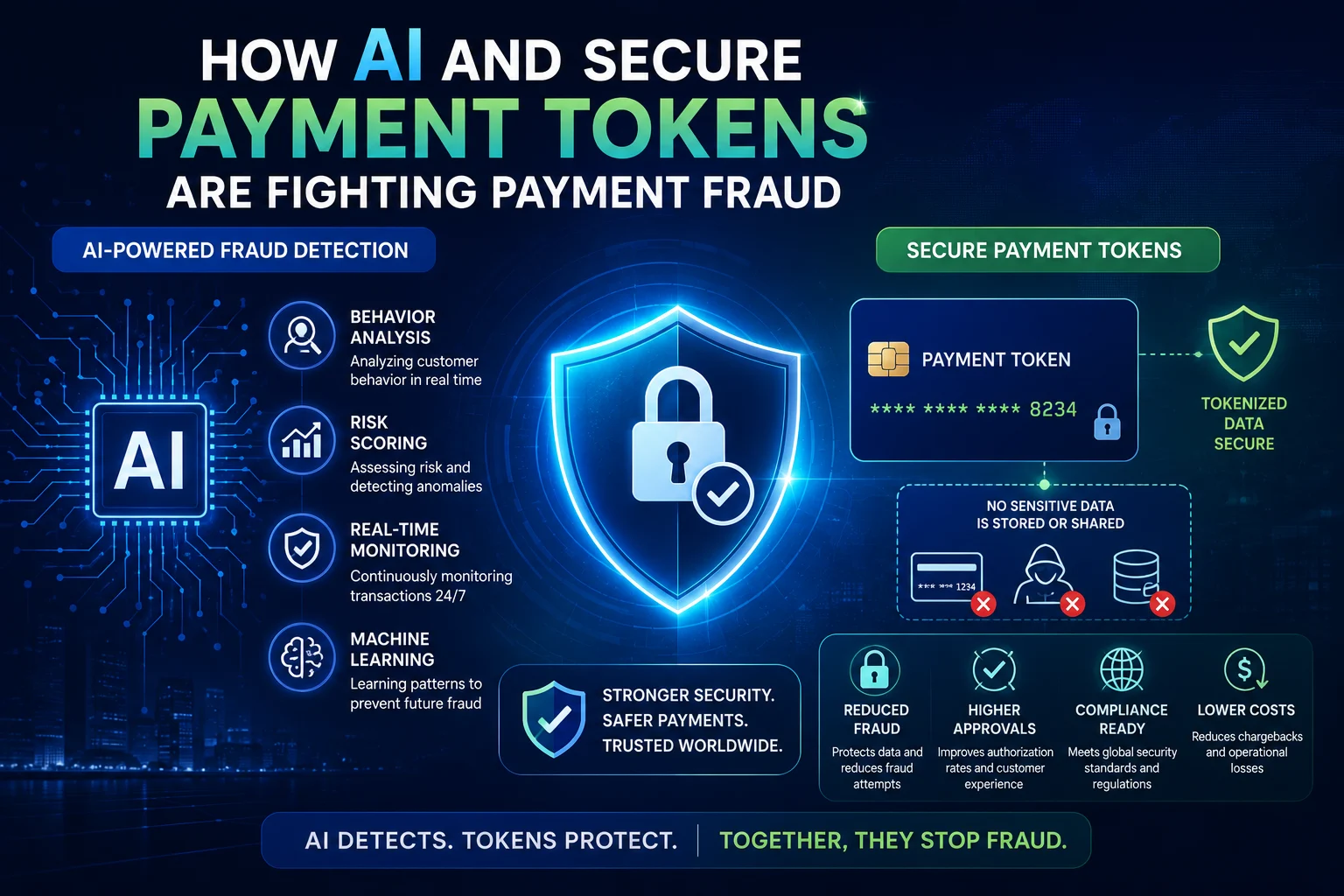
Traditional fraud prevention relied on fixed rules: flag transactions over a certain amount, block certain countries, require extra verification past a threshold. Modern AI-driven systems replace that with behavioral modeling, analyzing transaction patterns, device fingerprints, and spending history in real time, then scoring each transaction’s risk within milliseconds. The reported results are substantial: modern AI transaction monitoring systems reportedly identify fraudulent behavior with over 95% precision while cutting false positives by up to 80% compared to rules-based systems, and industry estimates put real-time interception of fraudulent transactions at around 92% before completion.
2. Speed that manual review simply can’t match
The practical user-facing problem AI fraud detection solves is a genuine tradeoff merchants have lived with for years: catching fraud usually meant slowing down or declining legitimate customers too. AI-driven systems narrow that tradeoff considerably, processing thousands of alerts per second, analyzing millions of transactions in parallel rather than in a review queue, and cutting investigation time by more than 80% compared to legacy manual processes that could take days or weeks to resolve a single case. For a customer trying to check out, that’s the difference between a smooth payment processing experience and an unnecessary decline on a legitimate purchase.
3. Institutional adoption is real, but uneven
The data here tells an honest, mixed story rather than a uniform success narrative:
- Over 82% of financial institutions now use machine learning for fraud detection, and organizations that have implemented advanced AI monitoring reportedly saw a 38% reduction in fraud-related losses.
- E-commerce platforms report a 55% drop in payment fraud after AI adoption, according to industry-compiled figures.
- Yet a separate 2026 survey from the Association for Financial Professionals found that just 17% of US organizations actually leverage AI to combat payments fraud, even though 76% experienced attempted or actual payments fraud in 2025, a clear gap between the technology’s proven effectiveness and how widely it’s actually deployed, often due to cost concerns and perceived technology immaturity rather than doubts about whether it works.
4. Tokenization is AI’s structural partner, not a competing solution
AI detection and network tokenization solve different halves of the same problem, and the strongest high-risk payment gateway and merchant services setups increasingly deploy both together rather than choosing one. Tokenization removes the raw card number from circulation entirely, so even a successful phishing or data-breach attack yields credentials that are useless outside their specific context, a structural fix. AI detection, by contrast, catches the behavioral anomalies, the login from an unusual device, the spending pattern that doesn’t match a customer’s history, that tokenization alone can’t address, because a legitimate token used by an illegitimate person still looks valid on paper. Together, they cover both the “stolen credential” attack vector and the “impersonation and social engineering” vector that’s growing fastest.
The User-Facing Problem, and How It Actually Gets Solved
For everyday cardholders and merchants alike, the practical pain point isn’t abstract, it’s the moment a legitimate transaction gets declined, or worse, a fraudulent one goes through undetected. Both failure modes erode trust in digital payments broadly:
- If your problem is: “too many legitimate customers get falsely declined,” AI-driven behavioral scoring directly targets that, since it reduces false positives far more effectively than static rule sets ever could.
- If your problem is: “fraud is slipping through because static rules can’t keep up with new attack patterns,” real-time AI scoring closes that gap by adapting to emerging patterns rather than waiting for a human to update a rulebook.
- If your problem is: “we’re liable for stored card data and worried about a breach,” network tokenization removes much of that liability by design, regardless of how good your fraud-scoring model is.
None of these fixes is a silver bullet on its own, which is precisely why the strongest payment gateways in 2026 are layering AI detection, tokenization, and traditional verification (3D Secure, biometrics) rather than betting everything on one method.
Where the Investment Priorities Are Heading
The data on where financial institutions are actually putting their budgets in 2026 tells its own story about how seriously the industry is taking this shift:
- AI and fraud mitigation are now tied as the top technology spending priorities for banks in 2026, reflecting sustained pressure from both the threat and the demonstrated returns of getting defense right.
- 78% of enterprises plan to increase investment in AI fraud prevention, and over 60% of organizations that have already adopted it report measurable ROI within the first year, largely through reduced investigation time and fewer chargeback losses.
- 63% of merchants are exploring or planning to implement agentic AI, specifically within payments and fraud prevention workflows, suggesting the next wave of adoption is already being planned rather than merely discussed.
- On the flip side, 43% of merchants already accept real-time payments, which tightens the detection window for banks and payment service providers considerably, fraud has to be caught in seconds, not the hours or days legacy systems assumed.
That combination, rising real-time payment volume plus rising AI investment, is precisely why so many payment gateways are racing to modernize simultaneously. The faster money moves, the less room there is for manual review, and the more the entire fraud-prevention burden shifts onto automated systems making decisions in milliseconds.
The Counterpoint
The steelman case against over-trusting AI fraud defense: the same TransUnion research showing fraud growth also shows one in six US consumers lost money to digital fraud in the past year, with a median loss of over $2,300, a sign that, in aggregate, defenses aren’t yet outpacing the threat despite genuinely impressive detection statistics. AI fraud detection tools reportedly flag 85% to 93% of deepfake attempts, which sounds strong until you consider that means 7% to 15% get through, and at the scale of billions of transactions, that residual gap still represents enormous absolute losses. A skeptic could reasonably argue that publishing “95% precision” and “92% real-time interception” statistics creates false confidence, when the attacker side is innovating just as fast, if not faster, using the same underlying AI capabilities.
That’s a fair challenge, and it’s worth taking seriously rather than treating fraud statistics as a victory lap. But the counterpoint doesn’t invalidate the defensive gains, it argues for realistic expectations rather than none at all. The honest conclusion is that AI-driven defense measurably outperforms the manual, rules-based systems it’s replacing, even while the absolute fraud numbers keep climbing because the volume and sophistication of attacks are also climbing. Better defense against a faster-growing threat can still mean rising losses in aggregate; that’s not evidence the defense isn’t working, it’s evidence the threat is growing even faster than the (genuinely improving) countermeasures.
Comparison: Traditional Rules-Based Fraud Detection vs. AI-Driven Detection
| Dimension | Rules-Based Detection | AI-Driven Detection |
|---|---|---|
| Decision speed | Manual review can take hours to days | Real-time, millisecond-level scoring |
| False positive rate | Higher, static thresholds flag many legitimate transactions | Reduced by up to 80% in reported industry data |
| Adaptability | Requires manual rule updates | Learns from evolving transaction and fraud patterns |
| Deepfake/social engineering detection | Largely ineffective | Flags 85-93% of deepfake attempts, per industry estimates |
| Institutional adoption (2026) | Still the default at many smaller firms | Used by 82%+ of financial institutions, but only 17% of US firms for payments specifically |
| Best paired with | Basic transaction limits | Network tokenization, biometric/3DS verification |
Practical Takeaway
If you’re a merchant relying primarily on static fraud rules, the data makes a clear case for layering in AI-driven detection, not as a replacement for tokenization and standard verification, but alongside them, since each addresses a different failure mode. If you’re a payment provider advising merchants on merchant accounts or cross-border payments infrastructure, the adoption gap is worth flagging directly: AI fraud defense works, based on the available data, but only 17% of US organizations are actually using it for payments specifically, which means a large share of the market is still exposed to attack patterns their defenses were never designed to catch.
Open question worth sitting with: as generative AI keeps lowering the cost of running convincing scams at scale, does the fraud arms race settle into a rough equilibrium where AI-driven defense keeps pace with AI-driven attacks, or does the gap between well-resourced payment providers who can afford advanced AI detection and smaller merchants who can’t widen into a two-tier fraud-exposure landscape over the next few years?
Comments
No comments yet. Be the first to share your thoughts.
Leave a comment