
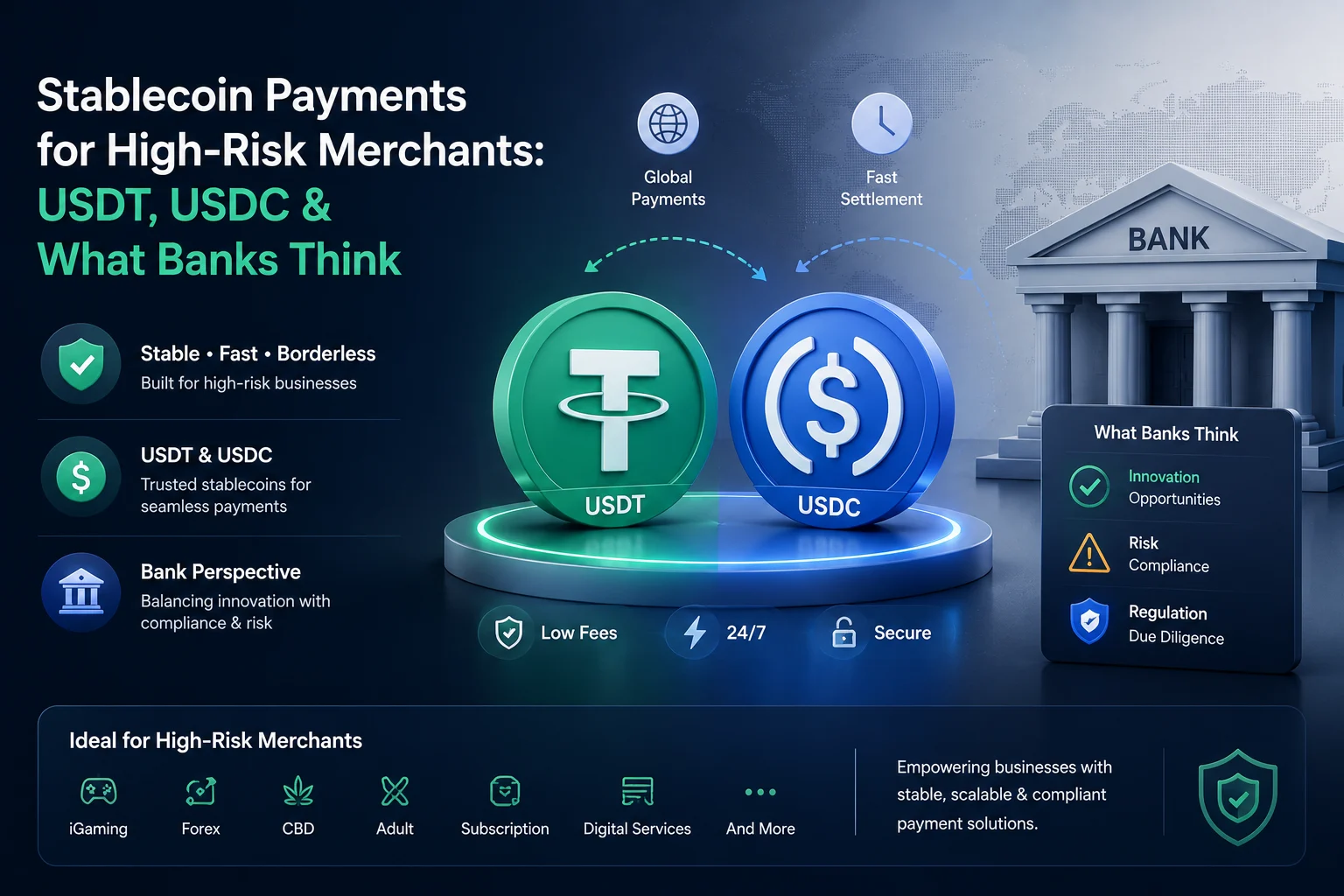
Why High-Risk Merchants Are Turning to Stable-coins
If you operate a business in a high-risk vertical, adult content, online gaming, nutraceuticals, forex, CBD, travel, or crypto-adjacent services, you already know the frustration. Card processors terminate accounts. Banks ask uncomfortable questions. Rolling reserves tie up cash flow. Chargebacks arrive without warning.
Stable-coin payments are emerging as a structural solution to these problems, not a workaround, but a genuinely different payment architecture that addresses the root causes of merchant account instability.
Unlike Bitcoin or Ethereum, stable-coins, most prominently USDT (Tether) and USDC (USD Coin), are pegged to fiat currencies, eliminating volatility risk while retaining the transaction finality, borderless reach, and chargeback-resistance that make crypto payments attractive to merchants. In 2026, stable-coin payment volume has crossed into territory that banks, card schemes, and regulators can no longer ignore.
This guide explains how stable-coin payments work for high-risk merchants, what USDT and USDC offer in practice, and what traditional banks and payment processors actually think about the shift.
Key Takeaways
Everything that matters, in under 60 seconds.
- Stable-coins are pegged to fiat: USDT and USDC maintain a 1:1 peg with USD, eliminating the volatility problem that makes Bitcoin impractical for everyday merchant payments.
- High-risk merchants face systematic banking restrictions: stable-coin payments offer a compliant path to transaction finality without relying on card networks that can terminate accounts overnight.
- No chargebacks on stable-coin transactions: blockchain transactions are irreversible by design; dispute resolution is handled at the platform level, not through card scheme chargeback mechanisms.
- Banks are cautious but increasingly engaged: major banks in the US, UK, and EU are developing stable-coin strategies, but most retail acquiring banks still restrict stable-coin-related merchant activity.
- USDC is generally preferred for regulated compliance: Circle’s regulatory posture and licensing profile make USDC more acceptable to compliance-focused processors than USDT.
- A hybrid approach works best: maintaining a specialist high-risk merchant account for fiat card payments alongside a stable-coin payment gateway provides full market coverage without single-point-of-failure risk.
- Compliance still applies: AML, KYC, and Travel Rule obligations apply to stable-coin transactions in most jurisdictions; compliance infrastructure is non-negotiable.
What Are Stable-coins and Why Do They Matter for Merchants?
A stable-coin is a cryptocurrency whose value is pegged to a reference asset, most commonly the US dollar, through one of three mechanisms:
- Fiat-backed stable-coins: (USDT, USDC): each token is backed by USD reserves held by a custodian. 1 USDT = $1 USD.
- Algorithmic stable-coins: (historically: UST, now largely discredited after the Terra collapse): peg maintained through algorithmic supply mechanisms. Unsuitable for merchant use.
- Crypto-collateralised stable-coins: (DAI): backed by over-collateralised crypto assets. More decentralised but subject to collateral volatility events.
For high-risk merchants, fiat-backed stable-coins, overwhelmingly USDT and USDC, are the relevant category. They combine the programmability and transaction finality of blockchain with the price stability required to price products in dollars, euros, or pounds without currency risk.
USDT vs USDC: Which Stable-coin Is Better for High-Risk Merchants?
The two dominant stable-coins have meaningfully different risk profiles from a merchant perspective.
USDT (Tether)
USDT is the largest stable-coin by market cap and daily transaction volume. For merchants, this means:
- Highest liquidity: across the widest range of exchanges, wallets, and OTC desks
- Broadest geographic reach: USDT is widely used in LATAM, Southeast Asia, Eastern Europe, and markets where USD access is restricted
- Multi-chain availability: USDT operates on Ethereum (ERC-20), Tron (TRC-20), Solana, Polygon, and other networks, providing settlement flexibility
The primary concern with USDT is reserve transparency. Tether has faced sustained scrutiny from regulators, including a 2021 CFTC settlement, over the composition of its reserves. For compliance-conscious merchants and their payment processors, this creates a degree of counterparty risk that must be evaluated.
USDC (USD Coin)
USDC is issued by Circle and governed through the Centre Consortium. It has positioned itself as the compliance-forward stable-coin:
- Monthly reserve attestations: by a Big Four accounting firm provide greater transparency than USDT
- Regulatory licensing: Circle holds money transmitter licences across US states and is actively pursuing EU e-money institution authorisation under MiCA
- Institutional preference: major US banks, custodians, and regulated payment processors favour USDC when engaging with stablecoin payment infrastructure
- Freeze capability: Circle can freeze USDC addresses at the request of law enforcement; a compliance feature that makes it more palatable to regulators and banking partners
For most high-risk merchants operating in regulated jurisdictions (US, UK, EU, Canada), USDC offers the stronger compliance profile. USDT offers superior liquidity and reach in LATAM and emerging markets where regulatory scrutiny of stable-coin reserves is lower.
How Stable-coin Payments Solve Core High-Risk Merchant Problems
Problem 1: Chargeback Exposure
Chargebacks are the primary reason high-risk merchant accounts face instability. Card scheme rules allow customers to dispute transactions up to 120 days after purchase, and in digital goods categories, fraud-related disputes are common.
Stablecoin transactions are irreversible at the blockchain level. Once a USDT or USDC payment is confirmed on-chain, it cannot be reversed by a card issuer or payment network. Dispute resolution becomes a platform-level function, refund policies enforced by the merchant, not chargeback mechanisms enforced by Visa or Mastercard.
This structurally eliminates the chargeback ratio problem that destabilises high-risk merchant accounts, removing the metric that most commonly triggers account reviews and terminations.
Problem 2: Account Termination Risk
A high-risk merchant processing card payments lives under constant threat of account termination, triggered by chargeback thresholds, regulatory news cycles, processor policy changes, or acquiring bank risk reviews.
Stable-coin payment processing removes the acquiring bank entirely from the transaction flow. The merchant accepts payment directly to a wallet address, on-chain, with no intermediary who can unilaterally suspend access. Settlement is automatic and custody can be self-managed or handled through a regulated custodian.
Problem 3: Cross-Border Payment Friction
High-risk merchants often serve global audiences but face significant friction in cross-border payment processing, currency conversion costs, card decline rates in certain regions, and local payment method complexity.
USDT and USDC settle globally in minutes, across borders, without currency conversion costs. A buyer in Brazil sends USDC in the same transaction flow as a buyer in Canada or the UK. For merchants targeting LATAM markets specifically, where USD access is restricted and local card rails are expensive, stable-coin payments offer materially better economics than fiat card processing.
Problem 4: Rolling Reserve Cash Flow Impact
Most high-risk merchant account providers require a rolling reserve, typically 5–10% of monthly processed volume held for 90–180 days. For a merchant processing $500,000 monthly, this means $25,000–$50,000 in capital is perpetually inaccessible.
Stable-coin settlement is immediate. There is no acquiring bank holding reserves, no rolling hold period, no float captured by intermediaries. Settlement to the merchant wallet is final at transaction confirmation.
What Banks Actually Think About Stable-coin Payments
The banking sector’s relationship with stable-coins in 2026 is best described as structured caution moving toward selective engagement.
Major Banks Are Building, Not Blocking
Several global financial institutions, JPMorgan (JPM Coin), Société Générale (EUR CoinVertible), and Standard Chartered, have launched or are piloting proprietary stable-coin infrastructure for institutional settlement. The US Federal Reserve’s work on real-time payment infrastructure and the Bank of England’s digital pound research are both directly influenced by stable-coin adoption pressure.
At the institutional level, banks understand that stable-coins are not going away.
Retail Acquiring Banks Remain Restrictive
The banks that underwrite merchant accounts, the acquiring banks behind payment processors, take a much more cautious posture. For retail acquiring banks, stable-coin-related merchants represent:
- Regulatory uncertainty: evolving FinCEN, FCA, and MiCA guidance creates compliance ambiguity that conservative banks avoid
- AML exposure: stable-coin transactions require blockchain analytics and wallet screening tools that most retail banks have not yet deployed
- Reputational risk: association with high-risk verticals, even through compliant stable-coin infrastructure, creates exposure that bank compliance teams flag
The practical outcome: most domestic acquiring banks will not directly process card payments for merchants whose primary business model is stable-coin-based. High-risk merchants using stable-coins still need specialist high-risk merchant account providers for their fiat card processing rail, the stable-coin rail operates in parallel, not as a substitute for all payment types.
Offshore Processors Are More Stable-coin-Friendly
Offshore merchant account: providers, particularly those in Malta, Cyprus, Seychelles, and Cayman Islands jurisdictions, have developed more sophisticated underwriting frameworks for crypto-adjacent and stable-coin-accepting merchants. These processors understand the risk profile, have appropriate AML tooling, and are not subject to the same regulatory conservatism as domestic US or UK acquiring banks.
Compliance Requirements for Stable-coin Payment Acceptance
Accepting stable-coin payments does not eliminate compliance obligations, it changes their character.
KYC at the Point of Payment
In jurisdictions where the merchant qualifies as a Virtual Asset Service Provider (VASP), KYC verification of the payer may be required at defined thresholds. At minimum: wallet screening against OFAC, HMT, and EU sanctions lists at the point of transaction. Chainalysis, Elliptic, and TRM Labs provide real-time blockchain analytics APIs for this purpose.
Travel Rule for USDT/USDC Transfers
Stable-coin transfers above threshold (USD $3,000 in the US; EUR €1,000 in the EU; equivalent in UK and Canada) between VASPs require Travel Rule data transmission, sender and receiver identity information accompanying the transaction.
Tax and Accounting Treatment
In the US, UK, Canada, and EU, stable-coin receipts are taxable events. USDT and USDC received as payment are treated as property (US), exchange tokens (UK), or digital assets (EU) for tax purposes. Proper invoicing, transaction records, and accounting system integration are required.
AML Programme Coverage
Any merchant accepting stable-coin payments as a material revenue channel should ensure their AML programme explicitly covers virtual asset receipt, including on-chain transaction monitoring rules.
Stable-coin vs Card Payments: Side-by-Side Comparison
| Feature | Stable-coin (USDT/USDC) | Card (High-Risk Merchant Account) |
|---|---|---|
| Chargeback risk | None – transactions are final | High – up to 120-day dispute window |
| Account termination risk | None – no intermediary | Moderate to high in high-risk verticals |
| Settlement speed | Minutes (on-chain confirmation) | 1–3 business days |
| Rolling reserve | None | 5–10% for 90–180 days |
| Cross-border fees | Minimal (network gas fees only) | 1.5–3.5% FX + cross-border surcharges |
| Buyer familiarity | Growing but still niche | Universal |
| Compliance complexity | Moderate (blockchain AML tools needed) | Moderate (PCI DSS, card scheme rules) |
| LATAM market reach | Excellent (USDT widely used) | Variable (high decline rates in some markets) |
Frequently Asked Questions (FAQ)
Q1: Can I accept USDT and USDC payments without a crypto licence? In most jurisdictions, accepting stable-coin payments in exchange for goods or services does not automatically trigger VASP licensing requirements. However, if you are converting stable-coin to fiat, offering exchange services, or holding stable-coin on behalf of customers, registration obligations may apply. Obtain jurisdiction-specific legal advice before launching.
Q2: What is the difference between USDT on ERC-20 vs TRC-20 for merchants? ERC-20 (Ethereum network) USDT carries higher gas fees but benefits from the broadest wallet and DeFi ecosystem compatibility. TRC-20 (Tron network) USDT has much lower transaction fees and is widely used in LATAM and Asia. Most payment gateways support both; choose based on your customer base’s dominant wallet infrastructure.
Q3: Are stable-coin payments subject to chargebacks? No. Blockchain transactions are irreversible, there is no card network intermediary to initiate a chargeback. Disputes are handled through the merchant’s own refund policy. This is one of the primary reasons high-risk merchants favour stable-coin payment processing.
Q4: Do I still need a high-risk merchant account if I accept stable-coins? Yes, for the majority of merchants. Most consumers still pay with cards. Stable-coin payments serve a growing but still minority segment of buyers. Maintaining a specialist high-risk merchant account alongside a stable-coin gateway provides full-spectrum payment coverage.
Q5: How do I convert USDC payments to USD or GBP? Most crypto payment gateways offer automatic fiat conversion at the point of settlement, the gateway accepts USDC from the buyer and deposits the equivalent fiat (minus fees) to your bank account. OTC desks at regulated exchanges also provide institutional conversion for higher volumes.
Q6: Which is more compliant for UK and EU merchants – USDT or USDC? USDC is generally preferred by compliance-focused processors and banking partners in the UK and EU, due to Circle’s regulatory licensing profile, reserve transparency, and active engagement with FCA and MiCA frameworks.
Final Thoughts: Stable-coins as Strategic Infrastructure for High-Risk Merchants
Stable-coin payments are not a fringe concept for high-risk merchants in 2026, they are a mature, deployable payment rail that solves real operational problems that card-based merchant services cannot.
The merchants who adopt stable-coin payment infrastructure strategically, running it in parallel with a specialist high-risk merchant account, implementing proper AML and KYC tooling, and choosing the right gateway for their geographic market, are building genuinely more resilient payment operations than those who rely exclusively on card processing.
Banks remain cautious. Card schemes remain restrictive. But the infrastructure for compliant, scalable stable-coin payment processing is established and operational. The question for high-risk merchants is no longer whether to add this capability, it’s when.
Compare specialist stable-coin payment gateways and high-risk merchant account providers on TheFinRate, the payments industry’s trusted directory for compliant payment infrastructure.
Comments
No comments yet. Be the first to share your thoughts.
Leave a comment