
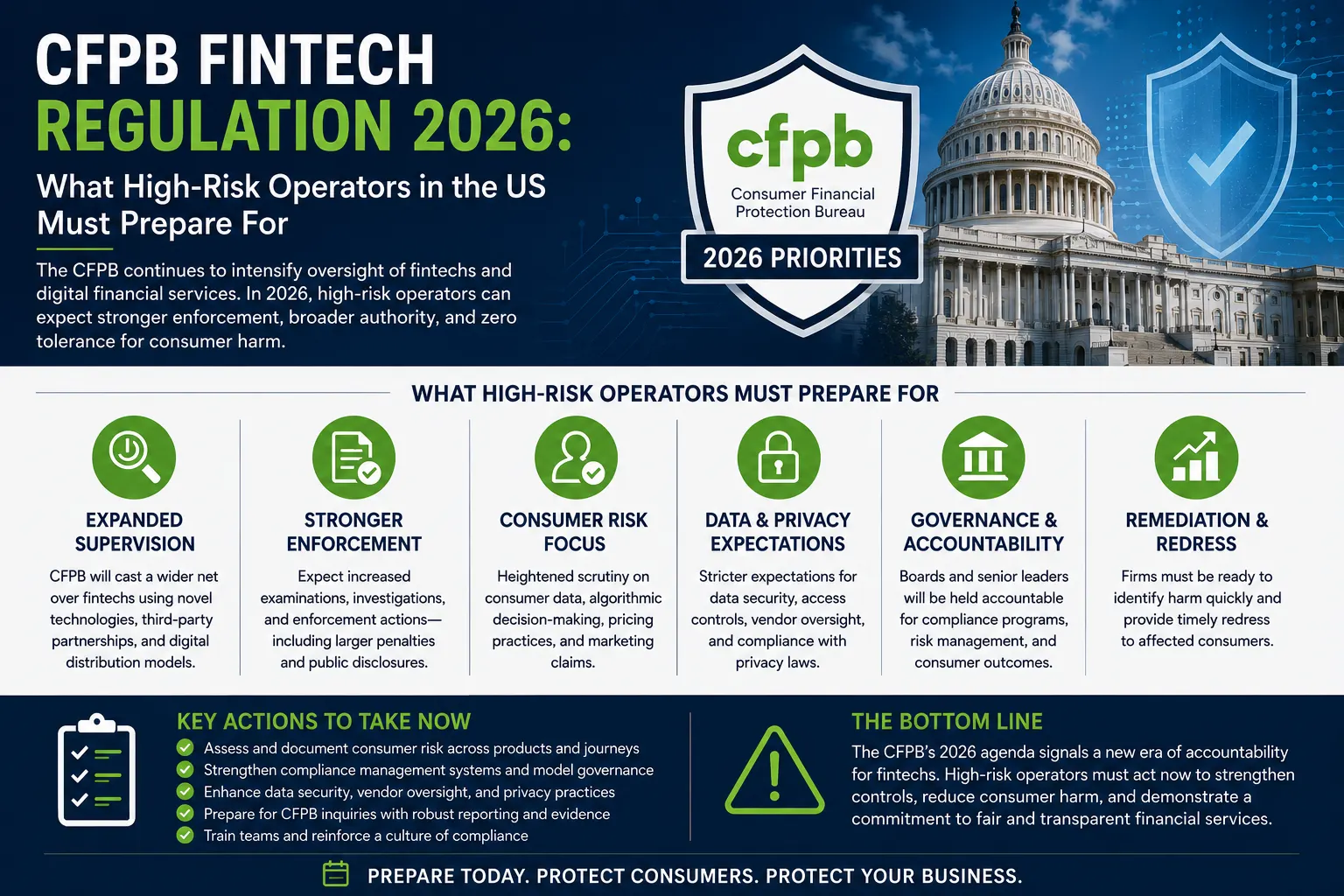
The story most high-risk payment operators expect to hear about the CFPB in 2025 and 2026 is one of expanding federal oversight. The actual story is closer to the opposite, and that reversal creates its own distinct compliance challenge. Since the change in presidential administration in early 2025, the CFPB has rescinded guidance, dropped enforcement priorities, and seen a key digital payments rule repealed by Congress, while state attorneys general and state-level regulators have moved aggressively to fill the resulting gap. For high-risk merchants and payment providers operating in the US, this guide explains what has actually changed, what remains in force, and what genuinely needs preparation.
TL;DR
- The CFPB’s “larger participant” rule for digital payment apps, which would have brought nonbank wallet and payment companies under direct CFPB supervision, was repealed by Congress under the Congressional Review Act in 2025
- The CFPB has withdrawn multiple advisory opinions and interpretive rules since the 2025 administration change, and announced it will not prioritize enforcement of several previously finalized rules
- State attorneys general have stepped into the federal enforcement gap, with 2025 marking the most active year of state-level consumer finance enforcement on record
- California’s new Business and Consumer Services Agency (BCSA), launching July 1, 2026 under former CFPB Director Rohit Chopra, is positioned as a de facto state-level CFPB
- The CFPB’s Open Banking rule (Personal Financial Data Rights) remains in force, with compliance required by April 1, 2026 for the largest institutions
- UDAAP enforcement, unfair, deceptive, or abusive acts and practices, remains the core legal framework that high-risk payment operators must comply with, regardless of which level of government is doing the enforcing
The CFPB in 2025-2026: Retrenchment, Not Expansion
High-risk payment operators planning their 2026 compliance strategy around an aggressively expanding CFPB are working from an outdated assumption. Since the change in administration that took effect in early 2025, the CFPB has materially scaled back its rulemaking and enforcement posture, a shift documented across multiple legal and regulatory tracking sources covering the agency’s activity through early 2026.
Congress repealed the CFPB’s rule defining “larger participants” in the market for consumer-use digital payment applications through the Congressional Review Act in 2025. That rule would have brought nonbank digital wallet and payment app providers, companies that many high-risk merchants depend on as payment gateways and payment providers, under direct CFPB supervisory examination. Its repeal means those companies currently fall outside the CFPB’s direct supervisory authority, at least for now, leaving a meaningful gap in federal oversight of the digital payment infrastructure layer that high-risk merchants rely on.
The CFPB also delayed and effectively declined to enforce its final rule on payday, vehicle title, and certain high-cost installment loans, announcing, two days before the original compliance deadline, that it would not prioritize enforcement or supervision actions related to the rule’s penalties. The Bureau has signalled intent to revisit the rule’s remaining provisions through new rulemaking, but no detailed timeline has been published. Separately, the CFPB and Department of Justice jointly withdrew prior guidance on the consideration of immigration status in credit decisions under the Equal Credit Opportunity Act.
This pattern, withdrawal of guidance, non-enforcement announcements, and a major rule repealed by Congress, represents the most significant rollback in CFPB regulatory activity in the agency’s history, and it directly affects how high-risk merchant services and payment processing relationships are federally supervised in 2026.
What Has NOT Changed: The Open Banking Rule and UDAAP
Not every CFPB initiative has been rolled back, and high-risk operators should not mistake the broader retrenchment for a wholesale absence of federal payments regulation.
The Personal Financial Data Rights Rule (Open Banking)
The CFPB’s “Open Banking” rule, finalized in late 2024 under the prior administration, remains in force. The rule requires covered financial institutions, credit card issuers, and digital wallet providers to give consumers and authorised third parties secure access to specified financial data without charge, establishing privacy and security protections that limit how third parties can use the data they receive.
Compliance is required by April 1, 2026 for the largest covered institutions, with later compliance dates phasing in for smaller entities. For high-risk payment providers and merchant services platforms that touch consumer financial account data, particularly those offering account aggregation, budgeting tools, or data-driven underwriting, this rule represents an active, non-negotiable federal compliance obligation that has continued forward even as other CFPB initiatives have been paused or reversed.
UDAAP: The Framework That Survives Every Administration Change
Unfair, Deceptive, or Abusive Acts or Practices (UDAAP) enforcement remains the foundational legal framework governing high-risk payment processing in the US, and it has not been weakened by the broader CFPB retrenchment. UDAAP applies regardless of which federal or state agency is doing the enforcing, the CFPB, the FTC, or individual state attorneys general can all bring UDAAP-adjacent actions under their respective authorities.
For high-risk merchants, this means fee disclosures, marketing claims, cancellation flows, and customer service practices remain subject to the same substantive legal standard they always have been, clear, accurate, and not misleading, even as the agency most associated with enforcing that standard has become less active at the federal level.
The Real Story: States Are Filling the Federal Gap
The most operationally significant development for high-risk operators in 2025–2026 is not what the CFPB stopped doing, it is what state regulators started doing in response. State attorneys general responded to the decline in CFPB enforcement by stepping into consumer finance regulation more aggressively than at any point on record, and legal trend analysis from late 2025 and early 2026 indicates this pattern is set to continue and likely intensify through the remainder of 2026.
California: A De Facto State-Level CFPB
California’s response has been the most structurally significant. On May 12, 2026, Governor Gavin Newsom announced the appointment of former CFPB Director Rohit Chopra to lead a newly created cabinet-level Business and Consumer Services Agency (BCSA), officially launching July 1, 2026. The BCSA consolidates licensing, regulatory, and enforcement authority across multiple consumer-facing sectors, including the Department of Financial Protection and Innovation (DFPI), which already holds binding authority over money transmitters, fintech enterprises, and digital asset service providers operating in or serving California.
Newsom framed the move explicitly as a response to federal retrenchment in consumer financial protection, and California’s DFPI was already moving independently before this reorganisation, enforcing UDAAP-equivalent prohibitions under the California Consumer Financial Protection Law against all DFPI-licensed entities effective January 1, 2026, and expanding into state-level digital asset and cryptocurrency licensing as of March 2026. Given California’s market size, the DFPI has historically operated as a de facto national regulator whose standards influence practice well beyond the state’s borders, a dynamic that high-risk merchants serving California customers, even from out-of-state operations, cannot reasonably ignore.
Other States Are Not Standing Still
California is the most visible example, but it is not isolated. State attorneys general nationally have been credited with “rebooting” investigations that the CFPB previously initiated but did not complete, alongside new enforcement priorities of their own, including crackdowns on financial exploitation of homeowners and continued scrutiny of high-cost lending and payment products. High-risk merchants operating across multiple US states should expect this fragmented, state-by-state enforcement landscape to be the operative compliance reality for the foreseeable future, rather than a temporary gap awaiting federal restoration.
What This Means for High-Risk Merchant Accounts and Payment Providers
The shift from a CFPB-centric to a state-centric enforcement model changes the practical compliance calculus for high-risk merchants in several concrete ways.
Multi-state compliance complexity has increased, not decreased.
A high-risk merchant that previously calibrated its compliance programme primarily against anticipated CFPB rules must now track an increasingly active and divergent set of state-level standards, DFPI in California, and an expanding set of state AG priorities elsewhere, each with its own enforcement posture and interpretive guidance.
Payment providers and merchant services platforms face renewed scrutiny from a different direction.
With the CFPB’s larger-participant rule for digital payment apps repealed, federal supervisory examination of nonbank payment providers has narrowed, but California’s DFPI explicitly licenses and supervises money transmitters and fintech enterprises, meaning payment providers serving high-risk merchants with California exposure remain under active state-level oversight regardless of the federal rollback.
UDAAP-based risk has not disappeared – it has been redistributed.
High-risk merchants whose marketing claims, refund policies, or fee disclosures would previously have drawn CFPB scrutiny should now expect equivalent or greater scrutiny from state regulators and attorneys general, particularly in California, New York, and other states with active consumer finance enforcement programmes.
Crypto and digital asset oversight is shifting toward the states.
California’s DFPI assuming state-level digital asset licensing authority in March 2026 signals that high-risk merchants using crypto payout infrastructure should monitor state-level crypto licensing requirements as closely as federal frameworks like the GENIUS Act, rather than assuming federal preemption covers the full compliance picture.
Pros and Cons of the Current US Regulatory Environment for High-Risk Merchants
Pros
- Reduced near-term federal supervisory examination risk for payment providers previously expected to fall under the CFPB’s larger-participant rule
- The Open Banking rule’s continued progress provides regulatory stability and predictability for data-sharing infrastructure that high-risk merchant services platforms increasingly depend on
- UDAAP’s consistency across administrations means merchants with genuinely compliant marketing and disclosure practices face no fundamental change in the substantive legal standard
- A more fragmented enforcement landscape can, in some cases, mean slower or less coordinated action against any single merchant compared to a unified federal approach
Cons
- State-by-state compliance fragmentation increases the operational and legal cost of maintaining a multi-state high-risk payment processing footprint
- California’s BCSA reorganisation under a former CFPB Director signals an aggressive, well-resourced enforcement posture that high-risk merchants with California exposure should not underestimate
- The withdrawal of CFPB guidance and advisory opinions removes interpretive clarity that merchants and payment providers previously relied on for compliance planning
- Crypto and digital asset licensing requirements are now diverging at the state level, adding complexity for high-risk merchants using crypto payout rails
- The federal regulatory gap may prove temporary, a future administration change could rapidly restore CFPB enforcement activity, meaning merchants who deprioritise federal compliance infrastructure now may face a difficult transition later
FAQ: CFPB Fintech Regulation for High-Risk Operators in 2025-2026
Has the CFPB stopped regulating high-risk payment processing entirely?
No – the CFPB continues to enforce UDAAP standards and is actively progressing the Open Banking rule. What has changed is the agency’s broader rulemaking and enforcement posture, including the repeal of the larger-participant rule for digital payment apps and reduced enforcement of several other initiatives. The CFPB has not been eliminated or stripped of its core authority.
Does California’s DFPI apply to merchants based outside California?
Yes, in many cases. The DFPI’s authority generally extends to entities serving California consumers, regardless of where the business is physically headquartered. High-risk merchants and payment providers with a meaningful California customer base should assess their DFPI exposure independent of their state of incorporation or operation.
What is the Open Banking rule’s compliance deadline for smaller payment providers?
The April 1, 2026 deadline applies to the largest covered institutions. Smaller institutions have later phased compliance dates under the rule’s tiered implementation schedule. Confirm your specific institution’s applicable deadline directly against the CFPB’s published compliance tiers.
Should high-risk merchants still worry about federal CFPB enforcement in 2026?
Yes, with appropriate proportion. While near-term federal enforcement intensity has declined, UDAAP remains fully in force, and federal regulatory posture has historically shifted significantly between presidential administrations. Maintaining genuinely compliant practices, rather than assuming a permanent reduction in oversight, is the lower-risk long-term strategy.
How does this regulatory shift affect crypto payout providers serving high-risk merchants? Crypto and digital asset licensing oversight is increasingly moving to the state level, with California’s DFPI assuming state-level digital asset licensing authority as of March 2026. High-risk merchants using crypto payout infrastructure should track state licensing requirements in every state where they have meaningful transaction volume, in addition to federal frameworks like the GENIUS Act.
Comments
No comments yet. Be the first to share your thoughts.
Leave a comment