
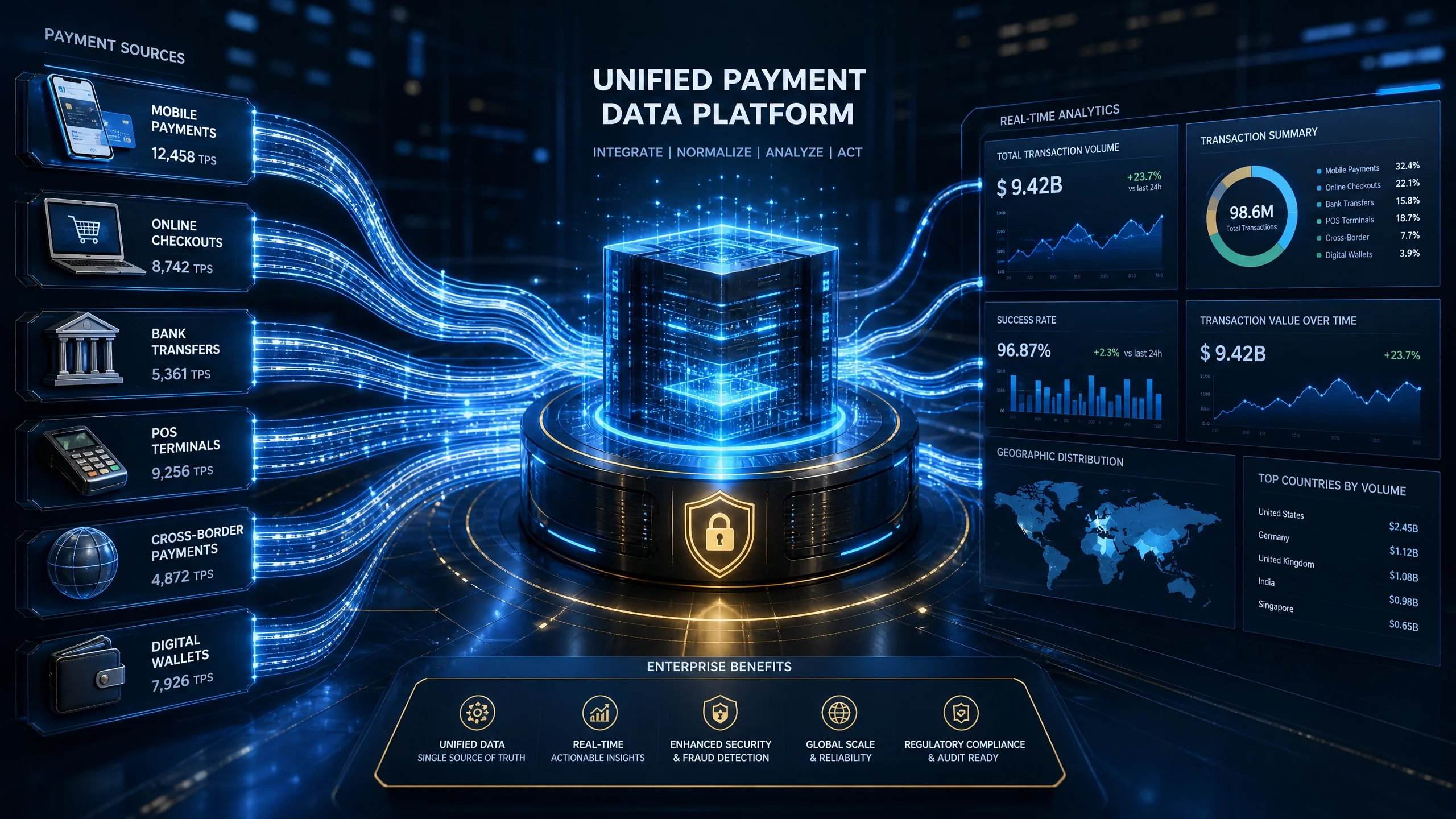
Most enterprise businesses don’t have a payment data problem because they lack data. They have one because their data lives in a dozen disconnected places, a gateway dashboard here, a processor report there, a spreadsheet stitching it all together. A payment data platform solves this by pulling every transaction, every currency, and every rail into one unified view, so finance and ops teams stop reconciling numbers and start acting on them.
TL;DR
Enterprise businesses running payments across multiple markets typically operate several payment gateways, payment providers, and settlement rails at once, and each one produces its own data format, reporting cadence, and currency logic. A payment data platform consolidates that fragmented data into a single source of truth, giving finance, treasury, and ops teams real-time visibility into transaction performance, reconciliation status, and cross-border settlement.
For travel companies specifically, this solves a distinct pain point: bookings, cancellations, and refunds flow through multiple merchant accounts and currencies, making manual reconciliation slow and error-prone during peak season. In 2026, the shift toward ISO 20022 data standards and stricter network data requirements makes this consolidation less optional and more foundational to how enterprise payments operate.
Why Payment Data Fragmentation Is an Enterprise-Wide Problem
Enterprise businesses rarely run on a single payment processing setup. A company selling in the US, UK, and EU might rely on one gateway for domestic cards, another for local payment methods, a separate acquirer for high-risk categories, and a handful of bank rails for settlement. Each of these systems reports data differently:
- Different transaction ID formats, making cross-referencing manual and slow
- Different settlement timing, so “today’s revenue” means something different depending on which system you’re checking
- Different currency handling, with some providers settling in local currency and others converting automatically
- Different levels of granularity, from full itemized transaction data to summarized daily batches
For a finance team, this fragmentation means hours spent every month just assembling a single accurate picture of revenue, fees, and disputes, before any actual analysis can begin.
What a Payment Data Platform Actually Does
A payment data platform sits above the individual gateways, processors, and banking rails a business uses, ingesting data from each and normalizing it into a consistent structure. In practice, this means:
- Unified transaction records: every payment, refund, and chargeback represented the same way regardless of which provider processed it
- Real-time reconciliation: automatically matching payments to orders, invoices, or bookings without manual spreadsheet work
- Cross-provider reporting: a single dashboard showing performance across every payment gateway and acquiring relationship
- Currency normalization: converting and presenting cross-border payments data in a consistent base currency for reporting, without losing the original transaction detail
- Centralized dispute and chargeback tracking: so fraud and dispute patterns are visible across the entire payment stack, not siloed by provider
This isn’t simply a bigger spreadsheet. The value comes from treating payment data as structured, queryable infrastructure rather than a collection of exports that someone has to manually stitch together.
The 2026 Shift: Why This Matters More Now
Several developments in 2026 are pushing payment data consolidation from a nice-to-have toward a operational requirement:
- ISO 20022 data mandates are tightening: As structured data requirements roll out across SWIFT and other rails, missing or incomplete data fields are increasingly triggering hard declines rather than soft failures, according to industry analysis from payments providers tracking the shift. Enterprises without clean, consolidated data are more exposed to this risk.
- Network-level rewards for data quality: Card networks are introducing incentives tied directly to data completeness, transactions with richer, more complete data fields qualify for better rates, while incomplete data increasingly costs money in lost authorizations.
- Interoperability is becoming the strategic differentiator: Enterprise payment teams are moving toward architecture that connects pay-ins and pay-outs through unified infrastructure, managing balances and reusing data across markets rather than treating each region as a separate system.
- AI-driven fraud and reconciliation tools need consolidated inputs: Fraud scoring and anomaly detection only work as well as the data feeding them. Fragmented, incomplete transaction data limits what even sophisticated fraud tools can catch.
The direction is consistent across the industry, payment data is shifting from a back-office reporting function to a strategic layer that affects approval rates, fraud detection, and compliance simultaneously.
Core Pain Points a Unified Platform Solves
1. Reconciliation Overload
Enterprises processing high transaction volumes across multiple merchant services providers often dedicate significant finance headcount purely to reconciliation, matching payments to orders, confirming settlement amounts, and chasing discrepancies. A unified payment data platform automates this matching, freeing finance teams to focus on analysis rather than data assembly.
2. Inconsistent Currency Reporting
Businesses accepting online payments and digital payments across multiple currencies often struggle to answer a simple question: what did we actually make this month, in one currency, across every market? Without normalization, this requires manual conversion and reconciliation across every provider’s individual reporting.
3. Disconnected Fraud and Dispute Visibility
When chargebacks and fraud alerts live inside separate payment gateways and processor dashboards, patterns that would be obvious in a unified view get missed. A spike in disputes tied to a specific product line or region is far easier to catch when all dispute data sits in one place.
4. Slow, Reactive Decision-Making
Without consolidated data, finance and ops teams are often working from numbers that are days old by the time they’re assembled. Real-time consolidation turns payment data into something leadership can act on immediately, rather than a monthly retrospective exercise.
The Travel Industry’s Specific Data Problem
Travel companies face a version of this problem that’s particularly acute. A single booking might involve a deposit charged months in advance, a balance payment closer to departure, a partial refund after an itinerary change, and a currency conversion if the customer paid internationally, often across more than one merchant account if the business operates a high-risk payment gateway relationship separate from its standard processing.
This creates specific friction:
- Booking-to-payment matching becomes complex: A single trip can generate multiple transactions across different dates and sometimes different processors, making it hard to see the full financial picture of one booking without manual work.
- Cancellation-driven chargebacks are hard to track in aggregate: Airlines’ schedule changes or weather disruptions can trigger dispute spikes that are difficult to spot early if dispute data isn’t consolidated across every payment provider in use.
- Seasonal volume spikes stress manual reconciliation processes: Peak booking season is exactly when finance teams have the least time to manually match payments across systems, and exactly when errors are most costly.
- Multi-currency bookings complicate revenue reporting: A travel company selling packages priced in GBP, EUR, and USD needs a single, accurate currency-normalized view of revenue, not three separate reports that have to be reconciled by hand.
A payment data platform addresses this directly by giving travel businesses one place to see every booking-related transaction, regardless of which payment gateway or currency processed it, alongside real-time dispute and refund tracking.
What to Look for When Building or Buying One
Enterprises evaluating a payment data platform, whether built in-house or sourced from a vendor, should prioritize:
- Broad provider connectivity: the platform needs to ingest data from every gateway, processor, and bank rail the business actually uses, not just the most common ones
- Real-time or near-real-time ingestion: daily batch reporting isn’t sufficient for businesses that need same-day visibility into cash position
- Structured, standardized data output: output that aligns with ISO 20022 principles positions the business well for the industry’s broader shift toward structured payment data
- Built-in reconciliation logic: automatic matching against orders, invoices, or bookings, not just raw transaction exports
- Dispute and chargeback aggregation: a single view of disputes across every provider, since fragmented visibility is one of the most common reasons fraud patterns go unnoticed
- Role-based access and reporting: finance, treasury, and ops teams often need different views of the same underlying data
Final Thoughts
A payment data platform isn’t just an efficiency upgrade, it’s becoming foundational infrastructure as card networks and messaging standards demand richer, cleaner data across every transaction. For enterprise businesses running multiple payment gateways, merchant accounts, and currencies at once, consolidating that data isn’t a reporting nicety; it directly affects approval rates, fraud detection, and how quickly finance teams can actually act on what’s happening in the business.
Travel companies stand to gain the most immediate benefit, given how naturally fragmented booking-related payment data already is. But the underlying case applies to any enterprise business managing cross-border payments, multiple payment wallets, and a growing list of payment providers: the businesses that treat payment data as unified infrastructure will out-execute the ones still reconciling it by hand.
FAQs
What is a payment data platform?
A payment data platform consolidates transaction data from multiple gateways, processors, and payment rails into a single, standardized system, giving businesses unified reporting, reconciliation, and dispute visibility.
Why do enterprise businesses need this instead of relying on individual provider dashboards?
Individual dashboards only show data from one provider at a time. Enterprises using multiple gateways and processors need a consolidated view to see true performance, cash position, and dispute trends across their entire payment stack.
How does this help with cross-border payments specifically?
A unified platform normalizes currency data across markets, so finance teams get one accurate, consolidated revenue picture instead of manually converting and combining reports from each regional provider.
Is this relevant for smaller businesses, or only large enterprises?
The core problem, fragmented data across providers, scales with transaction volume and provider count. Smaller businesses using a single processor may not need this yet, but any business running multiple payment relationships benefits from consolidation.
How does a payment data platform improve fraud detection?
Fraud and dispute patterns that span multiple providers are far easier to spot when all transaction and chargeback data lives in one place, rather than being siloed across separate dashboards.
Does this replace the need for individual payment gateways or processors?
No. A payment data platform sits above existing gateways and processors, consolidating their data rather than replacing the underlying payment infrastructure itself.
Why is 2026 a turning point for payment data consolidation?
Tightening ISO 20022 data mandates and network-level data quality incentives mean incomplete or fragmented payment data increasingly has direct financial consequences, from declined transactions to lost fee reductions.
Comments
No comments yet. Be the first to share your thoughts.
Leave a comment