
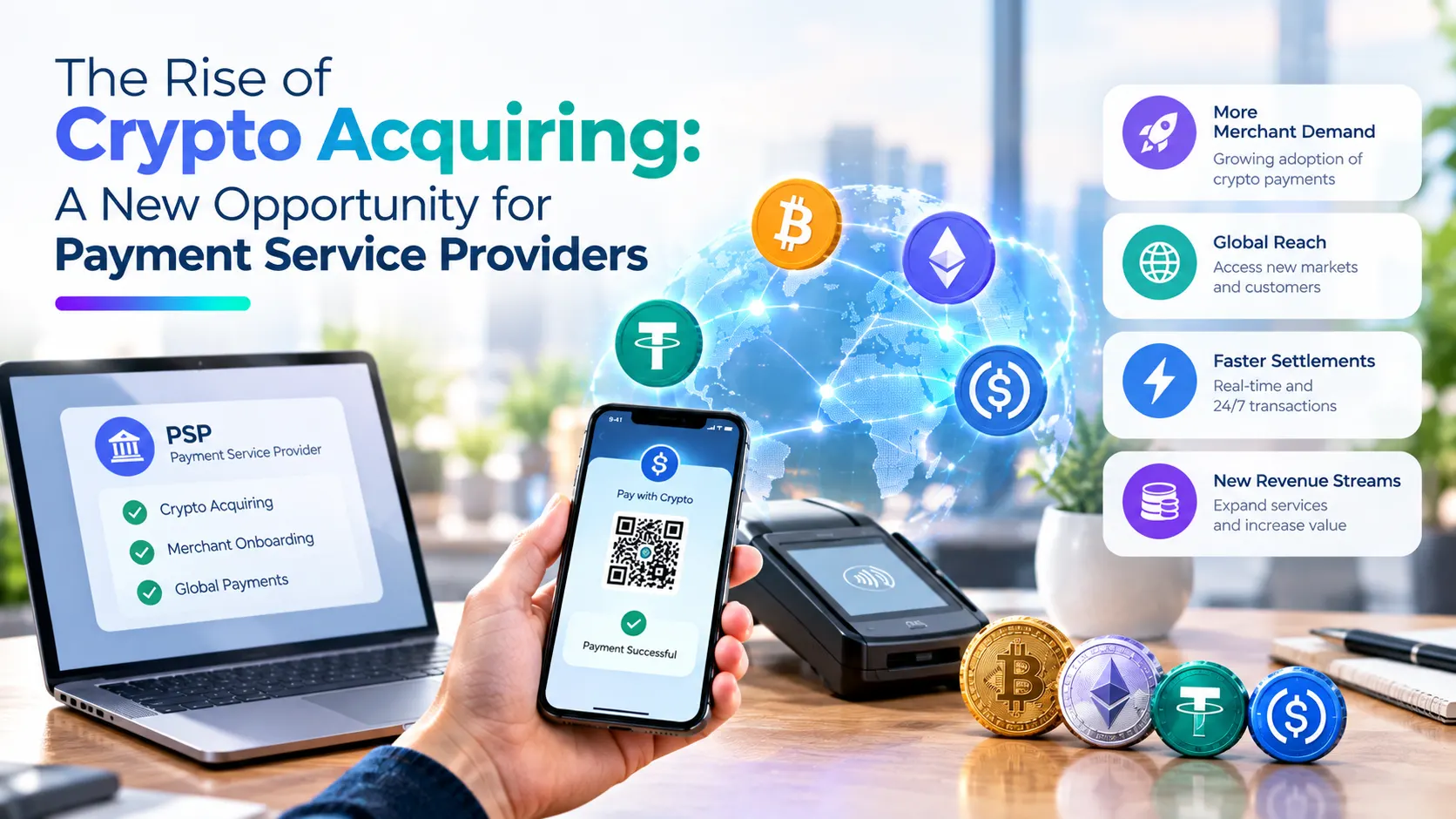
For most of crypto’s history, payment service providers treated it as a separate universe, something bolted on as a standalone product or ignored entirely. That’s changing fast, and it’s changing at the top of the industry, not the fringes.
According to TheFinRate research tracking payment provider offerings and public disclosures across the acquiring space, a growing share of PSPs are now folding crypto acceptance directly into their core acquiring stack rather than spinning up a separate “crypto payments” division. That shift in framing matters more than it sounds, it’s the difference between crypto being a side project and crypto being just another acquiring capability, sold and supported the same way card acceptance is.
PSPs are increasingly treating crypto and stablecoin acceptance as a standard acquiring capability rather than a separate product line. Stripe, Visa, and Mastercard have all made billion-dollar moves into stablecoin infrastructure in the past 18 months, and Worldpay, Checkout.com, Nuvei, and Fiserv are following with their own stablecoin rails. This mirrors how digital wallets and alternative payment methods were absorbed into mainstream acquiring a decade ago, and it’s opening a real competitive window for providers who move early.
From Standalone Product to Core Capability
The earlier generation of crypto payment tools were built and sold as separate from a merchant’s main payment stack. A business would run its normal card processor and, separately, a crypto payment gateway bolted on for the handful of transactions that needed it.
That model created friction on both sides. Merchants had to manage two systems, two reconciliation processes, and two support relationships. PSPs treating crypto as a side project had little incentive to integrate it deeply into onboarding, risk, or reporting.
Crypto acquiring flips this. Instead of a bolt-on tool, crypto acceptance becomes a checkbox during merchant onboarding, the same way accepting Amex or enabling recurring billing is a checkbox, not a separate contract.
The Scale of the Shift Happening Right Now
This isn’t a niche trend playing out at small crypto-native startups. It’s happening inside the largest payment companies in the world, backed by real money and production volume.
Stripe’s $1.1 billion acquisition of stablecoin infrastructure platform Bridge, completed in February 2025, was the clearest early signal. Within months, Stripe launched Stablecoin Financial Accounts, letting businesses in 101 countries hold dollar-backed stablecoin balances, receive funds on both crypto and fiat rails, and send stablecoins globally, deliberately designed so stablecoins stay invisible to the end customer. Stripe now charges a flat 1.5% for stablecoin payment acceptance across more than 70 countries, compared to 2.9% plus $0.30 for standard card transactions.
Visa’s stablecoin settlement moved from a 2021 pilot into full production. By April 2026, Visa had expanded USDC settlement to nine blockchains and reached a $7 billion annualized run rate, up 50% quarter-over-quarter, supporting more than 130 stablecoin-linked card programs across over 50 countries.
Mastercard made its largest stablecoin bet yet in March 2026, announcing a definitive agreement to acquire stablecoin infrastructure provider BVNK for up to $1.8 billion, giving it end-to-end stablecoin infrastructure across more than 130 countries. The same year, Mastercard opened settlement to six different stablecoins across eight blockchains. Worldpay, Checkout.com, Nuvei, and Fiserv are all building comparable stablecoin rails directly into their acquiring infrastructure.
The broader numbers make the scale clear: stablecoins settled over $27.6 trillion in total value in 2024 alone, with roughly $5 trillion of that tied directly to real-world payments like merchant payouts, remittances, and cross-border platform transactions rather than crypto-native trading.
Why PSPs Are Making This Move Now
A few forces are converging to make crypto acquiring a viable line item rather than an experiment.
Stablecoins removed the volatility objection: PSPs can offer crypto acceptance with instant fiat conversion, meaning merchants never have to think about price risk. That single change made crypto acceptance sellable to mainstream merchants, not just crypto-native ones.
Merchant demand is shifting from novelty to necessity: Cross-border merchants, in particular, are asking for crypto settlement specifically because of the FX and speed advantages, not because it’s trendy, that final settlement step, moving money from the acquiring bank to the merchant’s account, has run on the same one-to-two business day cycle for decades, and stablecoins are the first real challenger to that cycle.
Compliance tooling has matured: Travel Rule compliance, sanctions screening, and KYC integration for crypto flows are now available as embeddable services rather than custom-built infrastructure, lowering the barrier for PSPs to offer this without building a compliance team from scratch.
Competitive pressure is real: Once Stripe, Visa, Mastercard, Worldpay, and Fiserv are all offering stablecoin settlement as standard, smaller PSPs face direct pressure to match it or risk losing merchants who expect the option, even if they rarely use it.
What Crypto Acquiring Actually Looks Like in Practice
For a PSP, offering crypto acquiring as a core capability typically means:
- Crypto and stablecoin acceptance available at onboarding, alongside standard card and ACH options
- Automatic stablecoin-to-fiat conversion built into settlement, not a manual merchant task
- Unified reporting and reconciliation across crypto and traditional payment methods
- Compliance and risk screening applied consistently across all payment types, not siloed for crypto specifically
- Volatility shielding at the transaction level, either a short-window locked rate or immediate conversion at receipt, so merchants never carry price risk between commitment and settlement
This is a meaningfully different experience than the old model of a separate crypto gateway sitting awkwardly next to a merchant’s real payment stack.
The Opportunity for PSPs Willing to Move First
PSPs that treat crypto acquiring as core infrastructure now have a genuine differentiation angle, particularly for merchant segments where cross-border settlement or reduced chargeback exposure matters most, high-ticket e-commerce, B2B, digital services, and cross-border marketplaces.
There’s also a retention angle. Merchants juggling a separate crypto gateway alongside their main processor are prime candidates to consolidate with a PSP that offers both natively, that’s a switching opportunity for whoever gets there first with a genuinely integrated offering, before the market leaders like Stripe and Worldpay absorb that demand entirely.
What This Means for Merchants Evaluating PSPs
For merchants, this shift is worth watching when choosing a payment provider. A PSP offering crypto acceptance as a genuine, integrated acquiring feature, with unified reporting and real compliance backing, is a meaningfully different proposition than one offering it as an afterthought through a third-party plug-in.
The questions worth asking a PSP directly: Is crypto settlement unified with standard reporting, or a separate dashboard? Is compliance handled in-house, or outsourced with no visibility? Is volatility risk actually eliminated, or just assumed away? Those answers tend to reveal whether a provider treats crypto acquiring as real infrastructure or as a marketing checkbox.
The Bottom Line
Crypto acquiring is following a familiar pattern, the same one alternative payment methods and digital wallets went through a decade ago, moving from standalone novelty to standard acquiring feature. With Stripe, Visa, Mastercard, and the major acquirers now committing billions of dollars and production infrastructure to this shift, the PSPs recognizing it early aren’t chasing a crypto trend; they’re positioning themselves ahead of what merchants are already starting to expect as baseline.
Sources & Further Reading: Spark Money research on payment processor stablecoin integration; Cobo’s PSP stablecoin integration analysis; Nilson Report coverage of digital asset infrastructure for PSPs and acquirers; public disclosures from Stripe, Visa, and Mastercard.
Comments
No comments yet. Be the first to share your thoughts.
Leave a comment