
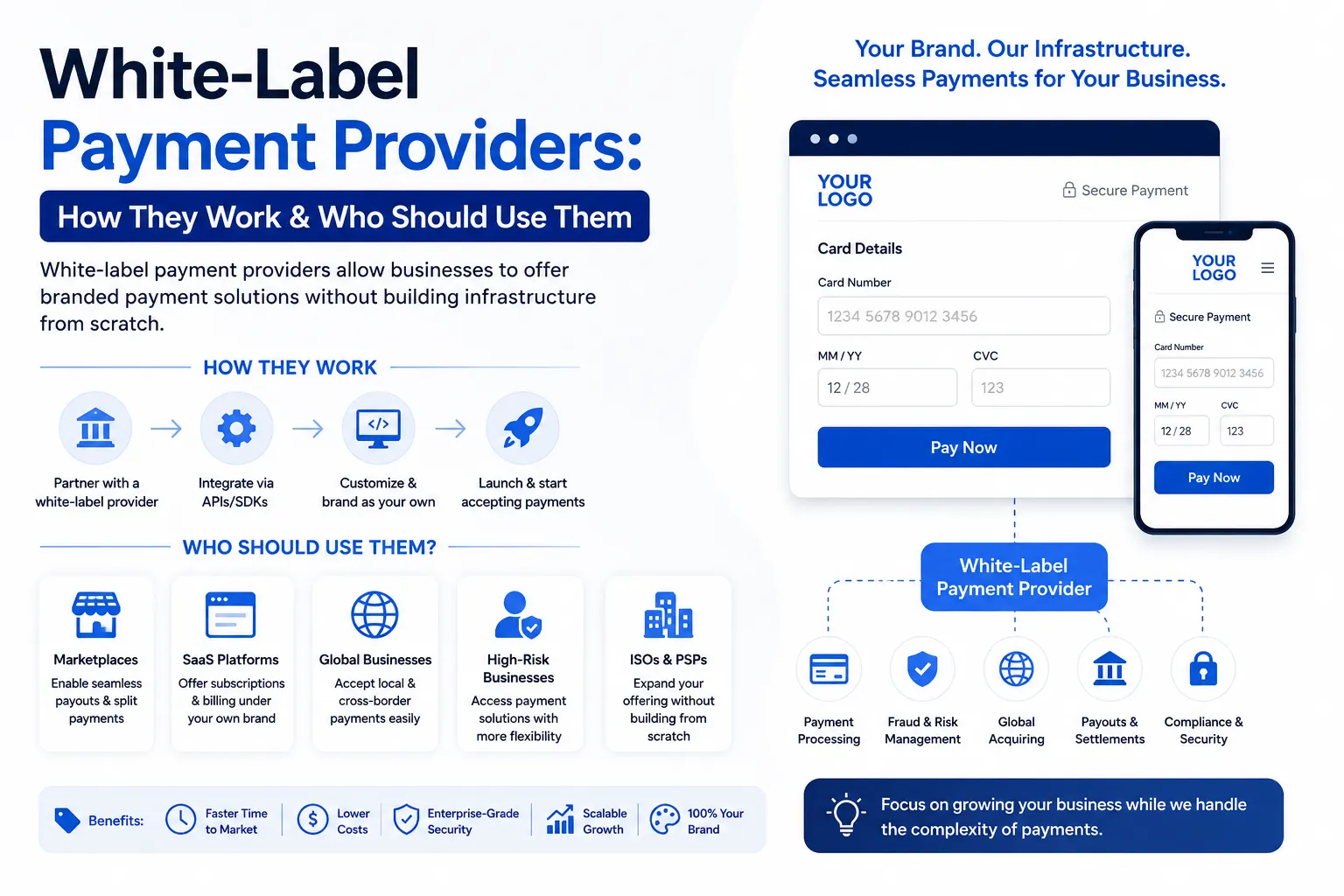
Building a payment gateway from the ground up, with PCI DSS certification, acquirer relationships, fraud prevention systems, and API infrastructure, typically costs millions of dollars and takes years before the first transaction processes. White-label payment providers exist to solve that problem. They supply the full payment processing stack; you put your brand on it.
TL;DR
- A white-label payment provider is a third-party infrastructure vendor whose payment gateway platform is licensed and rebranded by another business
- The global white-label payment gateway market is valued at approximately $3.02 billion in 2026, projected to reach $8.19 billion by 2035 (14.5% CAGR)
- Primary users are PSPs, ISOs, SaaS/ISV platforms, fintech startups, and marketplaces, not end merchants
- Key advantages: faster time to market (weeks vs years), lower capital outlay, full brand control, and built-in compliance
- High-risk merchant support varies significantly between providers, due diligence is essential
- Leading platforms in 2026 include Akurateco, IXOPAY, Corefy, DECTA, SDK.finance, and Nuvei
What Is a White-Label Payment Provider?
A white-label payment provider is a vendor that builds and maintains the core payment processing infrastructure, the payment gateway, merchant management portal, fraud tools, reporting dashboards, and API layer, and licenses that entire stack to another business to operate under its own brand.
From the merchant’s perspective, they’re interacting with your payment gateway. The underlying technology, compliance infrastructure, and acquiring relationships belong to the white-label vendor. This model is sometimes called a white-label PSP or a payment gateway reseller program, depending on how much of the stack is included.
How It Differs from a Standard Payment Gateway
When a business integrates Stripe or PayPal, it processes payments through someone else’s brand. With a white-label payment gateway, the operator, an ISO, a SaaS company, a fintech startup, deploys the same technology but presents it as its own branded payment product. The operator controls the merchant-facing portal, sets its own fees, manages onboarding, and owns the customer relationship entirely.
How White-Label Payment Processing Works
The transaction flow in a white-label environment follows the same fundamental path as any standard payment gateway, but a branded layer sits between the merchant and the underlying infrastructure:
- A customer initiates a payment on a merchant’s checkout page
- The card data is submitted to the white-label gateway operating under the operator’s brand
- The gateway tokenizes the card data and routes the authorization request to the acquiring bank or payment network connected to the vendor
- The acquirer or card scheme (Visa, Mastercard) approves or declines the transaction
- The response returns to the merchant within milliseconds
- Settlement occurs according to the merchant account configuration managed by the white-label operator
The white-label operator manages the merchant portal, onboarding workflows, fee configuration, and reporting. The infrastructure vendor handles PCI DSS compliance, platform uptime, fraud detection, and processor connectivity, often across hundreds of pre-integrated acquirers and alternative payment methods.
2026 Market Snapshot
The white-label payment gateway market is expanding rapidly and is now a structurally significant segment of the global payments industry.
The global white-label payment gateway market is valued at approximately $3.02 billion in 2026 and is projected to reach $8.19 billion by 2035, representing a 14.5% CAGR. Cross-referencing market estimates, a separate analysis puts the broader market at $5.4 billion in 2024 growing to $12.7 billion by 2033 at a 10.3% CAGR, reflecting differences in scope and methodology but confirming a consistent high-growth trajectory.
By application segment in 2025, Payment Service Providers (PSPs) account for approximately 50% of market revenue, followed by ISVs (Independent Software Vendors) at around 30%, and ISOs with other resellers at 20%. ISVs are the fastest-growing segment, projected to expand at over 18% CAGR, driven by the embedded finance push across vertical SaaS platforms.
Global non-cash payment volumes exceeded 1.6 trillion transactions by the end of 2025, underpinning the infrastructure demand that white-label payment providers are built to serve. Asia Pacific is the largest and fastest-growing regional market, led by eCommerce growth in China, India, Japan, and South Korea.
Who Uses White-Label Payment Providers?
White-label payment solutions are built for businesses that want to offer online payment processing or merchant services under their own brand, not for individual merchants managing their own sales.
PSPs and Financial Institutions
Payment Service Providers use white-label gateways to build or extend their processing infrastructure without developing every component internally. Banks and EMIs (Electronic Money Institutions) use white-label platforms to launch branded digital payment products, including payment wallets, multi-currency merchant accounts, and card issuing, without building the full technology stack from scratch.
Independent Sales Organizations (ISOs)
ISOs use white-label payment gateways to transform their merchant relationships. Instead of referring merchants to a third-party platform and losing the customer connection, ISOs deploy a branded gateway, portal, and dashboard under their own name. This model improves merchant retention, generates recurring revenue from transaction margins, and gives ISOs significantly more control over their merchant services business.
SaaS Platforms and ISVs
Software companies serving vertical industries, healthcare billing, hospitality, legal services, field operations, embed payment functionality directly into their platforms. A white-label payment gateway lets a SaaS company offer fully branded payment processing, invoicing, and subscription billing without acquiring a payment license or building compliance infrastructure. ISVs are the fastest-growing buyer segment in the market.
Fintech Startups and EMIs
Fintech startups launching cross-border payment platforms, digital payment wallets, or challenger banking products use white-label infrastructure to go to market in weeks rather than years. Building PCI DSS-certified payment processing from the ground up requires both a dedicated technical team and substantial capital investment. White-label vendors absorb that burden, letting fintech teams focus on product and distribution.
Marketplaces and Platforms
Marketplaces managing payments between buyers and multiple sellers, covering split payment flows, commission handling, seller merchant accounts, and currency conversion, use white-label gateways to manage those flows under a single branded experience rather than exposing third-party infrastructure to their users.
Key Features to Evaluate in 2026
Not all white-label payment providers deliver the same infrastructure depth. The strongest platforms share these characteristics:
- Smart routing and cascading: Intelligent transaction routing across multiple acquirers to maximize approval rates and reduce processing costs. Cascading retries failed transactions through alternative processors automatically.
- Multi-acquirer connectivity: Leading platforms offer 600–650+ pre-built integrations with banks, acquirers, and alternative payment methods. Akurateco lists 650+; Corefy 600+.
- PCI DSS Level 1 compliance: The highest certification level for payment processors. Verify current certification before committing to any vendor.
- Full brand control: Your domain, your checkout pages, your merchant portal, your API documentation. No vendor branding visible anywhere in the merchant-facing product.
- Merchant management tools: Multi-merchant admin panels with role-based access, transaction monitoring, chargeback workflows, and automated reconciliation.
- AI-driven fraud detection and 3DS2: 3-D Secure authentication is now a baseline expectation. IXOPAY acquired AI payment intelligence company Congrify in 2025 to strengthen fraud prevention capability. Leading providers integrate machine learning for real-time fraud scoring.
- Cross-border payments and multi-currency support: Support for local payment methods (SEPA, iDEAL, PIX, Boleto, UPI, Alipay), multi-currency settlement, and cross-border payment rail connectivity.
- Flexible deployment: Cloud SaaS is the 2026 default, but platforms like SDK.finance offer source code licensing for operators requiring full IP ownership and data sovereignty control.
White-Label vs Build From Scratch: Real Cost Comparison
| Factor | Build From Scratch | White-Label Provider |
|---|---|---|
| Time to First Transaction | 12-36 months | 4-12 weeks |
| Estimated Build Cost | $2M-$10M+ | Monthly fee + per-transaction model |
| PCI DSS Certification | Internal project (6-18 months) | Vendor-managed and included |
| Acquirer Relationships | Must be built independently | Pre-integrated via vendor network |
| Ongoing Maintenance | Full internal engineering team | Vendor-managed infrastructure |
| Brand Control | Complete | Full (on true white-label platforms) |
| Compliance Burden | Entirely internal | Shared with vendor |
| Scalability | Bounded by internal capacity | Scales with vendor infrastructure |
Building from scratch is the right choice only for large, well-capitalized organizations with highly specific proprietary requirements and the regulatory licensing to operate as a direct payment service provider. For ISOs, ISVs, fintech startups, and growing PSPs, white-label payment processing is the faster and lower-risk path to launching a branded payment product.
High-Risk Payment Processing and White-Label Gateways
This is a critical differentiation point that most white-label evaluations overlook. Not all white-label payment providers support high-risk merchant categories, and some explicitly prohibit them.
Standard white-label platforms optimized for retail eCommerce or SaaS merchants commonly restrict or exclude: online gambling and iGaming, adult content platforms, forex and CFD trading, CBD and nutraceuticals, crypto payment businesses, and subscription models with high chargeback exposure. These restrictions often flow from the underlying acquiring bank relationships rather than the gateway software itself.
For operators building a white-label high-risk payment gateway, or planning to onboard merchants in restricted verticals, the evaluation criteria are fundamentally different:
- Confirm which merchant categories the vendor’s acquiring network actively underwrites
- Verify the platform’s capability to manage rolling reserves and chargeback thresholds per merchant account
- Assess chargeback monitoring tools, dispute workflow management, and alert thresholds
- Confirm 3DS2 support with flexible exemptions management for high-risk transaction profiles
- Request references from existing high-risk merchants or operators on the platform
A white-label PSP that cannot underwrite iGaming or adult merchants cannot serve those merchants, regardless of the sophistication of its payment gateway technology. Get category approvals confirmed in writing before any contract signature.
Pros and Cons
Pros
- Time to market of 4-12 weeks vs 12-36 months for a custom build
- No infrastructure build costs; PCI DSS compliance included in the vendor’s platform
- Full brand ownership, merchants interact entirely with your branded payment product
- Recurring revenue model, operators earn margin on every transaction processed
- Cross-border payments capability included in leading platforms without additional integration work
- Scales with transaction volume without internal engineering investment
- AI fraud detection and 3DS2 compliance managed by the vendor
Cons
- Dependency on vendor uptime, acquirer relationships, and compliance continuity
- Limited control over core infrastructure architecture and risk policy decisions
- Pricing opacity, most vendors require a sales conversation before costs are disclosed
- High-risk gaps, mainstream platforms routinely restrict high-risk merchant categories
- Migration complexity, switching vendors later requires rebuilding merchant integrations and potentially re-onboarding all merchant accounts
- Contract structures, setup fees, monthly minimums, and multi-year terms are common; total cost of ownership is higher than the per-transaction rate suggests
Top White-Label Payment Providers in 2026
Maverick Payments: US-based white-label payment provider offering customizable payment gateways, ACH, recurring billing, and POS solutions. Includes fraud prevention, chargeback management, merchant reporting, and PCI DSS Level 1 compliance for software providers, PSPs, and high-risk businesses.
Akurateco: A Europe-based white-label PSP platform with 650+ pre-integrated acquirers, banks, and APMs. Available as SaaS, on-premises, or cloud-agnostic deployment. PCI DSS Level 1 certified. Serves PSPs, acquirers, and financial institutions across regulated markets globally.
IXOPAY: White-label payment orchestration platform that processed $171 billion in transactions in 2025 and stores over 2.1 billion payment tokens. Acquired Congrify in 2025 to integrate AI-driven payment intelligence. PCI DSS Level 1 certified.
Corefy: Payment orchestration and white-label PSP platform with 600+ provider integrations, full white-label merchant portal and API documentation, real-time monitoring, and AML/KYC automation. PCI DSS Level 1 certified.
DECTA: Focused white-label gateway emphasizing high authorization rates through selective, high-quality acquirer integrations. Added Klarna BNPL in 2026 to strengthen checkout options for European merchant portfolios operated by white-label partners.
SDK.finance: Digital banking and payment infrastructure platform offering both cloud SaaS and source code license models. Capable of 2,700+ transactions per second. Suitable for PSPs, EMIs, and fintech companies requiring full IP ownership.
Nuvei: A global payment provider offering a customizable white-label payment gateway supporting digital wallets, credit cards, and 250+ alternative payment methods. Includes advanced fraud prevention tools and eCommerce platform integrations.
Who Should and Shouldn’t Use White-Label Payment Processing
White-label payment processing is the right model for ISOs looking to own the merchant relationship rather than just refer it. For SaaS companies that want payment processing as a core revenue stream, not just an integrated feature. For fintech startups launching payment wallets or cross-border payment services that need to reach market in weeks. For PSPs that need to expand processor connectivity and feature breadth faster than internal development allows.
It is not suitable for individual merchants looking to accept online payments. Standard payment gateways, Stripe, PayPal, Checkout.com, Adyen, serve that use case more efficiently, with simpler onboarding and no minimum volume requirements. White-label is a B2B infrastructure play: the business positioned between the technology vendor and the end merchant.
FAQ
Q: What is the difference between a white-label payment gateway and a PayFac?
A white-label gateway is a technology layer, the operator deploys the vendor’s infrastructure under their own brand. A PayFac (payment facilitator) takes on legal and financial liability for its sub-merchants, manages underwriting, and controls settlement. A PayFac can use a white-label gateway as its technology, but not every white-label operator becomes a PayFac.
Q: Do white-label payment providers support high-risk merchants?
Not universally. Most mainstream platforms restrict high-risk categories including gambling, adult, forex, and CBD. Operators serving those verticals must explicitly validate category support with the vendor’s acquiring network before signing any agreement, and get category approvals in writing.
Q: How long does it take to launch a white-label payment gateway?
Most platforms offer time-to-market of 4–12 weeks for a branded deployment, compared to 12-36 months for a custom build. The timeline depends on integration complexity, branding requirements, and merchant onboarding workflow setup.
Q: What PCI DSS level should a white-label payment provider hold?
PCI DSS Level 1, the highest certification tier, applicable to processors handling over 6 million card transactions annually. Akurateco, IXOPAY, and Corefy all hold Level 1 certification. Always verify current certification status directly with the vendor.
Q: Can a white-label payment gateway support cross-border payments?
Yes. Multi-currency support, local payment method integrations (SEPA, iDEAL, Boleto, UPI, Alipay), and cross-border settlement rails are standard features on enterprise-grade white-label platforms. This makes them well-suited for operators building payment products targeting international merchant portfolios.
Q: How is white-label payment processing priced?
Pricing is almost universally custom-quoted and not publicly disclosed. Expect a combination of a monthly platform fee, per-transaction charges, setup costs, and in some cases an annual maintenance or PCI compliance fee. Total cost of ownership is typically higher than the base transaction rate implies, factor in minimums, setup, and integration costs when comparing vendors.
Q: Is there a minimum transaction volume required?
Many enterprise-grade providers do require minimum volume commitments, often discussed during the sales process. Operators below certain volume thresholds may find some platforms commercially unsuitable.
Comments
No comments yet. Be the first to share your thoughts.
Leave a comment