
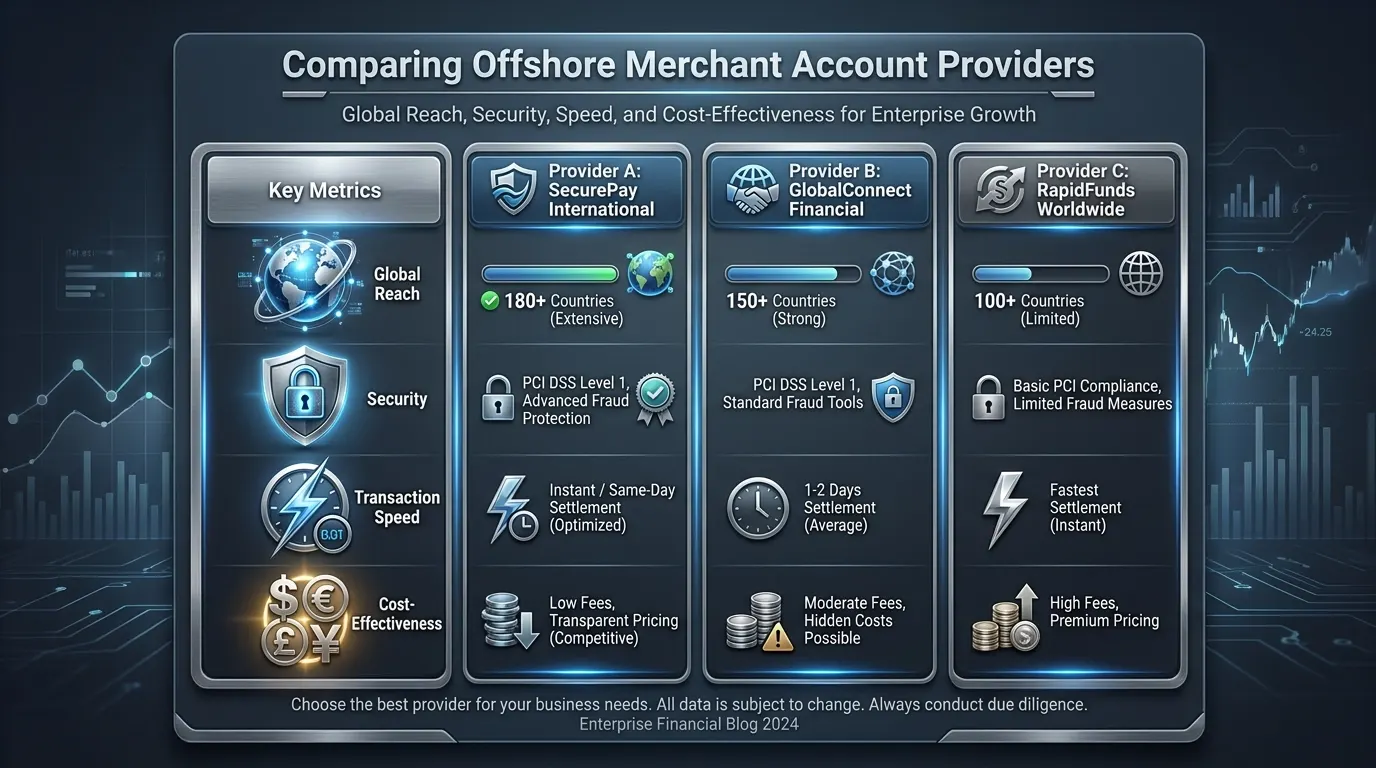
Choosing an offshore merchant account provider is rarely a simple side-by-side of processing rates. Two providers can quote nearly identical headline fees and still deliver completely different outcomes once reserves, settlement delays, and chargeback handling enter the picture. For travel companies especially, the wrong choice shows up at the worst possible time, mid-booking-season, with funds frozen and no clear explanation.
TL;DR
Comparing offshore merchant account providers means looking past the advertised rate and evaluating fee transparency, licensing, reserve terms, settlement speed, fraud tooling, and industry fit together. Travel companies in particular need providers who understand delayed delivery, seasonal volume spikes, and cancellation-driven chargebacks, since generalist processors tend to treat these as red flags rather than normal business patterns. The strongest comparison approach uses a consistent checklist across every provider so quotes are judged on equal terms, not on whoever pitches the lowest number first. Below is a practical framework for running that comparison in 2026.
Why a Structured Comparison Matters
Offshore payment providers vary enormously in specialization, licensing quality, and risk appetite. Some are true high-risk specialists with deep travel-industry experience. Others are closer to generic international payment gateways that happen to support offshore acquiring but don’t have real underwriting depth for complex verticals.
Without a structured framework, most merchants default to comparing the one number that’s easiest to compare: the transaction fee. That’s a mistake. A slightly higher transaction fee paired with fast settlement, low reserves, and strong chargeback tools is almost always cheaper in practice than a “discount” account that freezes funds during your busiest month.
Confirm Licensing and Regulatory Standing
Before comparing pricing, confirm the provider is properly licensed and works with acquiring banks that meet recognized security and compliance standards. Ask directly:
- Is the provider PCI DSS compliant, including the current v4.0.1 standard?
- What AML and KYC protocols does the acquiring bank follow?
- Which jurisdiction is the acquiring bank based in, and what regulatory body oversees it?
A provider that hesitates to answer these questions clearly is a warning sign. Legitimate offshore merchant services providers are usually upfront about their licensing, since it’s part of what makes them trustworthy partners for online payments at scale.
Demand Full Fee Transparency
Fee structures are where most comparisons go wrong, mainly because providers don’t present costs the same way. Build your own comparison table using these categories for every provider you evaluate:
- Setup fees: one-time onboarding costs
- Monthly/maintenance fees: recurring account costs regardless of volume
- Transaction fees: usually a percentage plus a fixed amount per transaction
- Currency conversion markups: typically 1% to 3%, but can vary sharply between providers
- Chargeback fees: the cost charged per dispute, win or lose
- Rolling reserve percentage and holding period: how much of your revenue is held back and for how long
Watch for providers advertising unusually low headline rates. These often hide costs in mid-qualified transaction tiers or long-term equipment leases that only surface after the contract is signed. If a provider won’t give you a complete written fee schedule before you sign anything, treat that as disqualifying.
Evaluate Reserve Terms Realistically
Rolling reserves are standard across offshore high-risk payment gateway providers, but the terms differ widely. When comparing providers, ask specifically:
- What percentage of processing volume is held in reserve?
- How long is the holding period before funds are released?
- Is the reserve a rolling reserve, an upfront reserve, or a capped reserve?
For travel companies, this matters more than almost any other factor. A tour operator collecting deposits for a summer season needs to model cash flow around exactly how long funds are held, especially if bookings run months ahead of departure dates.
Check Multi-Currency and Settlement Capabilities
If your customers pay in multiple currencies, your comparison needs to weigh more than “does the provider support multi-currency.” Dig into:
- Which specific currencies and payment wallets are supported
- Settlement currency options, do you get paid in your home currency, or does the provider hold funds in the currency collected?
- Actual settlement speed, since offshore accounts often settle slower than domestic ones, particularly for newly onboarded high-risk merchants
- Whether the provider supports the payment rails your customers actually use, not just card networks
Strong multi-currency support is one of the clearest differentiators between a genuine cross-border payments specialist and a provider that simply markets itself as “global.”
Assess Fraud and Chargeback Tooling
Not all offshore providers build fraud protection into the core account. Some charge extra for basic tools that competitors include standard. Compare providers on:
- Built-in 3D Secure (3DS2) authentication support
- Real-time fraud scoring and geolocation/device matching
- Chargeback alert systems that flag disputes before they escalate
- Access to representment support for disputing illegitimate chargebacks
This is especially relevant given Visa’s Acquirer Monitoring Program, which set an excessive fraud and chargeback threshold of 1.5% as of April 2026. Providers who treat this proactively, with alerts and prevention tools rather than just a monitoring dashboard, are a meaningfully better long-term fit.
Look for Genuine Industry Specialization
A provider that lists “travel” among fifteen other supported verticals is very different from one that actively specializes in travel-industry underwriting. Ask providers directly:
- How many active travel merchants do they currently support?
- What’s their typical approval timeline for travel accounts?
- Do they understand seasonal volume spikes, or will a booking surge trigger an automatic review?
- Have they handled disputes tied to cancellations, schedule changes, or “service not as described” claims?
Generalist payment processing platforms may claim to support travel, but they rarely have underwriting teams built around its specific dispute patterns. That gap tends to surface exactly when it’s most costly during a chargeback spike after a mass cancellation event.
Compare Support and Onboarding Experience
Offshore transactions cross time zones, so support availability matters more than it does domestically. Compare:
- Whether support is available 24/7 across phone, email, and live chat
- Whether you get a dedicated account manager or a rotating support queue
- How clearly the provider communicates realistic processing limits and expectations during onboarding
- Whether documentation requirements are explained upfront rather than trickled out mid-application
Comparison Checklist at a Glance
| Category | What to Compare |
|---|---|
| Licensing & Compliance | PCI DSS v4.0.1, AML/KYC protocols, acquiring bank jurisdiction |
| Fee Structure | Setup, monthly, transaction, FX markup, chargeback fees |
| Reserves | Percentage held, holding period, reserve type |
| Multi-Currency Support | Currencies accepted, settlement currency, settlement speed |
| Fraud & Chargeback Tools | 3DS2, fraud scoring, chargeback alerts, representment support |
| Industry Fit | Active travel merchants supported, seasonal volume handling |
| Support | 24/7 availability, dedicated account management |
A Note for Travel Companies Specifically
Travel merchants face a distinct combination of long delivery windows, high ticket sizes, and cancellation-driven disputes that most domestic merchant accounts simply aren’t built to absorb. When comparing offshore providers, weigh the categories above against your actual booking cycle, how far in advance customers pay, how often cancellations occur, and how quickly you need access to funds to cover supplier payments. A provider that looks strong on paper but settles funds too slowly for your operating cash flow isn’t a fit, regardless of how competitive the transaction fee looks.
Final Thoughts
Comparing offshore merchant account providers properly means resisting the pull toward the lowest advertised rate and instead running every candidate through the same checklist: licensing, full fee disclosure, reserve terms, multi-currency capability, fraud tooling, industry specialization, and support quality. The providers that score well across all seven categories, not just one or two, are the ones that hold up when volume spikes, disputes rise, or your business scales into new markets.
FAQs
What’s the biggest mistake merchants make when comparing offshore providers?
Focusing only on the headline transaction rate. Reserve terms, settlement speed, and hidden fees often matter far more to total cost and cash flow than the advertised percentage.
How do rolling reserves affect the comparison?
Reserves hold back a percentage of your processing volume for a set period. Two providers with similar fees can have very different cash flow impacts depending on their reserve percentage and holding period.
Is a lower transaction fee always the better deal?
Not necessarily. A provider with a slightly higher fee but faster settlement, lower reserves, and stronger fraud tools often costs less overall than a “discount” provider with hidden charges.
Why does industry specialization matter for travel companies?
Generalist processors may support travel on paper but lack underwriting experience with cancellation-driven disputes and seasonal volume spikes, which increases the risk of account freezes.
What documentation should I expect during the comparison and application process?
Most offshore providers require business formation documents, beneficial ownership information, processing history, website details, and your chargeback and refund policies.
How important is 24/7 support for an offshore merchant account?
Very important. Offshore transactions span time zones, and issues like declined payments or fraud alerts often need immediate attention outside standard business hours.
Should I compare offshore providers the same way I’d compare domestic ones?
Not exactly. Offshore comparisons need extra scrutiny on licensing, jurisdiction, currency conversion costs, and settlement speed, factors that carry less weight in a purely domestic account comparison.
Comments
No comments yet. Be the first to share your thoughts.
Leave a comment