
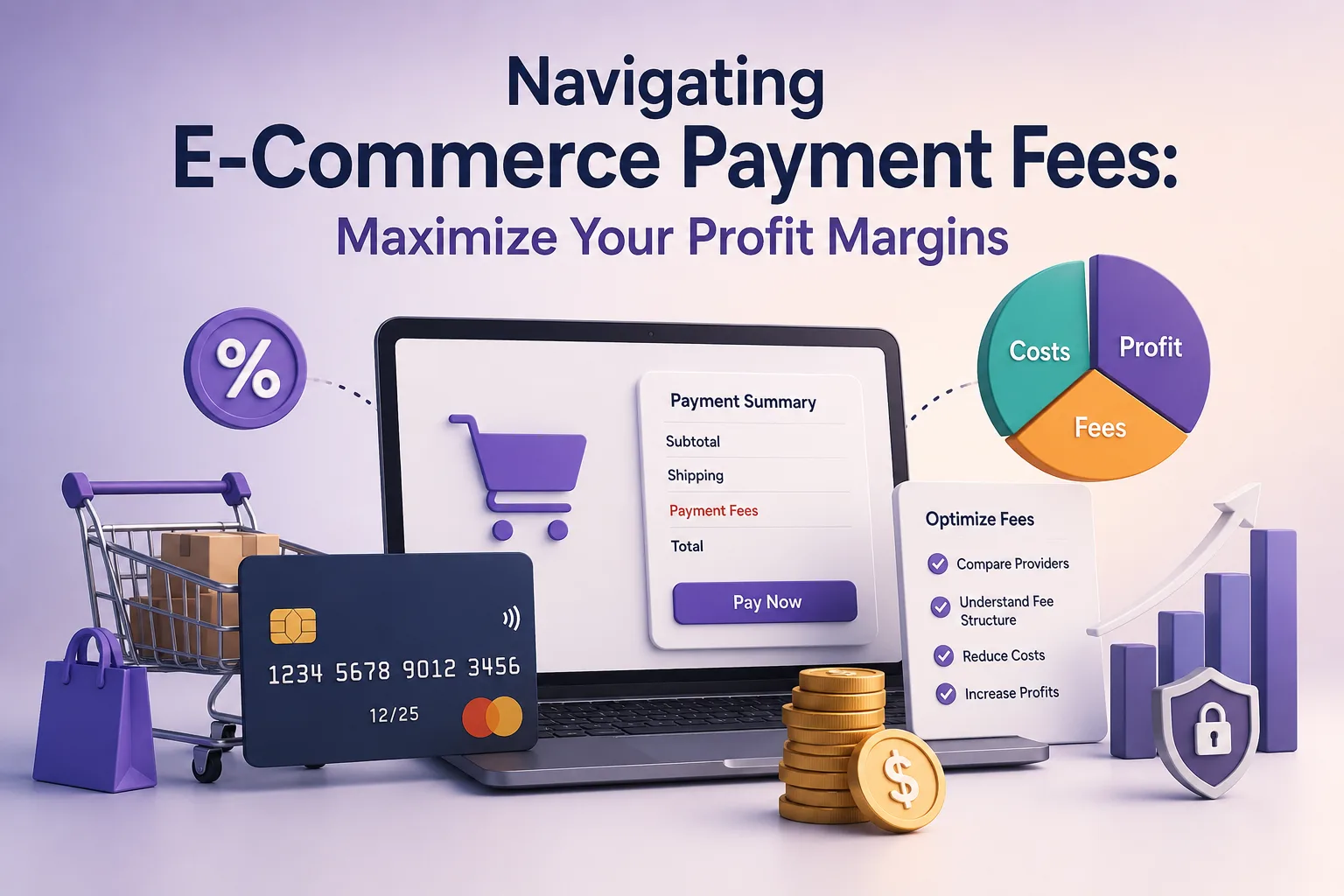
US merchants paid roughly $187.2 billion in payment processing fees in 2024, growing 8.7% year-over-year, nearly 1.5 times faster than payment volume itself grew. For a business with a 10% profit margin, a 2.5% processing fee alone consumes a quarter of every dollar of profit on a card sale. Understanding where that money actually goes is the first step toward keeping more of it.
TL;DR
E-commerce payment fees are made up of interchange, assessment, and processor markup, and only the last one is actually negotiable. Card-not-present transactions typically cost 1.8%-3.5%, higher than in-person retail, and hidden charges like PCI non-compliance fees and statement fees can push a business’s true effective rate well above its advertised rate. The most effective ways to protect margin are auditing your actual effective rate, switching to interchange-plus pricing, cleaning up transaction data quality, and proactively preventing chargebacks rather than just negotiating a lower headline rate. Travel companies face a steeper version of this challenge, since delayed delivery and high-value bookings push both interchange costs and chargeback exposure well above standard e-commerce averages.
What Actually Makes Up an E-Commerce Payment Fee
Every card transaction is priced from three components, and understanding which ones you can and can’t influence is the foundation of any cost-reduction strategy:
- Interchange fees: paid to the card-issuing bank, set by Visa, Mastercard, and other networks, making up 70%-90% of total card processing costs and largely non-negotiable at the network level
- Assessment fees: smaller fees paid directly to the card networks, also non-negotiable
- Processor markup: the only component actually within your control, and where real savings live
Because card-not-present transactions are inherently harder to verify than in-person swipes, e-commerce interchange runs higher than retail: typically 1.8%-3.5% online compared to 1.3%-2.7% in person. A business processing $100,000 monthly at average online rates pays somewhere between $1,500 and $3,500 in fees, $18,000 to $42,000 annually, often the second-largest operating cost after labor.
Step One: Calculate Your Real Effective Rate
Most e-commerce operators assume their advertised rate, say, 2.9% + $0.30, tells the full story. It rarely does. Hidden markups, statement fees, and PCI non-compliance charges routinely push the true effective rate to 3.1% or higher.
To find your actual number:
- Pull your last three months of processing statements
- Divide total fees paid by total transaction volume for the same period
- Compare that effective rate against your advertised rate to measure the gap
If your statement bundles all fees into one number without breaking out interchange, assessments, and markup separately, that’s a strong signal you’re on tiered or flat-rate pricing, and likely overpaying relative to what interchange-plus would cost at your volume.
Choosing the Right Pricing Model
- Flat-rate pricing: is simplest for brand-new stores just getting their footing, since a single consistent percentage makes cost forecasting easy without needing to analyze card-mix data
- Tiered pricing: groups transactions into qualified, mid-qualified, and non-qualified buckets controlled by the processor, and is widely considered the least transparent, most expensive model once real volume kicks in
- Interchange-plus pricing: separates the true network cost from processor markup on its own line, and is the clear winner for most growing e-commerce businesses once monthly volume becomes meaningful
Larger merchants with negotiating leverage frequently secure markups nearly half what smaller, less established businesses pay, volume and clean processing history compound into real pricing power over time.
Levers That Actually Move Your Effective Rate
Beyond the pricing model itself, several operational factors influence what you actually pay per transaction:
- Transaction data quality: Missing address verification, missing CVV data, or transactions that settle late get automatically downgraded into more expensive interchange categories, two businesses processing identical volume can pay meaningfully different rates purely based on data completeness.
- Card mix: Rewards and premium credit cards carry higher interchange than standard debit. Understanding your rolling 90-day card-type breakdown reveals where cost is concentrated, though most processors only provide this data on request.
- Chargeback prevention: Lowering your processing rate doesn’t always lower your total cost, batch timing, routing defaults, and gateway settings can quietly erase negotiated savings, while unresolved chargeback patterns often have a bigger impact on the bottom line than the rate itself.
- Settlement and batch timing: Delayed settlement is one of the more overlooked triggers for interchange downgrades, and it’s worth verifying batch timing directly with your payment gateway rather than assuming it’s optimized by default.
Alternative Payment Methods and Their Tradeoffs
- ACH for B2B sales: Business customers often prefer invoice-based purchasing, and net terms with ACH avoid card processing fees entirely while potentially supporting larger order sizes.
- Debit incentives: Debit interchange runs lower than credit, and offering a small discount for debit payment (rather than surcharging credit, which carries stricter compliance rules) can shift card mix favorably.
- Buy-now-pay-later: Services like Affirm or Klarna charge their own merchant fees but can convert customers who’d otherwise abandon cart, particularly at higher average order values, the net impact depends heavily on your specific conversion data.
- Payment wallets: Digital payment wallets now account for roughly 30% of global point-of-sale volume, and markets shifting toward lower-cost instant-payment rails present a genuine opportunity to reduce blended costs over time.
Avoid pushing alternative payment methods so aggressively that checkout friction increases, a lost sale costs far more than the processing fee it would have carried.
Cross-Border and International Fee Traps
Foreign transactions carry meaningfully higher costs than domestic ones. PayPal’s international transaction fee runs close to 3.9% plus a fixed fee, while Stripe charges around 3.25% + €0.25 for non-EU cards processed in Europe. Dynamic currency conversion can add further markups that aren’t always obvious to the merchant. Businesses with meaningful cross-border payments volume should evaluate dedicated international payment infrastructure rather than accepting default foreign transaction fees as a fixed cost, the gap between a generalist payment gateway and one built for multi-currency volume compounds quickly at scale.
A Note on Subscription and Recurring Billing
Businesses running subscription or recurring billing face a distinct version of the fee-optimization problem: small per-transaction differences compound significantly over a customer’s lifetime value, and card expiration or failed renewals create both lost revenue and unnecessary decline-related fees. Reviewing how your payment gateway handles automatic card-updater services and retry logic for failed renewals is worth as much attention as the headline processing rate itself, since involuntary churn from expired or declined cards often costs more over a year than the difference between two competing pricing quotes.
A Practical Fee-Reduction Checklist
- Calculate your true effective rate from actual statements, not the advertised rate
- Request a card-type breakdown from your processor covering the last 90 days
- Confirm your merchant account shows itemized interchange, assessments, and markup separately
- Verify address verification and CVV data are being captured consistently at checkout
- Review chargeback patterns for preventable causes, unclear product descriptions, poor customer service response times, or fulfillment delays
- Revisit processor markup periodically; it’s negotiable and rarely revisited after the original agreement is signed
- Ask specifically about batch and settlement timing, since delayed batching is a commonly overlooked trigger for interchange downgrades that most merchants never think to check
Why Travel Companies Face a Steeper Fee Curve
Travel businesses navigating e-commerce payment fees deal with a version of these challenges intensified by the sector’s underlying risk profile:
- Delayed delivery inflates both interchange and reserve requirements: Since customers often pay months before a trip occurs, travel bookings frequently trigger higher risk-based interchange categories and rolling reserves that standard e-commerce businesses rarely encounter.
- High-value tickets amplify every basis point: A 0.5% difference in effective rate matters far more on a $3,000 vacation package than a $40 retail order, making rate optimization proportionally more valuable for travel businesses.
- Chargeback exposure runs structurally higher: Cancellations, itinerary changes, and weather disruptions drive dispute rates in travel above what most standard payment processing agreements are underwritten to absorb, and chargeback fees compound quickly at scale.
- Cross-border complexity is the default: Travel companies serving international customers face the FX and dynamic-conversion fee traps outlined above as a routine part of business, not an occasional edge case, making dedicated cross-border infrastructure more valuable than for typical domestic e-commerce.
- Standard providers often decline the relationship entirely: Many mainstream payment providers are cautious about travel’s transaction pattern regardless of processing history, pushing travel businesses toward a specialized high-risk payment gateway or dedicated merchant services partner from the outset, where fee transparency and chargeback tooling typically matter more than the lowest advertised headline rate.
Final Thoughts
Payment processing fees are one of the few major cost centers most e-commerce businesses genuinely control, once they understand what’s actually negotiable. Calculating your real effective rate, moving to interchange-plus pricing where volume justifies it, cleaning up transaction data quality, and proactively managing chargebacks together do more for margin protection than chasing the lowest advertised headline rate. For travel companies especially, that discipline matters even more, since delayed delivery, high ticket values, and elevated dispute rates compound quickly if left unmanaged.
FAQs
What’s a good effective payment processing rate for e-commerce?
Effective rates for online transactions generally fall between 1.8% and 3.5%, though businesses on outdated pricing models or with poor transaction data quality often pay above that range without realizing it.
Is interchange-plus pricing always better than flat-rate?
For most growing e-commerce businesses, yes, but very new, low-volume stores may still prefer flat-rate’s simplicity until volume justifies the switch.
Why do my processing fees vary month to month?
Card mix, transaction data completeness, and settlement timing all influence your effective rate, so a shift in any of these, even without a contract change, can move your total cost.
Can I pass processing fees on to customers?
Surcharging credit card transactions is legal in most US states with proper disclosure, but surcharging debit transactions is prohibited under the Durbin Amendment; offering a discount for debit or cash payment is the compliant alternative.
How much do international card transactions typically cost extra?
International and cross-border transactions commonly carry fees in the 3%-4% range once conversion and foreign transaction fees are included, notably higher than standard domestic rates.
Do chargebacks affect my processing rate?
Yes, both directly through per-dispute fees and indirectly, since elevated chargeback ratios can push a business into higher-risk pricing categories over time.
Why do travel companies pay more in payment processing fees?
Delayed service delivery, high average transaction values, and elevated chargeback rates combine to push both interchange categorization and processor risk premiums above standard e-commerce averages.
Comments
No comments yet. Be the first to share your thoughts.
Leave a comment