
TL;DR
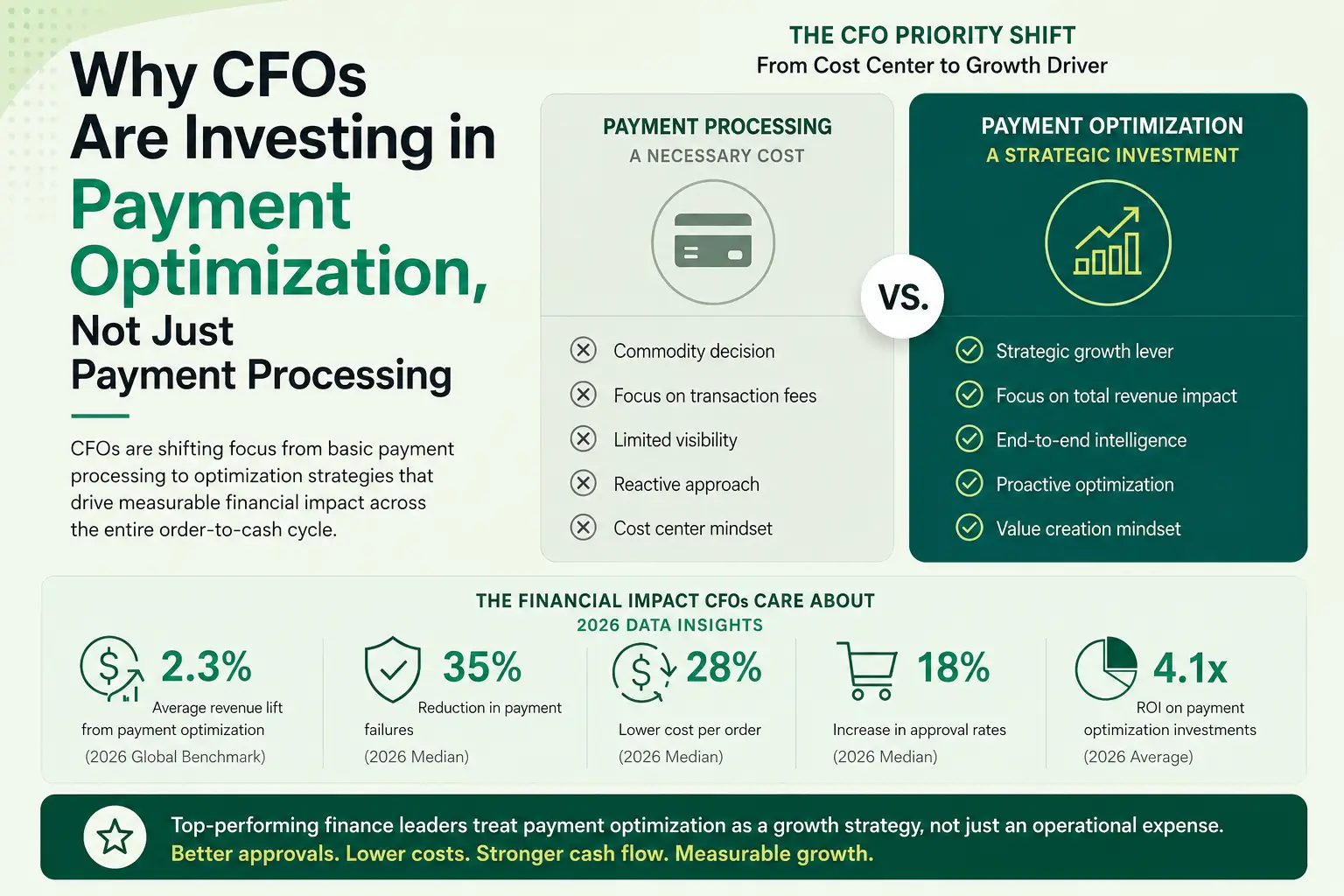
Payment processing used to be a cost line CFOs negotiated and forgot. In 2026, that’s changing. HSBC’s Treasury Pulse Survey found payments optimization now ranks among the core pillars of corporate resilience, and over 60% of treasuries are adopting payment-status and payee validation tools. CFOs are asking a new question: how much revenue and liquidity is our payment infrastructure quietly losing? This guide covers why that shift is happening and how finance leaders are acting on it in 2026.
The Old CFO Mental Model: Payment Processing as a Cost Line
For most of the last decade, payment processing sat in finance’s budget the same way electricity or office supplies did, a recurring cost to be minimized, not a lever to be optimized.
- Vendor selection was driven primarily by processing fee percentage
- Success was measured by cost per transaction, not revenue recovered
- Payment infrastructure decisions were delegated to IT or operations, rarely reviewed at the CFO level
- Contracts were renewed on autopilot unless fees increased noticeably
This model made sense when payment volume was simpler, mostly domestic, and margins weren’t as sensitive to authorization rates, false declines, or cross-border friction. That’s no longer the environment CFOs are operating in.
Why the Old Model Is Breaking Down in 2026
Cost Optimization Is the Top CFO Priority, And Payments Are Now Part of That Conversation
Gartner’s latest survey of more than 200 CFOs found that 56% rank enterprise-wide cost optimization among their top five priorities heading into 2026, with 51% citing improved forecast accuracy as a close second. Historically, “cost optimization” meant headcount and vendor renegotiation. Increasingly, it means treasury and payments infrastructure.
Treasury Leaders Are Explicitly Naming Payments as a Resilience Pillar
HSBC’s Treasury Pulse Survey, covering more than 500 companies across 33 countries, found operational cost reduction is the top business goal for 53% of treasury teams, followed by lowering financing costs (50%) and adopting new technologies (48%). Critically, the same research frames payments optimization, real-time liquidity management, and automation as the pillars of treasury resilience, not a separate operational silo.
Payment Innovation Adoption Is Accelerating Fast
- Over 60% of treasuries have adopted or plan to adopt payment-status reporting and payee validation tools within two years, specifically to reduce errors and fraud risk
- Tokenization, embedded payments, and pay-into-wallet capabilities are expected to expand fivefold over the same period, even though adoption remains relatively low today
- Deloitte’s CFO Signals survey found 50% of North American CFOs named digitizing the finance function their #1 priority for 2026, with 87% saying AI will be extremely or very important to their finance department this year
The Revenue Case Has Become Impossible to Ignore
Separately from treasury efficiency, the revenue math behind payment optimization has become too large for finance leaders to treat as an IT concern. Large merchants have documented millions of dollars in additional annual revenue from authorization rate improvements as small as 0.5%, and false declines are estimated to cost merchants roughly $50 billion a year industry-wide, a number that increasingly lands on a CFO’s desk as a P&L problem, not a technical one.
What “Payment Optimization” Actually Means for a CFO
Payment optimization isn’t a single tool or vendor category. For finance leaders, it spans several connected disciplines:
- Authorization rate management: treating approval rate as a revenue metric, not just a technical one, since every declined legitimate transaction is lost revenue that marketing and sales already paid to generate
- Multi-provider and multi-acquirer strategy: reducing single-processor dependency to protect both continuity and negotiating leverage
- FX and cross-border cost management: actively managing currency conversion spread and routing rather than accepting whatever a single processor defaults to
- Payout intelligence and real-time visibility: unifying payment data across providers so finance can see performance trends before they become material issues
- Compliance-aware infrastructure investment: building payment systems that adapt to evolving card network rules and regulatory frameworks like ISO 20022, rather than scrambling reactively each time
None of these are single-purchase decisions. They’re ongoing operational disciplines, which is exactly why they need executive-level ownership rather than living entirely inside an IT backlog.
Payment Processing vs. Payment Optimization: A Direct Comparison
| Factor | Payment Processing (Old Model) | Payment Optimization (2026 Model) |
|---|---|---|
| Primary metric | Cost per transaction | Approval rate, false decline rate, revenue recovered |
| Ownership | IT or operations | CFO and treasury, with cross-functional input |
| Vendor strategy | Single processor, negotiated once | Multi-provider, continuously benchmarked |
| Data approach | Provider-supplied reports, reviewed periodically | Unified, real-time payout intelligence |
| View of cross-border payments | A cost to minimize | A performance and liquidity variable to manage actively |
| Response to card network rule changes | Reactive, after a compliance issue arises | Proactive, built into ongoing risk monitoring |
| Success measured by | Lower fees | Higher recovered revenue and stronger liquidity position |
Pros and Cons of Shifting Finance Strategy Toward Payment Optimization
Pros
- Recovers revenue directly, often at a scale that dwarfs achievable savings from fee negotiation alone
- Strengthens liquidity visibility, supporting the cash preservation and forecasting priorities most CFOs already rank highly for 2026
- Builds resilience against processor termination, card network rule changes, and cross-border friction simultaneously
Cons
- Requires cross-functional coordination between finance, engineering, and payments teams that many organizations haven’t historically maintained
- Meaningful payback typically requires enough transaction volume or cross-border complexity to justify the investment
- Shifting from a single vendor relationship to a multi-provider strategy adds real operational complexity, even if it reduces risk
Cross-Border and High-Risk Considerations for CFOs
Payment optimization matters even more for CFOs overseeing cross-border operations or high-risk merchant categories, where the old cost-line mental model breaks down fastest.
- Cross-border payments: carry structurally lower approval rates and higher FX costs by default; treating this purely as a processing fee to minimize misses the larger authorization-rate and routing opportunity
- High-risk merchant accounts: carry rolling reserves and termination risk that directly affect cash flow forecasting, a CFO managing liquidity needs visibility into this risk, not just the headline processing rate
- Merchant services providers and high-risk payment gateway relationships: increasingly need to be evaluated on infrastructure resilience and data transparency, not fee percentage alone
- Digital payments and payment wallets: are reshaping settlement speed expectations, which directly affects working capital assumptions CFOs build into cash forecasts
How CFOs Are Building This Into Finance Strategy
- Bring payment performance metrics into the same reporting cadence as other financial KPIs: authorization rate and false decline rate deserve the same visibility as DSO or cash conversion cycle
- Evaluate payment providers on data transparency and infrastructure resilience: not processing fee alone, especially for cross-border and high-risk merchant accounts
- Fund a multi-provider strategy proactively: treating processor diversification as a liquidity and continuity safeguard rather than a discretionary IT project
- Invest in unified payout data before predictive tooling: most of the value in payment optimization depends on having clean, consolidated transaction data across every provider first
- Coordinate treasury, finance, and payments teams explicitly: the CFOs seeing the strongest results are the ones who’ve stopped treating payments as someone else’s operational problem
- Track payment optimization ROI the same way other capital investments are tracked: recovered revenue and improved forecasting accuracy, not just cost avoided
Key Takeaways
- CFOs are shifting payment strategy from a cost-minimization exercise to a genuine optimization discipline, driven by both treasury resilience priorities and direct revenue recovery
- HSBC’s Treasury Pulse Survey confirms payments optimization now sits among the core pillars of treasury resilience for corporates globally, alongside real-time liquidity management and automation
- Over 60% of treasuries are adopting payment-status reporting and payee validation, while tokenization and embedded payments adoption is expected to expand fivefold in the next two years
- The revenue case is now too large to ignore: authorization rate improvements of even 0.5% can unlock millions in recovered revenue for enterprise merchants
- Cross-border and high-risk merchant categories carry additional liquidity and continuity risk that make payment optimization a genuine CFO-level concern, not just an operational detail
Frequently Asked Questions
What’s the difference between payment processing and payment optimization? Payment processing refers to the basic mechanics of moving money, capturing, authorizing, and settling transactions. Payment optimization treats the entire payment stack as a performance and liquidity lever, actively managing approval rates, FX costs, provider diversification, and compliance readiness rather than just minimizing processing fees.
Why are CFOs paying more attention to payments in 2026 specifically? Cost optimization is the top CFO priority heading into 2026 according to Gartner, and treasury leaders are now explicitly naming payments optimization as a resilience pillar rather than a back-office function, driven by both efficiency and direct revenue impact data.
How does payment optimization affect cash flow forecasting? Payment optimization improves visibility into settlement timing, authorization performance, and reserve exposure (particularly for high-risk merchant accounts), giving finance teams more reliable inputs for liquidity and cash forecasting.
Is payment optimization only relevant for large enterprises? The financial case scales with transaction volume and cross-border exposure, so the impact is most pronounced for enterprise merchants, but the underlying principles, tracking approval rate, avoiding single-processor dependency, apply at smaller scales too, just with proportionally smaller impact.
What role does AI play in CFO-level payment optimization strategy? AI supports predictive failure modeling, real-time payout intelligence, and automated reconciliation across providers, capabilities Deloitte’s research shows a majority of CFOs already consider important to their broader finance strategy for 2026.
Who should own payment optimization within a company? The strongest results come from shared ownership between the CFO’s finance and treasury functions and the technical teams managing payment infrastructure, rather than leaving it exclusively with IT or engineering.
Comments
No comments yet. Be the first to share your thoughts.
Leave a comment