
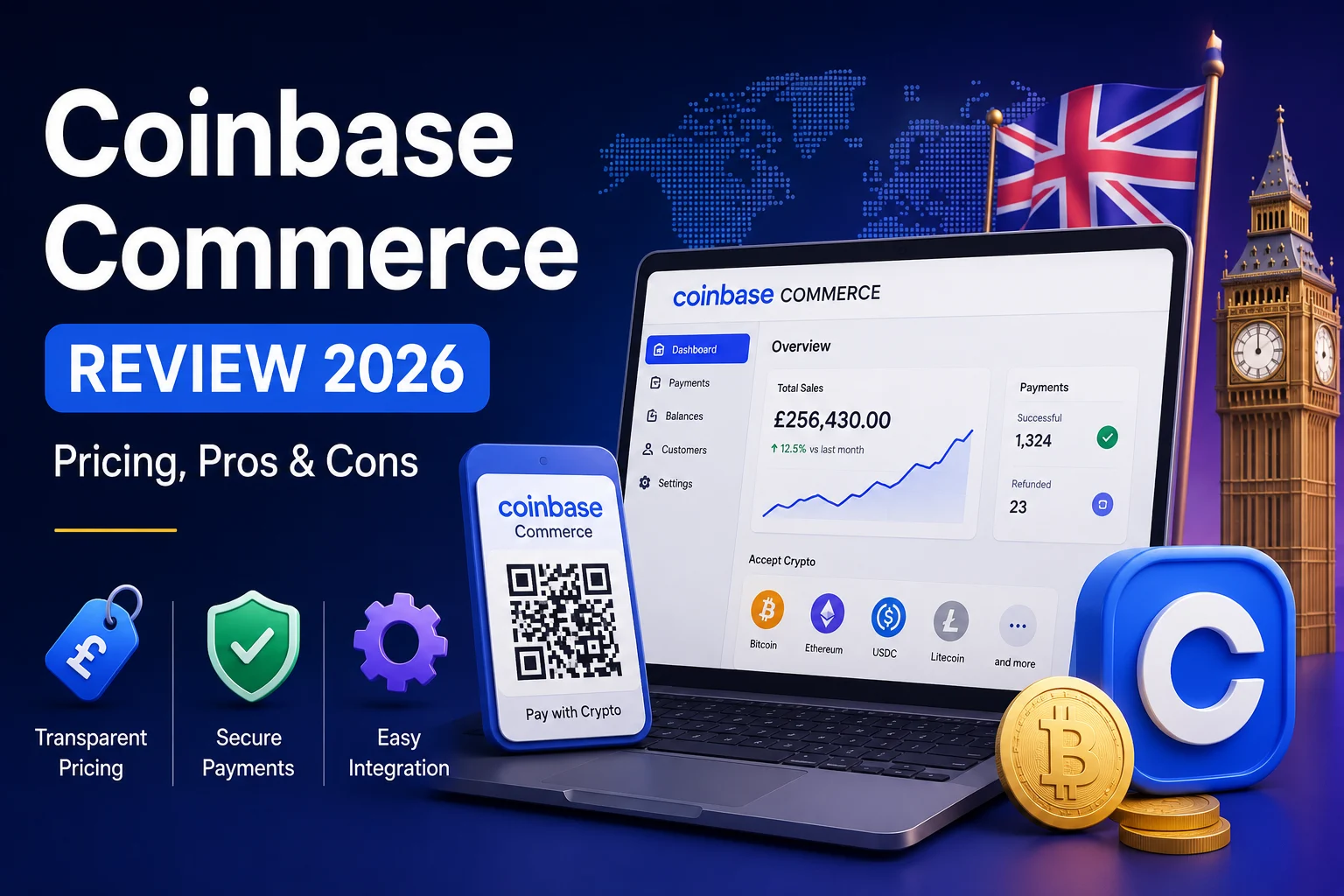
Coinbase Commerce is one of the most recognizable names in crypto payment gateways, largely riding on the brand trust of its parent exchange. But name recognition and the right fit for your merchant services stack are two different questions. This review breaks down the pricing, features, and real trade-offs of Coinbase Commerce heading into 2026.
TL;DR:
Coinbase Commerce charges a flat 1% fee on crypto payments, with no monthly subscription cost, and supports instant conversion to stablecoins to remove volatility risk. It’s a strong fit for established ecommerce businesses that want brand-recognized crypto payments with minimal setup. It’s a weaker fit for merchants needing broad fiat settlement options, deep customer support, or the widest possible cryptocurrency coverage, areas where competitors like CoinGate and NOWPayments pull ahead.
What Is Coinbase Commerce?
Coinbase Commerce is a hosted crypto payment gateway that lets businesses accept payments in Bitcoin, Ethereum, Bitcoin Cash, Litecoin, DAI, and USD Coin by default, with the option to expand coverage further. Merchants generate a payment link or embed a checkout button, customers pay directly from their own crypto wallets, and funds settle into the merchant’s Coinbase account.
It’s built primarily for ecommerce businesses and platforms already comfortable in the Coinbase ecosystem, offering native plugins for Shopify and WooCommerce alongside a full API for custom integrations. Unlike a traditional merchant account tied to card networks, there’s no underwriting process or credit check, any business with a Coinbase account can start accepting crypto payments relatively quickly.
Coinbase Commerce Pricing in 2026
Pricing is one of Coinbase Commerce’s clearest selling points, and it’s simpler than most traditional payment processing fee structures.
- Transaction fee: A flat 1% charged on all crypto payments, collected in the settlement currency of the transaction
- Monthly or subscription fees: None, there’s no recurring cost to maintain an account
- Network fees: Blockchain network fees apply separately depending on the cryptocurrency used and network congestion at the time of the transaction, and these are passed through to the customer or merchant depending on configuration
- Conversion fees: Instant conversion to a stablecoin like USDC carries no additional platform fee beyond the standard 1%, though minor spread costs can apply depending on market conditions
Compared to traditional card-based online payments, where processing typically runs 2%-4% once all fees are counted, Coinbase Commerce’s flat 1% is competitive. It’s worth noting, though, that some dedicated crypto payment gateways undercut it further, NOWPayments, for example, charges around 0.5% for same-coin payments, making Coinbase Commerce a mid-tier option on pure cost rather than the cheapest available.
Key Features
Coinbase Commerce’s feature set is built for straightforward crypto acceptance rather than deep customization, which is part of its appeal for merchants who want simplicity over control.
- Instant stablecoin conversion: letting merchants receive payment value in USDC rather than holding volatile assets
- Ecommerce plugin support: for Shopify and WooCommerce, alongside a REST API and webhook notifications for custom builds
- Multi-currency acceptance: covering major cryptocurrencies with the option to expand supported assets
- Accounting integrations: including connections to tools like Xero, useful for reconciliation
- Enterprise-grade security: including SOC 2 compliance and unique payment addresses generated per transaction
- No chargebacks: since blockchain transactions are final once confirmed, a meaningful advantage for merchants tired of chargeback fraud on traditional card-based payment providers
Pros of Coinbase Commerce
- Simple, transparent pricing: one flat fee, no hidden monthly charges
- Strong brand trust: backed by Coinbase’s position as one of the most recognized names in the crypto payments space
- Fast, straightforward setup: especially for merchants already using Shopify or WooCommerce
- Volatility protection: through automatic stablecoin conversion
- Solid security posture: including SOC 2 compliance and per-transaction wallet addresses
- No chargeback risk: reducing exposure to a major pain point in card-based merchant payment processing
Cons of Coinbase Commerce
- Customer support is a recurring complaint: Multiple independent reviews cite slow response times and limited support access, particularly when resolving transaction or verification issues.
- Limited fiat settlement flexibility: Unlike some competitors that settle directly in EUR, GBP, or USD, Coinbase Commerce is more tightly built around conversion to stablecoins within the Coinbase ecosystem, which may not suit every merchant’s accounting setup.
- Narrower default cryptocurrency coverage: Six supported assets by default is meaningfully fewer than competitors like NOWPayments, which supports several hundred.
- Network fees can be unpredictable: Merchants and customers are still exposed to blockchain congestion costs, which can spike during high-traffic periods regardless of the flat platform fee.
- No refund automation: Refunds require merchants to manually send crypto back to a customer’s wallet, which adds friction compared to a one-click refund on a traditional payment gateway.
Coinbase Commerce vs. Other Crypto Payment Gateways
Choosing between Coinbase Commerce and its competitors largely comes down to what a merchant values most: brand trust, cost, or asset variety.
| Provider | Fee | Notable Strength | Best Fit |
|---|---|---|---|
| Coinbase Commerce | 1% flat | Brand trust, easy setup | Established ecommerce merchants wanting simplicity |
| BitPay | 1%-2% + $0.25 | Enterprise-grade, long track record | Larger businesses needing daily fiat withdrawals |
| CoinGate | 1% flat | Broad EU/UK fiat settlement, MiCA-licensed | European merchants prioritizing regulatory clarity |
| NOWPayments | 0.5%-1% | Lowest fees, 300+ supported assets | Cost-conscious merchants with a global, crypto-native customer base |
For merchants deciding between these payment providers, the practical question is less “which is best” and more “which matches my settlement currency needs, support expectations, and cost sensitivity.”
Who Should Use Coinbase Commerce?
Coinbase Commerce tends to be the right fit for a specific type of merchant rather than a universal solution.
Good fit for:
- Ecommerce businesses already running Shopify or WooCommerce and wanting quick integration
- Merchants prioritizing brand recognition and trust signals for crypto-curious customers
- Businesses comfortable settling in stablecoins rather than requiring direct fiat bank transfers
- Teams that want simple, flat-fee pricing without evaluating a complex fee schedule
Less ideal for:
- High-frequency micro-transaction businesses, where network fees can outweigh the payment value
- Merchants requiring direct GBP or EUR settlement without routing through stablecoin conversion
- Businesses that need extensive multi-cryptocurrency support beyond the six default assets
- Teams that rely heavily on responsive customer support for transaction troubleshooting
Cross-Border Payments: Where Coinbase Commerce Adds Real Value
Cross-border payments remain one of the strongest use cases for crypto payment gateways generally, and Coinbase Commerce is no exception. Merchants selling internationally avoid the multi-day settlement delays and correspondent banking fees typical of traditional cross-border payments, since crypto transactions settle over blockchain networks directly between customer and merchant.
This matters particularly for merchants dealing with customers in markets underserved by traditional card-based payment wallets, where crypto offers a functional alternative to card declines and currency restrictions.
Why Travel Companies Should Evaluate This Category Carefully
Travel and booking businesses face a version of the cross-border payments problem more acute than most merchant categories, international customers, high average transaction values, and long gaps between booking and departure that leave room for currency risk to build.
For a travel company evaluating Coinbase Commerce specifically, a few considerations matter:
- Instant stablecoin conversion is genuinely useful here: since it removes the FX exposure that builds up between a customer’s booking date and the trip’s actual departure
- The lack of chargebacks cuts both ways: It protects the merchant from card-style dispute fraud, but it also means a genuinely dissatisfied customer has fewer recourse options than they would with a traditional card payment, worth factoring into refund and cancellation policy design
- Supplier payments to international hotels and operators: can benefit from the same fast settlement that makes crypto attractive for customer-facing bookings, though this typically requires a broader crypto payment strategy beyond just Coinbase Commerce alone
Travel merchants exploring this space should treat Coinbase Commerce as one option within a broader evaluation of crypto payment gateways, rather than a default choice, the specific mix of fiat settlement needs and customer geography will usually point toward one provider over another.
Should High-Risk Merchants Consider Coinbase Commerce?
Merchants who’ve struggled with underwriting for a traditional high-risk payment gateway sometimes look at crypto acceptance as an alternative path. Coinbase Commerce’s lack of chargebacks is a genuine advantage here, removing a major source of dispute-driven risk that pushes many merchants into high-risk categorization in the first place.
That said, Coinbase Commerce still requires standard Coinbase account verification, and merchants operating in restricted categories or jurisdictions may find the same compliance friction they’d encounter elsewhere. It’s a complement to traditional merchant accounts for many high-risk businesses, not necessarily a replacement.
Getting Started with Coinbase Commerce
For merchants ready to evaluate Coinbase Commerce directly, the setup process is designed to be fast relative to traditional merchant account onboarding:
- Create or link a Coinbase account, since Coinbase Commerce operates as an extension of the main Coinbase ecosystem
- Choose which cryptocurrencies to accept from the default list, or expand coverage as needed
- Set a settlement preference, hold in the received cryptocurrency, or auto-convert to a stablecoin like USDC
- Install the Shopify or WooCommerce plugin, or integrate via API for a custom checkout flow
- Test a small transaction before going live to confirm webhooks and settlement are working as expected
There’s no lengthy underwriting process like a traditional merchant account would require, which is part of why Coinbase Commerce appeals to smaller merchants who want to add crypto payments without a multi-week approval cycle. That speed is a genuine advantage, just be aware it also means less built-in guidance than a dedicated onboarding team might offer for merchants newer to crypto payments generally.
Frequently Asked Questions
How much does Coinbase Commerce actually cost?
A flat 1% fee on all crypto payments, with no monthly subscription cost. Blockchain network fees apply separately and vary based on the cryptocurrency used.
Does Coinbase Commerce protect against crypto price volatility?
Yes, through instant conversion to USDC or another stablecoin at the time of payment, which locks in the value received regardless of subsequent price movement.
Can I get a refund through Coinbase Commerce?
Refunds are possible but must be processed manually by sending crypto back to the customer’s wallet address, there’s no automated one-click refund like a traditional card payment gateway.
Is Coinbase Commerce good for international or cross-border payments?
Yes, this is one of its stronger use cases. Crypto payments settle directly between customer and merchant without the delays and fees typical of traditional cross-border payments.
How does Coinbase Commerce compare to CoinGate or NOWPayments?
Coinbase Commerce offers stronger brand recognition and a simpler default asset list, while CoinGate offers broader EU/UK fiat settlement and NOWPayments offers lower fees with far more supported cryptocurrencies. The right choice depends on settlement currency needs and cost sensitivity.
Comments
No comments yet. Be the first to share your thoughts.
Leave a comment