
Introduction
As digital commerce continues to grow, businesses need payment systems that are fast, secure, and easy to integrate. Whether operating an e-commerce store, SaaS platform, marketplace, or mobile application, companies rely on payment technology to deliver smooth customer experiences. A Merchant API makes this possible by enabling software applications to communicate directly with payment platforms and financial services.
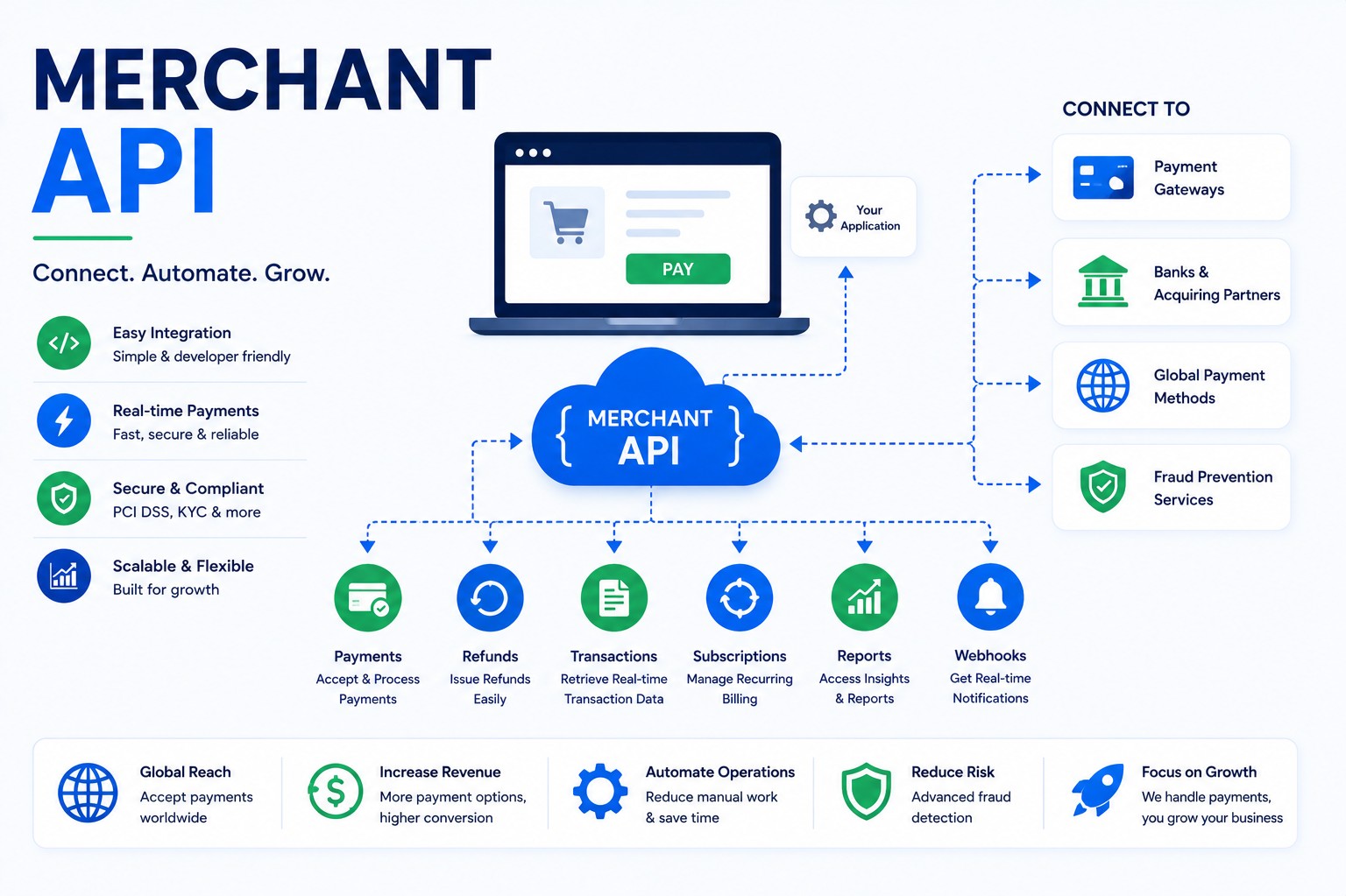
A Merchant API allows businesses to automate payment processing, manage transactions, retrieve financial data, process refunds, monitor settlements, and integrate payment capabilities into websites and applications. Instead of manually handling payment operations, developers can build secure and scalable payment workflows using standardized API connections.
From startups to global enterprises, Merchant APIs have become a core component of modern payment infrastructure, supporting faster innovation and improved operational efficiency.
What Is a Merchant API?
A Merchant API is an application programming interface that enables businesses to integrate payment and merchant services directly into their software, websites, or mobile applications.
It acts as a bridge between a merchant’s system and the payment provider, allowing secure communication for payment authorization, transaction processing, refunds, reporting, and account management.
Merchant APIs eliminate the need for manual payment handling while enabling businesses to build customized payment experiences.
How a Merchant API Works
When a customer initiates a payment, the application sends a secure request through the Merchant API to the payment provider.
The API transmits payment information, requests authorization from the acquiring and issuing banks, and returns the transaction status within seconds. If approved, the payment is processed and the transaction details are made available through the API.
Businesses can also use the API to retrieve payment history, initiate refunds, manage recurring billing, and generate financial reports.
Why Businesses Use Merchant APIs
Businesses increasingly require payment systems that integrate seamlessly with their existing technology stack.
Merchant APIs reduce manual work by automating payment workflows while providing greater flexibility than traditional hosted payment solutions. Developers can customize checkout experiences, automate reconciliation, monitor transactions in real time, and connect payment data with accounting or ERP systems.
This improves operational efficiency while delivering a better customer experience.
Key Features of a Merchant API
Modern Merchant APIs offer a wide range of capabilities beyond simple payment acceptance.
They support payment authorization, transaction management, recurring billing, refunds, payment status tracking, webhook notifications, customer tokenization, reporting, settlement information, and multi-currency processing.
Many APIs also include developer-friendly documentation, software development kits (SDKs), sandbox environments, and analytics dashboards that simplify implementation and ongoing maintenance.
Integration with Business Systems
Merchant APIs integrate with websites, mobile apps, ERP platforms, accounting software, CRM systems, subscription platforms, and e-commerce solutions.
These integrations allow businesses to automate payment collection, invoice generation, reconciliation, financial reporting, and customer account management.
API-driven automation reduces duplicate data entry while improving operational accuracy.
Security and Compliance
Security is one of the most important aspects of Merchant APIs.
Payment providers use encryption, tokenization, secure authentication, API keys, OAuth protocols, and digital certificates to protect sensitive payment information.
Most Merchant APIs also support PCI DSS compliance, fraud detection tools, Know Your Customer (KYC) processes, and Anti-Money Laundering (AML) requirements.
These security measures help protect businesses and customers from payment fraud and unauthorized access.
Benefits of Merchant APIs
Merchant APIs provide businesses with flexibility, scalability, and automation.
Companies can launch payment features faster, customize checkout experiences, reduce manual processing, improve transaction visibility, and integrate payments directly into their business workflows.
As transaction volumes grow, APIs enable businesses to scale efficiently without rebuilding their payment infrastructure.
This flexibility makes Merchant APIs valuable for organizations of all sizes.
Merchant API for Global Payments
Businesses operating internationally benefit from Merchant APIs that support multiple currencies, local payment methods, and cross-border transactions.
Customers can pay using their preferred payment options, while merchants receive centralized payment management through a single integration.
This simplifies international expansion while improving payment acceptance rates across different markets.
Common Use Cases
Merchant APIs are widely used across industries.
E-commerce businesses integrate APIs for online checkout, SaaS companies automate subscription billing, marketplaces manage buyer and seller payments, and mobile apps enable in-app purchases.
Financial institutions, travel companies, digital service providers, and enterprise platforms also use Merchant APIs to automate payment operations and improve customer experiences.
Artificial Intelligence and Merchant APIs
Artificial intelligence is enhancing Merchant APIs through intelligent payment routing, fraud detection, payment optimization, and predictive analytics.
AI-powered systems analyze transaction behavior in real time to identify suspicious activity, improve payment approval rates, and automate exception handling.
These capabilities help businesses reduce costs while improving payment reliability.
Future of Merchant APIs
Merchant APIs are evolving alongside Open Banking, embedded finance, and real-time payment networks.
Future APIs will offer deeper automation, AI-driven financial insights, faster settlement, improved interoperability, and expanded support for emerging payment methods.
As businesses increasingly adopt cloud-native financial systems, Merchant APIs will continue serving as the foundation of digital payment ecosystems.
Choosing the Right Merchant API
When selecting a Merchant API, businesses should evaluate documentation quality, ease of integration, supported payment methods, security standards, global coverage, uptime, scalability, reporting capabilities, pricing, and developer support.
A reliable API should integrate smoothly with existing systems while supporting future growth and international expansion.
Conclusion
A Merchant API is a critical technology for businesses looking to automate payment processing and build seamless digital payment experiences. By enabling secure communication between business applications and payment providers, Merchant APIs simplify transaction management, improve operational efficiency, and support global commerce.
Whether you’re running an e-commerce store, SaaS platform, marketplace, or enterprise application, implementing a robust Merchant API provides the flexibility and scalability needed to compete in today’s digital economy.
Comments
No comments yet. Be the first to share your thoughts.
Leave a comment