
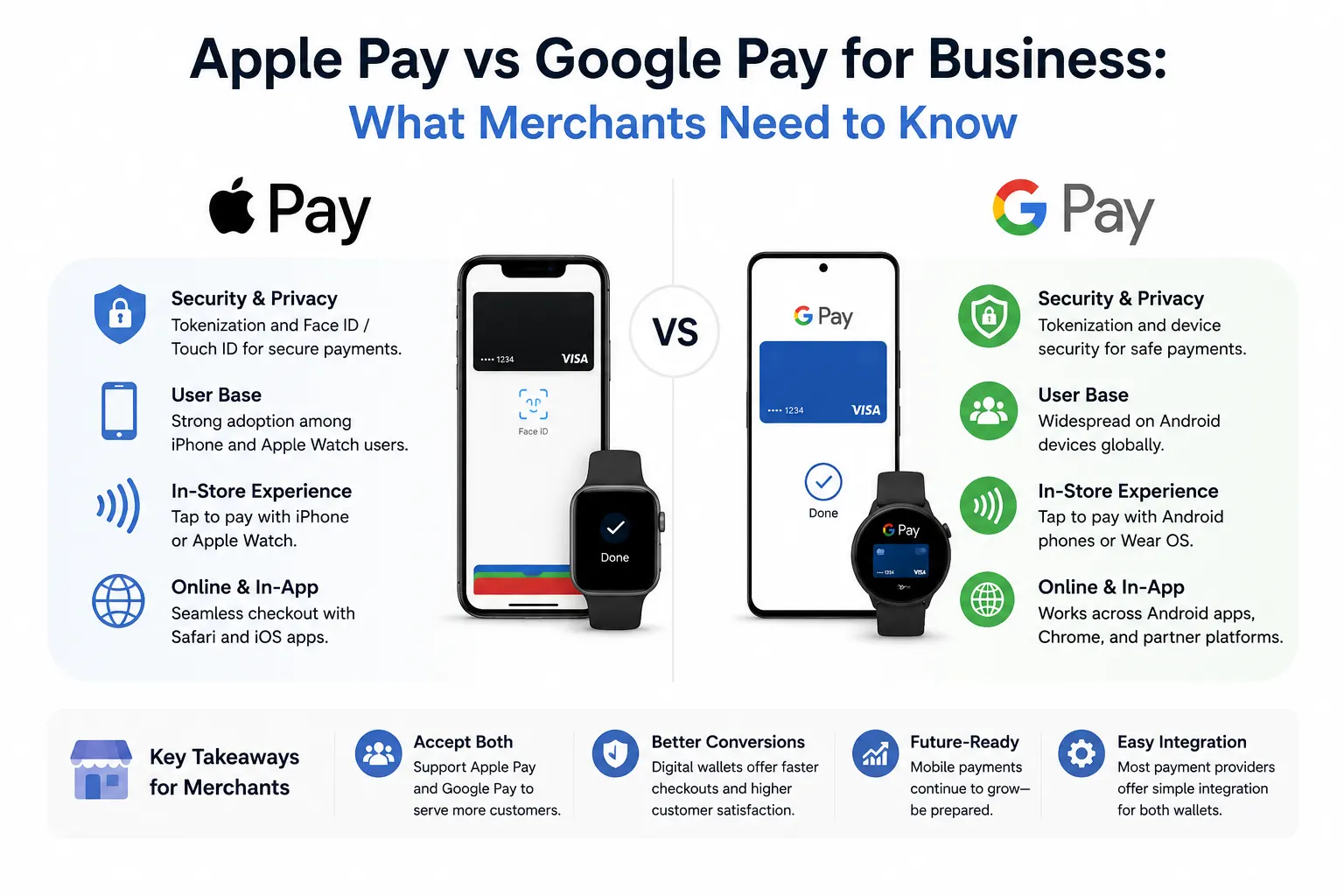
Apple Pay and Google Pay both settle through standard card networks, so neither one charges merchants an extra fee beyond normal card processing. The real decision for merchants isn’t cost, it’s which wallet your customers actually use, and whether your payment gateway supports both without added complexity. Here’s what matters for accepting these payment wallets in 2026.
TL;DR
- Neither Apple Pay nor Google Pay charges merchants an additional fee, both process at standard card interchange rates.
- Apple Pay dominates the US mobile wallet market with roughly 92% share, while Google Pay holds about 4%.
- Both wallets use tokenization, so your business never sees or stores the customer’s actual card number.
- Most card terminals and payment gateways that accept contactless Visa/Mastercard already support both wallets automatically.
- Regulatory pressure on Apple’s NFC restrictions is building in 2026 across the UK, Switzerland, and Brazil, which could reshape merchant acceptance terms.
Apple Pay vs. Google Pay: Quick Answer for Merchants
From a merchant’s perspective, Apple Pay and Google Pay work almost identically. Both use NFC (Near Field Communication) to transmit encrypted payment data from a phone or smartwatch to a card terminal, and both settle through the same payment processing rails as a physical card. If your terminal or payment gateway already accepts contactless Visa or Mastercard, it accepts Apple Pay and Google Pay automatically, no separate integration, no extra merchant account, and no additional cost.
The practical difference is audience, not mechanics: Apple Pay reaches iOS users, Google Pay reaches Android users, and most merchants need both to avoid excluding a meaningful share of customers.
How Apple Pay and Google Pay Work for Merchants
Both wallets replace the customer’s real card number with a one-time encrypted token before the transaction reaches your terminal. This means:
- Your business never stores or transmits the customer’s actual Primary Account Number (PAN)
- Transactions complete faster than chip or swipe payments
- Fraud liability for card-present purchases is generally reduced compared to manually keyed-in transactions
- No new hardware is required if your terminal already supports contactless card payments
Apple Pay uses a Secure Element chip built into the device to store encrypted card data. Google Pay uses Host Card Emulation with cloud-based tokenization. Both approaches hide the real card number from the merchant, so from a merchant services standpoint, the security posture is functionally equivalent.
Do Merchants Pay Extra Fees for Apple Pay or Google Pay?
No, this is one of the most common misconceptions merchants have. Apple Pay and Google Pay transactions process at the exact same interchange and processor rate as the underlying card. Providers like Stripe and Square charge identical rates for wallet transactions as they do for standard credit and debit card payments. Apple does charge a small fee to issuing banks (reported around 0.15% per transaction in some markets), but that cost is absorbed between the bank and card network, it never reaches the merchant.
The one nuance worth knowing: contactless transaction limits still apply in some regions. In the UK, for example, a single contactless tap is capped, and transactions above that threshold may require a PIN even when paid via wallet.
2026 Market Share and Adoption Data
- Apple Pay holds approximately 92% of US mobile wallet usage, with Google Pay at roughly 4% and Samsung Pay at 2%.
- Roughly 40% of online purchases are now completed on mobile devices, making wallet checkout support increasingly non-optional for online payments.
- Google Pay’s strength is global reach rather than US share, it leads in Android-dominant markets and emerging economies where iOS penetration is lower.
- Android represents close to 40-45% of the smartphone market in several international markets, including the UK, meaning merchants who skip Google Pay risk excluding a large customer segment outside the US.
The takeaway: in the US, Apple Pay drives the overwhelming majority of wallet transactions. Outside the US, especially in Android-heavy regions, Google Pay’s reach becomes far more relevant.
Apple Pay vs. Google Pay: Side-by-Side Comparison
| Factor | Apple Pay | Google Pay |
|---|---|---|
| Device compatibility | iOS, Apple Watch, iPad, Mac | Android, and limited iOS support |
| US market share (mobile wallets) | ~92% | ~4% |
| Merchant fees | None beyond standard card rate | None beyond standard card rate |
| Security method | Secure Element chip (on-device) | Host Card Emulation + cloud tokenization |
| Integration effort | Automatic via NFC-enabled terminal | Automatic via NFC-enabled terminal |
| Strongest markets | US, UK, Western Europe | Android-dominant and emerging markets |
| Regulatory scrutiny (2026) | Active antitrust probes (UK, Switzerland, Brazil) | Limited by comparison |
Security and Fraud Reduction
Tokenization is the core reason both wallets are considered lower-risk than manually entered card payments. Since the real card number never reaches the merchant’s system, exposure during a data breach is reduced, and chargeback rates on wallet transactions tend to run lower than card-not-present entry. For merchants managing payment processing across multiple channels, encouraging wallet usage at checkout is a practical, low-cost way to reduce fraud exposure without new equipment.
2026 Regulatory Update: Antitrust Pressure on Apple’s NFC Access
Apple Pay’s dominant position is facing new regulatory challenges in 2026:
- A UK class action filed in January 2026, valued at approximately £1.5 billion, argues that Apple’s bank fee structure represents an abuse of its NFC monopoly on iPhones.
- Switzerland opened an antitrust probe into Apple’s NFC restrictions in December 2025.
- Brazil’s competition authority (CADE) opened an inquiry in March 2026 into Apple’s refusal to support Pix contactless payments through its NFC chip.
- This follows the precedent set in the EU, where iOS 17.4 opened NFC access to third-party wallets starting in March 2024.
If these cases succeed, Apple may be required to open NFC access further, which could change how both wallets compete for merchant and consumer share over the next few years. Merchants operating internationally should watch this space, since expanded NFC access could introduce new wallet competitors into markets currently dominated by Apple Pay.
Which Should Merchants Prioritize: Apple Pay, Google Pay, or Both?
For most merchants, the answer is both, since neither carries an added cost, there’s little reason to support one and not the other. That said, prioritization matters for testing and messaging:
- US-focused merchants: Lead with Apple Pay given its dominant share, but keep Google Pay enabled by default.
- Global or Android-heavy audiences: Google Pay becomes equally or more important, particularly in India, Southeast Asia, and parts of Europe.
- High contactless volume businesses (retail, quick-service, transit): Both wallets reduce checkout friction meaningfully versus card entry.
- Ecommerce and subscription businesses: Wallet checkout buttons at the payment page reduce cart abandonment regardless of which wallet the customer prefers.
Digital Wallets, Payment Gateways, and Your Broader Merchant Account Setup
Apple Pay and Google Pay aren’t separate merchant accounts, they’re payment methods layered on top of your existing payment gateway and merchant account. Most modern payment providers (Stripe, Adyen, Square, Braintree) support both wallets by default, with no separate underwriting step required.
The exception is restricted or regulated verticals. Businesses operating through a high-risk payment gateway, credit repair, debt relief, nutraceuticals, adult, gambling, and similar categories, may find wallet support is limited or added later in the underwriting process rather than included by default. If wallet acceptance matters to your business and you fall into a high-risk category, confirm Apple Pay and Google Pay support directly with your provider before signing.
Cross-Border Considerations for Global Merchants
For merchants handling cross-border payments, wallet acceptance doesn’t change the underlying settlement currency or cross-border fee structure, that’s determined by your payment processor, not by Apple Pay or Google Pay. However, wallet dominance varies significantly by region, so a merchant selling into both the US and Asia-Pacific markets should expect Apple Pay to drive most US wallet volume, while Google Pay and regional wallets carry more weight elsewhere.
Pros and Cons for Merchants
Pros:
- No additional fees beyond standard card processing
- Faster checkout, particularly on mobile
- Reduced fraud exposure through tokenization
- No new hardware needed if contactless is already supported
- Easy to enable both wallets simultaneously with no added complexity
Cons:
- Coverage is split by ecosystem, supporting only one wallet excludes a meaningful customer segment
- High-risk merchants may face limited or delayed wallet support from their provider
- Regulatory changes to NFC access could shift the competitive landscape in the next few years
- Contactless transaction limits in some regions still require a PIN above a certain amount, even for wallet payments
FAQ
Do merchants pay extra for Apple Pay or Google Pay transactions?
No. Both process at the same rate as a standard card transaction, with no additional wallet-specific fee charged to the merchant.
Which wallet has more users, Apple Pay or Google Pay?
Apple Pay leads decisively in the US, with roughly 92% of mobile wallet share. Google Pay has broader relative strength internationally, particularly in Android-dominant and emerging markets.
Do I need special equipment to accept Apple Pay and Google Pay?
No, as long as your terminal already accepts contactless Visa or Mastercard payments, it supports both wallets automatically.
Is Apple Pay or Google Pay safer for merchants?
Both use tokenization to hide the customer’s real card number from the merchant, making their security profiles functionally similar from a business standpoint.
Can high-risk merchants accept Apple Pay and Google Pay?
Sometimes, but support varies by provider. High-risk payment gateway providers often prioritize card and ACH support, so wallet acceptance should be confirmed directly during underwriting.
Final Take
For most merchants, the Apple Pay vs. Google Pay decision isn’t really a choice, both cost the same to accept, so the practical move is supporting both and letting customer preference decide. What matters more in 2026 is confirming your payment gateway or high-risk payment gateway provider has both enabled, and watching the regulatory pressure building around Apple’s NFC access, which could reshape wallet competition over the next few years.
Comments
No comments yet. Be the first to share your thoughts.
Leave a comment