
TL;DR:
A checkout popup asking “would you like to pay in your home currency?” looks like a courtesy. It’s usually a 3-7% markup, sometimes as high as 12-18% in less transparent setups, wrapped in a friendly currency symbol. This is Dynamic Currency Conversion (DCC), and it quietly moves billions of dollars a year between international customers and the payment processors, banks, and merchants who profit from it. If you’re a merchant losing customer trust to unexpected charges, or a platform trying to understand why your cross-border payments costs keep creeping up, here’s exactly how the markup gets applied, who takes a cut, and what the actual fix looks like.
If you’re researching this, you’ve likely experienced it directly, a final charge that didn’t match what you expected, or a customer complaint about exactly that happening on your platform. That gap between the price shown and the price charged almost always traces back to the same mechanism, and it’s worth understanding precisely rather than treating it as an unavoidable cost of doing business internationally.
What’s Actually Happening: Dynamic Currency Conversion
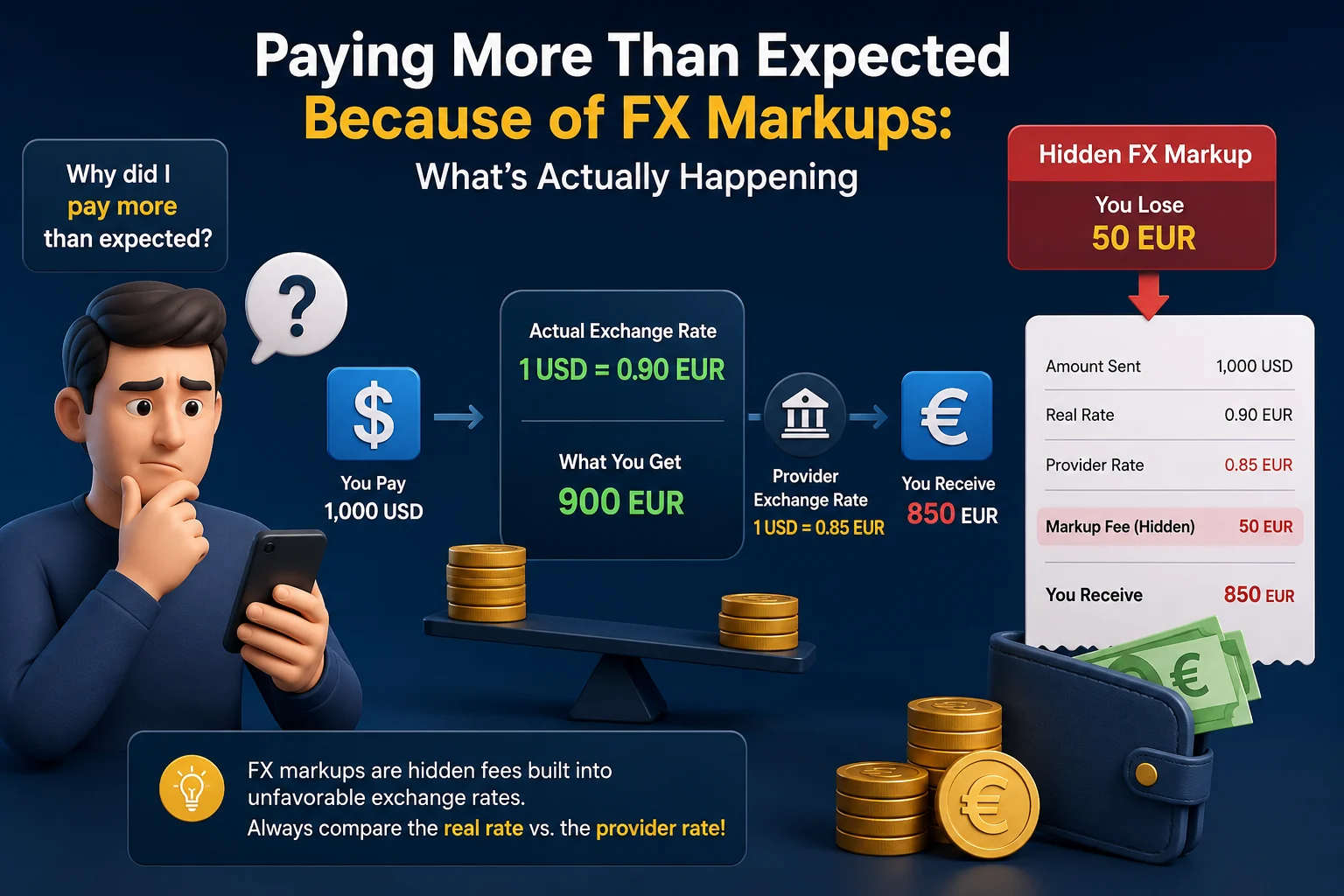
Dynamic Currency Conversion (DCC) is a feature offered by merchants, payment terminals, and ATMs that lets a customer pay in their home currency instead of the merchant’s local currency. It sounds like a convenience, and it’s marketed that way, but the exchange rate applied isn’t the real market rate. It’s the real rate plus a markup, and that markup is where the “paying more than expected” problem comes from.
Here’s the mechanism in plain terms: when a customer’s card is charged in a foreign currency, someone in the payment chain has to convert that amount. DCC intercepts that conversion at the point of sale, lets the customer see a single “all-in” number in their own currency, and embeds a markup directly into the exchange rate used, not as a separate line-item fee, but baked into the number itself. Unless a customer knows to compare that number against the real market rate, they have no easy way to tell they’ve been charged a premium.
How Big the Markup Actually Is
This isn’t a marginal cost. Reported markup ranges vary by source, but converge on a consistent pattern:
- Typical DCC markups run 3% to 7% above the wholesale interbank rate: according to multiple industry analyses.
- Some less transparent implementations show markups as high as 12-18%: above the real rate.
- On a $1,000 transaction, a DCC markup can add as much as $120 to the final charge, according to consumer finance reporting.
- Separate analysis of card-network FX markups more broadly found total markups often exceeding 3% of transaction value once network scheme rates, issuer-side foreign transaction fees, and point-of-sale markups are all layered together.
The gap between these figures and what a customer actually expects to pay is exactly what generates the complaints, chargebacks, and trust erosion driving searches for this topic in the first place.
Where the Markup Actually Comes From, It’s Not One Fee, It’s Several Layered On Top of Each Other
A single cross-border transaction can pick up markup at multiple points in the chain, and understanding each layer matters for anyone trying to actually reduce the cost rather than just complain about it:
- Card network “scheme rates”: Visa and Mastercard apply their own conversion rate, which already differs from the pure interbank rate.
- Issuer-side foreign transaction fees: the customer’s own card-issuing bank often adds a separate percentage on top, frequently in addition to any DCC markup.
- Point-of-sale or gateway markup: the merchant’s payment gateway or the DCC provider itself adds its own spread on top of the network rate.
- Merchant and acquirer commission: in many DCC arrangements, the acquiring bank and merchant receive a rebate or commission on each DCC transaction accepted, which is part of why DCC gets actively promoted at checkout rather than being a neutral option.
Each layer is individually modest-sounding, but stacked together, they explain why some real-world markups reach into double digits despite each individual party’s fee appearing reasonable on its own.
Why This Matters More for Certain Businesses
Any business processing online payments or digital payments across borders is exposed to this, but the impact compounds for specific categories:
- Subscription and recurring-billing businesses: where a customer notices the markup repeatedly rather than once, making trust erosion cumulative rather than a single bad experience.
- High-value transaction businesses: including iGaming payment and Casino Payment operations, where transaction sizes are often larger than typical retail purchases, so a 3-7% markup translates into meaningfully larger absolute costs per transaction.
- Platforms working with high-risk merchants or offshore merchants: structures, where cross-border settlement is already more complex, and an added, poorly disclosed FX layer compounds existing cost unpredictability for both the business and its customers.
Regulatory Pressure Is Increasing Transparency Requirements
This isn’t going unnoticed by regulators. Card network rules from Visa and Mastercard now require that customers actively choose DCC rather than have it applied by default, and mandate neutral presentation in how the choice is offered. In the EU specifically, payment transparency rules require clear disclosure of markups compared to the European Central Bank’s reference rate, meaning merchants operating in or serving EU customers face a growing compliance obligation to make FX costs explicit rather than embedded.
What Merchants and Platforms Can Actually Do About It
1. Choose payment providers that pass through the real rate
A growing number of payment providers differentiate themselves specifically by passing through the mid-market rate directly and charging an explicit, separate fee instead of a hidden markup. This is a genuine differentiator worth prioritizing when evaluating merchant accounts and payment processing relationships, since transparent pricing builds customer trust in a way embedded markups actively undermine.
2. Make DCC genuinely optional, not a soft default
If you offer DCC as a feature, ensure staff and checkout flows present it neutrally, “would you like to pay in your card’s currency or local currency?”, rather than steering customers toward it. Compliance with Visa and Mastercard’s neutrality requirements isn’t just a legal obligation; it’s also the difference between a customer feeling informed versus feeling misled after the fact.
3. Publish rate comparisons openly
Keeping your FX conversion margin competitive and transparent, and being willing to show customers how your rate compares to the ECB or interbank reference rate, directly addresses the “hidden fee” perception that drives complaints and chargebacks in the first place.
4. Consider alternative settlement rails for high-volume corridors
For businesses processing significant cross-border volume, alternative payment methods, including crypto payments and stablecoin-based settlement, are increasingly offered specifically because they provide a more transparent path for global value movement, bypassing several of the layered markup points that traditional card-based cross-border transactions accumulate.
5. Audit your own payment chain for stacked fees
If you’re a merchant rather than a platform, request a full breakdown from your payment gateways or acquiring bank showing every layer applied to a cross-border transaction, network rate, issuer fee, DCC markup, and any commission structure. This is the only reliable way to know whether you’re inadvertently passing excessive costs to customers or losing margin to markup you weren’t aware you were paying.
Practical Takeaway
FX markups aren’t inherently dishonest, some of that spread genuinely funds currency hedging, compliance overhead, and treasury management that keeps cross-border payment infrastructure functioning. But the gap between disclosed and undisclosed markup is exactly what turns a reasonable cost of doing business into a trust problem. Whether you’re a merchant trying to stop losing customers to unexpected charges, or a platform building merchant services for a global customer base, the fix is the same: choose transparent-rate providers, disclose markup clearly where it exists, and treat FX cost visibility as a competitive advantage rather than a detail to obscure.
Comments
No comments yet. Be the first to share your thoughts.
Leave a comment