
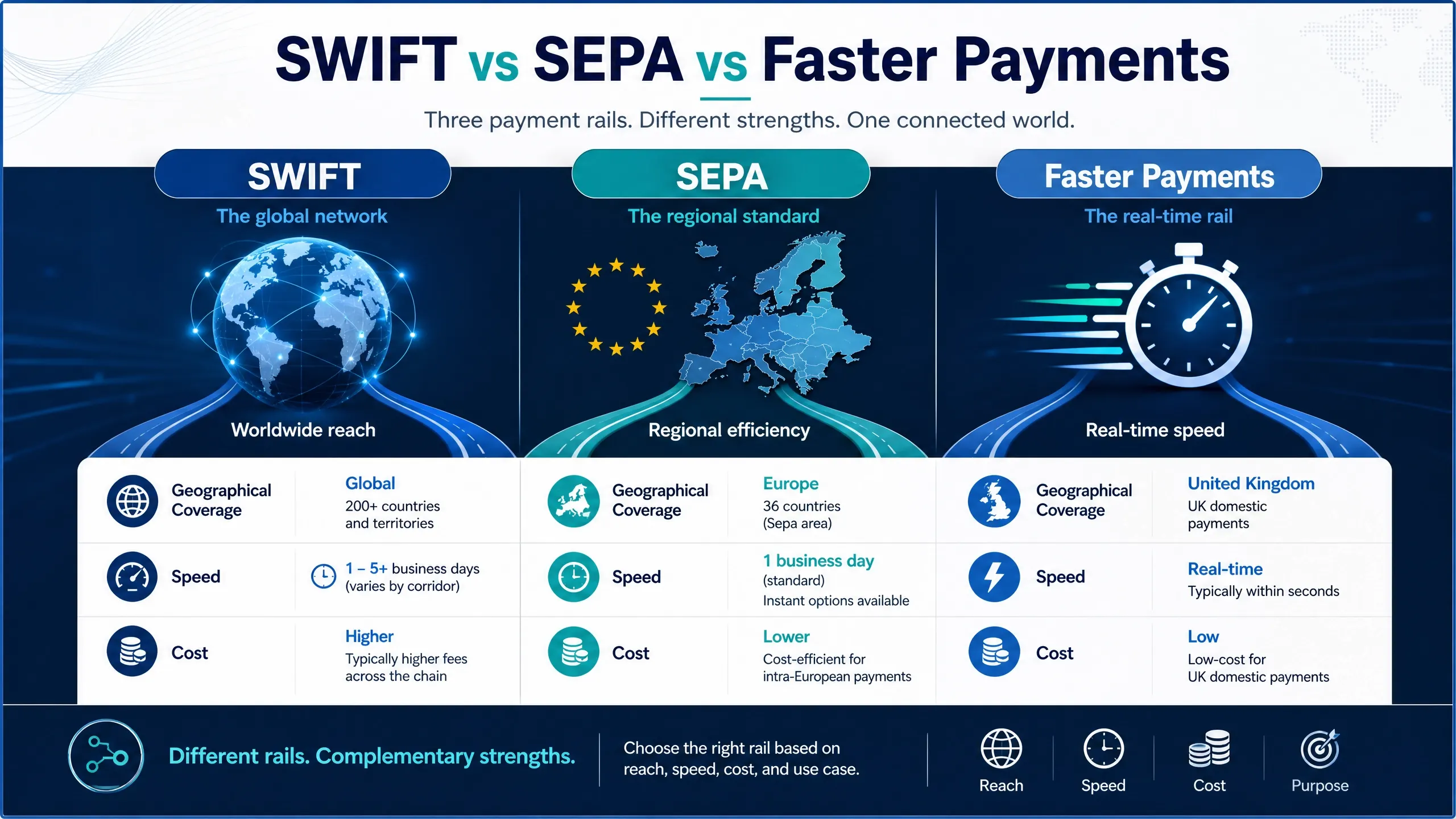
Choosing between SWIFT vs SEPA vs Faster Payments isn’t really a question with one universal answer. Each rail was built for a different job, global correspondent banking, eurozone credit transfers, and UK domestic settlement, respectively, and the right choice depends on currency, corridor, speed requirement, and cost tolerance. For payment-ops and treasury teams managing multi-market operations in 2026, getting this wrong means unnecessary fees, slower settlement, or compliance friction that shows up months later during a reconciliation review.
TL;DR
SWIFT remains the backbone for cross-border payments outside the eurozone and for high-value, multi-currency transfers, but it now runs on ISO 20022 messaging with a hard structured-address deadline in November 2026. SEPA (specifically SCT Inst) is mandatory across the euro area as of October 2025 and settles euro-denominated transfers in under 10 seconds, 24/7/365. Faster Payments is the UK’s domestic real-time rail, now supporting transactions up to £1 million, with its underlying infrastructure under review through the Payments Vision Delivery Committee. The right rail depends on currency, destination, and how much your payment gateway or ERP can support in structured data. Most global treasury operations will use all three rails for different flows rather than standardizing on just one.
The Core Difference: What Each Rail Actually Does
Before comparing costs and speed, it helps to be precise about what these three rails are:
- SWIFT: is a global messaging network, not a payment rail itself. It carries payment instructions between banks worldwide, and the actual settlement happens through correspondent banking relationships or real-time gross settlement (RTGS) systems.
- SEPA: is a eurozone payment scheme that standardizes euro-denominated transfers across 36 countries. SEPA Credit Transfer (SCT) and its instant variant, SCT Inst, both fall under the SEPA umbrella.
- Faster Payments: is the UK’s domestic real-time payment system, operated by Pay.UK, designed for near-instant sterling transfers between UK bank accounts.
None of these directly compete with each other in every scenario, they serve overlapping but distinct use cases, which is why most payment processing setups end up using more than one.
SWIFT: Global Reach, Now Running on ISO 20022
SWIFT is still the default choice for cross-border payments that fall outside the eurozone or involve currencies other than GBP and EUR. Its strength is universal reach, SWIFT connects over 11,000 institutions across 200+ countries, but that reach comes with tradeoffs in speed and cost compared to domestic real-time rails.
What’s changed for 2026:
- The coexistence period between legacy MT messages and the ISO 20022 (MX) standard ended in November 2025. All cross-border payment instructions must now use ISO 20022 messages.
- From January 2026, SWIFT began charging additional fees for institutions still relying on contingency processing or in-flow MT-to-MX translation, a clear financial incentive to complete the migration.
- The next major deadline lands on 14 November 2026: unstructured postal addresses will be rejected outright. Only hybrid or fully structured addresses (with Town and Country fields at minimum) will be accepted across CBPR+ messages.
- Data from SWIFT shows a large share of payments still carry unstructured address data, meaning many institutions have real remediation work ahead before the deadline.
When SWIFT is the right rail:
- Cross-border payments in currencies outside GBP and EUR
- Corridors without a shared regional instant-payment scheme
- High-value institutional transfers requiring correspondent banking or RTGS settlement
- Payments needing SWIFT gpi tracking for end-to-end visibility
SEPA: Mandatory Instant Payments Across the Euro Area
SEPA has undergone the most significant regulatory shift of the three rails in the past two years. The EU’s Instant Payments Regulation (IPR), in force since April 2024, turned SCT Inst from a voluntary scheme into a mandatory service for every payment service provider offering standard SEPA credit transfers.
Key 2026 milestones payment-ops teams should track:
- Since January 2025, PSPs in the euro area must be able to receive instant euro credit transfers within 10 seconds, 24/7/365, at no higher cost than a standard transfer.
- Since October 2025, PSPs must also be able to send instant transfers, and Verification of Payee (VoP) became mandatory, a free service that checks the payee’s name against their IBAN before a transfer executes.
- PSPs outside the euro area but within SEPA face extended deadlines (2027 for receiving, 2028 for e-money institutions), but competitive pressure means many are adopting ahead of schedule.
- The updated SCT Inst rulebook refines the execution window into three sub-limits (5, 7, and 9 seconds) covering maximum execution time, timeout safeguards, and confirmation deadlines.
- By November 2026, SEPA Instant will require structured or hybrid address formats, mirroring the SWIFT deadline.
When SEPA is the right rail:
- Euro-denominated payments within the SEPA zone
- Use cases needing near-instant settlement with fee parity to standard transfers
- Merchant and consumer flows increasingly running through Pay-by-Bank and account-to-account schemes built on SCT Inst rails
- Situations where regulatory VoP checks materially reduce fraud exposure
Faster Payments: The UK’s Real-Time Domestic Rail
Faster Payments handles the vast majority of UK domestic bank transfers, operating 24/7 with near-instant settlement for sterling payments between UK accounts.
What’s relevant in 2026:
- The per-transaction limit was raised to £1 million, giving corporate treasury teams considerably more room for high-value domestic transfers without falling back on CHAPS.
- The long-planned New Payments Architecture (NPA), intended to replace Faster Payments’ underlying infrastructure, was found insufficiently agile following the Garner Review. A new Payments Vision Delivery Committee, working with the Bank of England, FCA, and PSR, is now defining a more incremental upgrade path rather than a full-scale rebuild.
- CHAPS continues its own modernization, including ISO 20022 messaging updates and a published roadmap for extended RTGS settlement hours.
- The CHAPS authorised push payment fraud reimbursement limit remains at £85,000, a figure relevant to any UK-based treasury team weighing CHAPS against Faster Payments for high-risk transfers.
When Faster Payments is the right rail:
- Sterling payments between UK bank accounts
- Same-day or near-instant domestic settlement needs
- Payroll, supplier payments, and B2B transfers where CHAPS’ higher cost isn’t justified by the transaction value
- Scenarios where £1 million or less per transaction is sufficient
Side-by-Side Comparison
| Factor | SWIFT | SEPA (SCT Inst) | Faster Payments |
|---|---|---|---|
| Coverage | Global | Euro area (36 countries) | UK domestic |
| Settlement speed | Minutes to days (varies by corridor) | Under 10 seconds | Seconds |
| Currency | Any (typically multi-currency) | EUR only | GBP only |
| Availability | Business hours + correspondent chain | 24/7/365 | 24/7/365 |
| Per-transaction limit | No universal cap; bank-dependent | Varies by PSP | £1 million |
| Messaging standard | ISO 20022 (mandatory since Nov 2025) | ISO 20022 | ISO 8583, migrating toward ISO 20022 via NPA |
| Key 2026 deadline | Structured addresses mandatory Nov 14, 2026 | Structured addresses mandatory Nov 2026 | NPA scope under review |
| Typical use case | Cross-border, multi-currency, high-value | Eurozone instant transfers | UK domestic real-time payments |
What This Means for Payment Operations and Merchant Infrastructure
For treasury and payment-ops teams, the practical answer to “which rail should you use” is almost always “the one that matches the currency and corridor” rather than a single default. A payment stack built around modern payment gateways typically routes SEPA for euro transfers, Faster Payments for UK sterling, and SWIFT for everything else, with cross-border payments infrastructure increasingly expected to route intelligently between rails based on destination and cost.
This also matters directly for merchant accounts and merchant services providers supporting international sellers, including travel companies and other cross-border merchants managing supplier payouts across currencies. A merchant paying an overseas hotel partner in euros benefits from SEPA Instant’s speed and fee parity, while paying a US-based vendor still routes through SWIFT. Providers offering a genuine high-risk payment gateway for complex verticals need to support all three rails cleanly, since forcing every payout through a single rail regardless of currency adds cost and delay that merchants ultimately absorb.
The structured-data requirements arriving across SWIFT and SEPA in November 2026 also have downstream implications for payment wallets, digital payments platforms, and any payment providers handling online payments with cross-border legs, address data quality that was acceptable in 2024 will start causing rejections if it isn’t remediated well ahead of the deadline.
Action Items for Payment-Ops and Treasury Teams
- Audit which payment flows still rely on unstructured addresses and prioritize remediation before November 2026
- Confirm your correspondent banks and PSPs have fully migrated off MT-to-MX contingency processing to avoid the new 2026 conversion fees
- Reassess Faster Payments’ £1 million limit against current CHAPS usage to identify cost-saving opportunities
- Track the Payments Vision Delivery Committee’s Forward Plan for updates affecting UK domestic rail infrastructure
- Ensure SEPA Instant readiness includes Verification of Payee integration, not just instant settlement capability
Related Guides
- Cross-Border Payments Infrastructure: What Global Merchants Need in 2026
- Payment Gateway Comparison: What Merchants Should Evaluate in 2026
- High-Risk Payment Gateways vs. Standard Gateways: What Merchants Need to Know
- Global Payout Intelligence: Optimizing Cross-Border Settlement
FAQs
Is SWIFT being replaced by SEPA or Faster Payments?
No. SWIFT serves global, multi-currency cross-border payments, while SEPA and Faster Payments are regional schemes for euro and sterling transfers respectively. They coexist rather than compete directly.
Why did SWIFT start charging extra fees in 2026?
SWIFT introduced charges for legacy MT message contingency processing and in-flow translation starting January 2026 to accelerate full adoption of the ISO 20022 standard across the network.
What happens if my payment messages still use unstructured addresses after November 2026? Cross-border payments through SWIFT with unstructured address data will be rejected outright after the deadline. SEPA Instant carries a similar structured-address requirement around the same time.
Is SEPA Instant free to use?
PSPs cannot charge more for instant transfers than they charge for standard SEPA credit transfers, per the EU’s Instant Payments Regulation.
What’s the maximum Faster Payments transfer amount?
Up to £1 million per transaction, though individual banks may set lower limits for their own risk management purposes.
Do travel and merchant businesses need to think about these rail differences?
Yes, particularly for cross-border supplier payouts. Choosing the right rail per currency and corridor can reduce fees and settlement delays compared to routing everything through a single default rail.
Is the UK’s Faster Payments system being replaced soon?
Not immediately. The New Payments Architecture project was scaled back after review, and a new committee is now defining incremental upgrades to the existing Faster Payments infrastructure rather than a full replacement.
Comments
No comments yet. Be the first to share your thoughts.
Leave a comment