
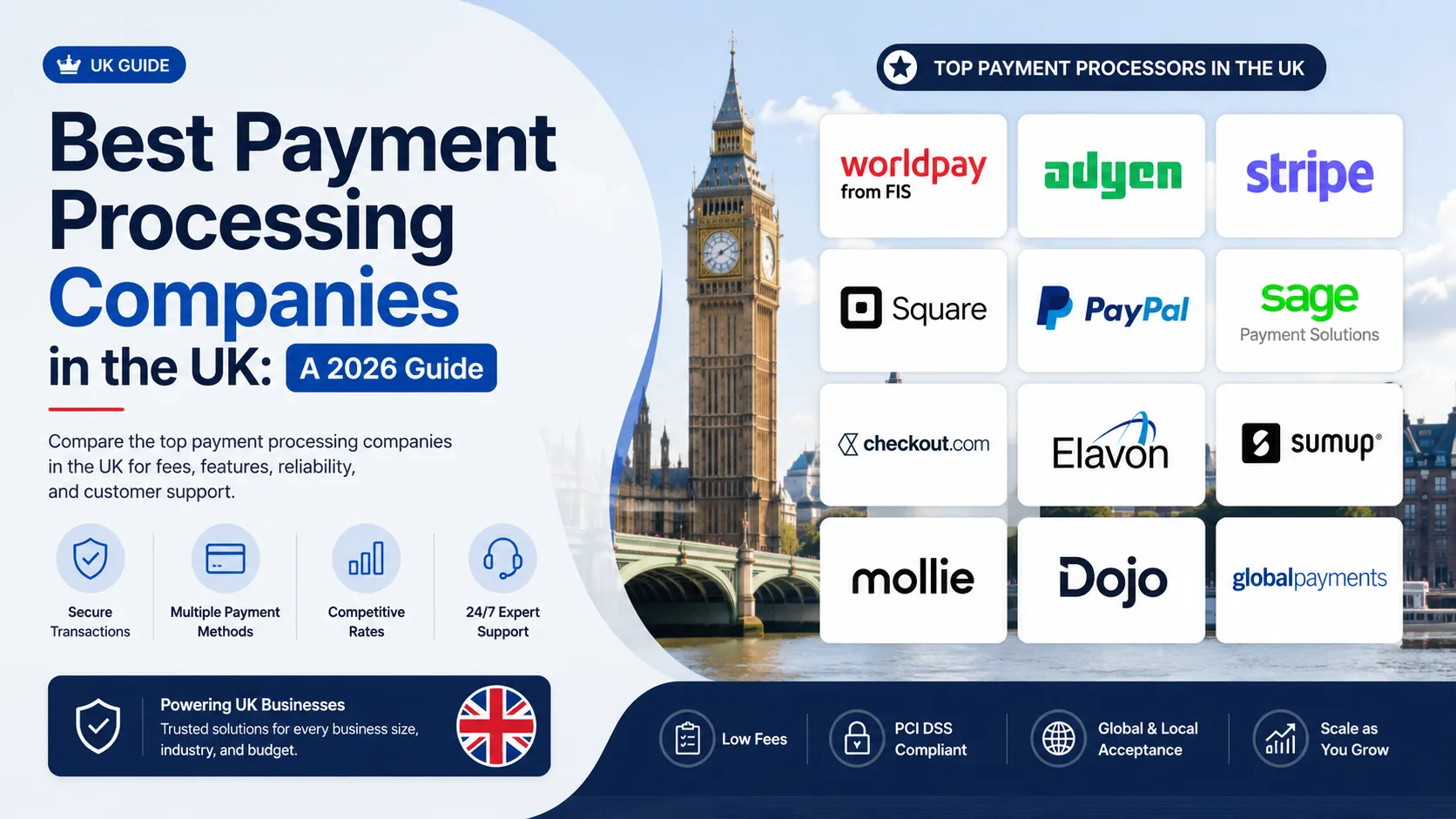
There were more than 2,000 payment service providers operating in the UK by 2024, and that number has only grown since. Finding the right payment processing UK businesses actually need means looking past the marketing pages toward what genuinely matters: FCA authorisation, real fee transparency, and whether a provider’s infrastructure fits how your business actually takes payments.
TL;DR
The UK’s leading payment processing companies in 2026 span bank-backed acquirers like Worldpay and Barclaycard, developer-first platforms like Stripe and Checkout.com, and full-stack finance platforms like Airwallex. Around 84% of UK SMEs prefer a single provider that bundles merchant account, gateway, and processing together rather than piecing together separate tools. Pricing ranges from roughly 0.69% to 1.75% depending on volume and card-present versus online transactions, with FCA authorisation and PSD2 Strong Customer Authentication now baseline requirements across the market. Travel companies typically need to look beyond this mainstream list, since delayed service delivery and elevated chargeback rates push many of these processors to decline or restrict travel merchant accounts.
What “Payment Processing” Actually Covers in the UK Market
A payment processor is the infrastructure that authorises, verifies, and settles a card transaction between a customer’s bank and a business’s account. In practice, the term overlaps heavily with payment gateways and merchant accounts, since most UK providers now bundle all three into a single product rather than requiring businesses to assemble them separately. This bundled approach is now the default: the large majority of UK SMEs source their entire card-acceptance stack, merchant services, gateway, and processing, from one provider rather than mixing vendors.
What to Evaluate Before Choosing a UK Processor
- FCA authorisation status: confirm the provider or its acquiring partner is properly regulated, which underpins fund safeguarding and dispute handling
- PSD2 and Strong Customer Authentication support: 3D Secure 2 is now standard, and how cleanly a provider handles SCA exemptions affects checkout conversion directly
- Pricing transparency: flat-rate, blended, or interchange-plus (sometimes written interchange++), and whether the quoted rate reflects your actual card mix
- Contract flexibility: many modern providers operate pay-as-you-go with no minimum term, while traditional acquirers often still require negotiated multi-year contracts
- Settlement speed: next-day payouts are now common; same-day or weekend settlement remains a genuine differentiator
- Cross-border capability: relevant for any UK business accepting online payments or digital payments from customers outside the UK
Leading Payment Processing Companies in the UK
Worldpay
Worldpay is the UK’s largest payment processor by transaction volume, processing roughly 40% of all card transactions in the country. Founded in the UK and now part of FIS, it supports in-store, online, and phone payments with direct connections to all major card schemes. Pricing is custom-quoted rather than published, which suits large enterprises and high-volume retailers well but offers less upfront transparency for smaller businesses.
Barclaycard
As the acquiring arm of Barclays, Barclaycard processes roughly one in three UK card transactions and offers a full suite spanning in-store terminals, online gateways, and phone payments. Its main advantage is direct integration with Barclays business banking, which can speed settlement for existing Barclays customers. Pricing requires a custom quote, and contract terms can be less flexible than newer fintech alternatives.
Stripe
Stripe has built a strong UK presence since launching in 2016, and its developer-friendly APIs, extensive plugin ecosystem, and transparent pay-as-you-go pricing make it a common default for online-first businesses, SaaS companies, and startups. It supports over 135 currencies, though it’s less suited to businesses primarily wanting a simple in-person card reader, a gap Stripe Terminal has increasingly closed.
Checkout.com
Headquartered in London, Checkout.com offers a unified API covering card acquiring, alternative payment methods, and payouts across over 150 currencies. Unlike flat-rate competitors, Checkout.com typically quotes interchange-plus pricing, which tends to be more cost-effective for businesses processing above roughly £500,000 a month, and it’s built with strong multi-currency settlement and real-time reporting.
Adyen
Adyen combines gateway software with its own merchant acquiring and processing infrastructure, and its UK client base includes well-known retail and entertainment brands. Its fee structure typically combines a fixed per-transaction fee with a percentage that varies by payment method, plus interchange. Adyen’s investment in in-house technology suits businesses wanting deep customisation over their checkout experience, more than smaller merchants wanting simplicity.
Airwallex
Airwallex operates as a broader finance platform rather than a processor alone, combining payment acceptance with multi-currency accounts, corporate cards, and expense management in one dashboard. It supports payment acceptance in 130+ currencies with over 160 local payment methods, and settlement in 14+ currencies without forced conversion, making it a strong fit for UK businesses with meaningful cross-border payments exposure.
Square, Dojo, and SumUp
For smaller UK businesses and in-person sellers, Square, Dojo, and SumUp all offer accessible card-reader-based processing with limited or no monthly commitment. Square and SumUp suit low-to-moderate volume retail and hospitality businesses well, while Dojo has built a strong reputation for fast next-day payouts, though its bespoke pricing typically requires a sales conversation rather than a published rate.
Comparison Snapshot
| Provider | Pricing Model | Best For |
|---|---|---|
| Worldpay | Custom, volume-based | Large enterprises, high-volume retailers |
| Barclaycard | Custom, bank-integrated | Established businesses banking with Barclays |
| Stripe | Pay-as-you-go, transparent | Online-first, developer-led businesses |
| Checkout.com | Interchange-plus | Higher-volume, multi-currency businesses |
| Adyen | Blended, per-scheme | Businesses wanting deep checkout customisation |
| Airwallex | Custom, multi-currency | International-facing businesses |
| Square / SumUp | Flat-rate | Small, in-person, or low-volume sellers |
| Dojo | Custom, bespoke | Hospitality and retail wanting fast payouts |
Payment Processing vs. Standalone Gateways
Some businesses still assemble a separate gateway and merchant account rather than using a bundled processor. This modular approach can suit businesses with very specific technical requirements or existing banking relationships they want to keep separate from their checkout technology. For most UK SMEs, however, a bundled processor reduces vendor management overhead and simplifies reconciliation, which is part of why the bundled model has become the clear market default rather than the exception.
Compliance Context Shaping 2026
- FCA authorisation remains the baseline check: Every processor on this list operates under FCA oversight either directly or through a regulated acquiring partner, which underpins how safeguarded funds and disputes are handled.
- PSD2 and Strong Customer Authentication are now standard, not optional: 3D Secure 2 authentication is expected across UK payment providers, and how well a provider manages SCA exemptions has a real, measurable effect on checkout abandonment.
- Interchange fee regulation still caps domestic rates: UK consumer debit interchange typically runs around 0.2%, with consumer credit capped at 0.3%, though these caps don’t apply to commercial cards or many cross-border transactions.
- Post-Brexit cross-border complexity persists: Businesses processing card payments between the UK and EU continue to navigate different interchange treatment than purely domestic UK transactions, which affects total cost for cross-border sellers.
Why Travel Companies Need a Narrower Shortlist
The processors above serve the mainstream UK market well, but travel companies typically don’t fit the risk profile most of these providers underwrite for by default:
- Delayed service delivery increases underwriting caution: Customers often pay months before a trip occurs, a pattern most mainstream UK processors treat conservatively or decline outright.
- Chargeback rates run structurally higher in travel: Cancellations, schedule changes, and itinerary disputes push dispute ratios above what standard processing agreements are built to absorb.
- Multi-currency, cross-border payments are the default, not the exception: UK travel businesses paying overseas suppliers while collecting customer payments in multiple currencies need infrastructure built for that complexity from day one, not bolted on afterward.
- Standard payment wallets and checkout flows don’t address supplier-side needs: Accepting payment wallets at checkout solves only half the picture for travel businesses that also need reliable multi-currency payout infrastructure.
For UK travel companies, the realistic path is usually a high-risk payment gateway provider or a specialist merchant services partner experienced in travel underwriting, rather than attempting to force volume through a mainstream processor built for lower-risk retail and SaaS businesses.
Final Thoughts
There’s no single best payment processor for every UK business, Worldpay and Barclaycard suit large, established operations wanting bank-backed infrastructure, Stripe and Checkout.com fit online and multi-currency businesses well, and Square or SumUp serve small in-person sellers effectively. Travel companies and other high-risk categories need to look beyond this mainstream shortlist entirely, toward providers built specifically for their risk profile and cross-border payment needs.
FAQs
What’s the difference between a payment processor and a payment gateway?
In practice the terms overlap heavily in the UK market, since most processors now bundle gateway functionality in. Technically, a gateway handles the transaction’s technical routing, while a processor manages authorisation and settlement.
Which UK payment processor is cheapest for small businesses?
It depends on volume and transaction type. Card-present pay-as-you-go readers like SumUp or Square suit low-volume sellers, while interchange-plus pricing from providers like Checkout.com becomes more cost-effective as volume grows.
Do UK payment processors need to be FCA regulated?
Providers operating in the UK payments space are generally regulated by the FCA directly or partner with an FCA-authorised acquirer, which underpins fund safeguarding and compliance.
Can travel companies use mainstream UK payment processors?
Often with difficulty. Delayed service delivery and elevated chargeback rates lead many mainstream processors to decline or heavily restrict travel merchant accounts.
What percentage of UK SMEs use a single payment provider for everything?
Around 84% of UK SMEs buy their merchant account, gateway, and processing from a single provider rather than combining separate vendors.
Is Strong Customer Authentication required for all UK card transactions?
SCA under PSD2 applies broadly to UK and EU card-not-present transactions, with certain low-value or low-risk transactions eligible for exemptions depending on the issuing bank’s risk assessment.
How much do UK payment processing fees typically cost?
Rates generally range from about 0.69% to 1.75% depending on the pricing model, card-present versus online transaction type, and monthly volume.
Comments
No comments yet. Be the first to share your thoughts.
Leave a comment