
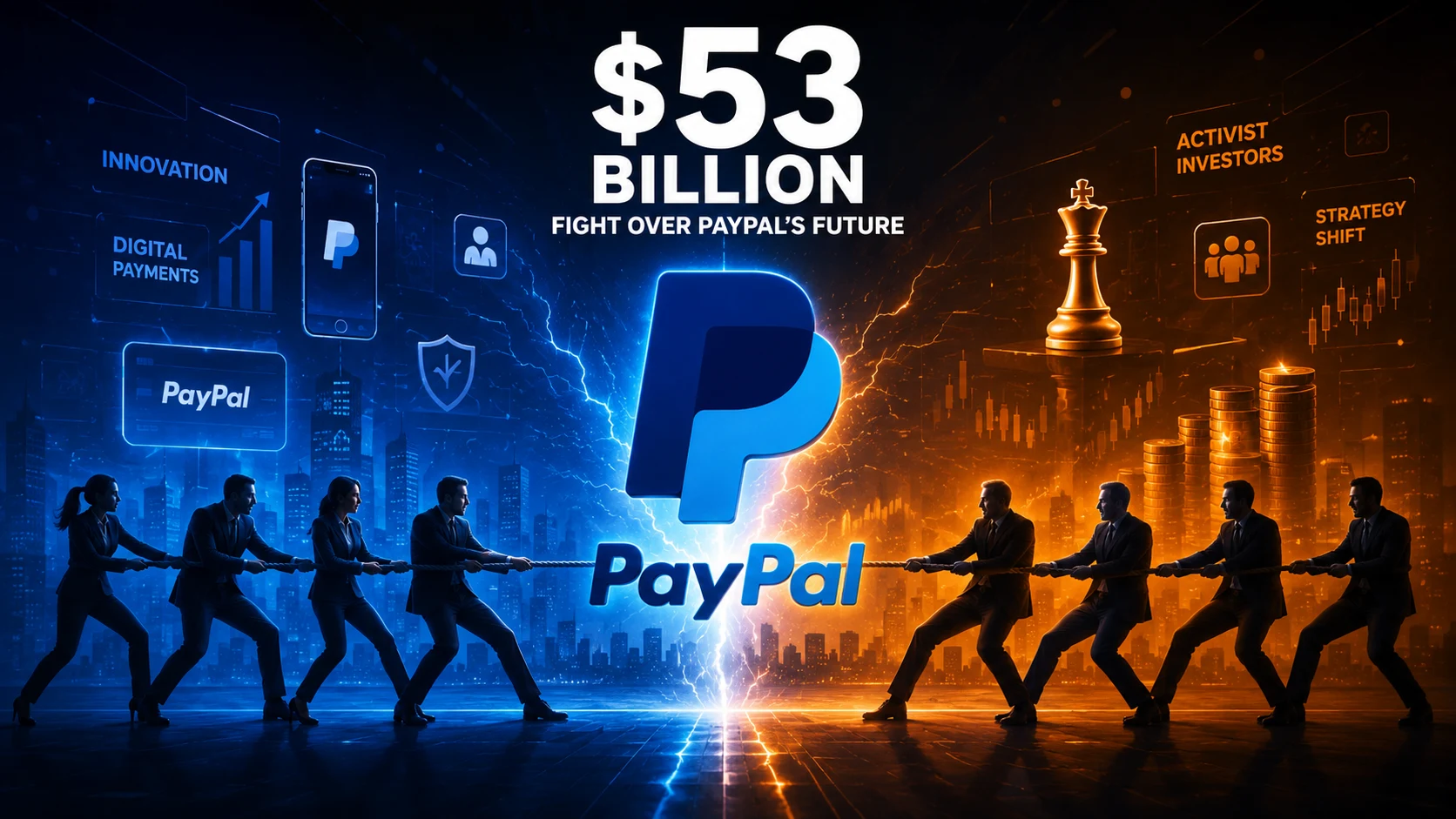
For a few days in mid-July, the payments industry watched something it hadn’t seen in years: one of the founding names of online commerce, sitting on the table as a takeover target for a company that didn’t exist when PayPal was already processing billions of dollars in payments.
Then, on July 20, PayPal’s board said no.
The rejection of a joint $53 billion offer from Stripe and private equity firm Advent International doesn’t end the story, if anything, it opens the most consequential chapter yet in what could become the largest acquisition in fintech history. What started as a quiet approach in February has turned into a very public standoff over what PayPal is actually worth, and the answer will shape the payments landscape for merchants, competitors, and consumers for years to come.
How We Got Here
The current bidding saga traces back further than most people realize. Reports of preliminary Stripe-PayPal discussions first surfaced in late February 2026, sending PayPal shares up roughly 7% on the mere possibility of a deal. At the time, PayPal was trading at a discount that made it an obvious target: shares were down sharply from their 52-week high, the stock was changing hands at around eight times projected 2026 earnings, and investor patience with the company’s repeated turnaround promises was wearing thin.
Those early conversations went nowhere publicly for months. Then, in mid-July, Reuters and CNBC confirmed that Stripe and Advent International had submitted a formal, financed offer: $60.50 per share in cash, valuing PayPal at roughly $53 billion. The bid wasn’t a rumor anymore, it came backed by close to $50 billion in committed bank financing from JPMorgan and Morgan Stanley, with Stripe, Advent, and reportedly Jack Dorsey’s Block contributing around $17 billion in equity. Under the proposed structure, Stripe and Advent would each hold an equal stake and keep PayPal intact, rather than break the company apart for parts.
Markets reacted immediately. PayPal’s stock jumped as much as 17% on the news, capping a stretch that had already seen shares climb nearly 32% in the preceding month. The $60.50 offer represented a 28% premium over PayPal’s closing price the day before the bid became public, enough to turn heads, but, as it turned out, not enough to close a deal.
The Board Says It’s Not Enough
PayPal convened a special board meeting on July 20 to weigh the offer. According to people familiar with the discussions, directors concluded the bid undervalued the company and are now pushing for a price closer to $70 per share, nearly $10 above what Stripe and Advent put on the table.
The board isn’t negotiating in a vacuum. PayPal has retained Goldman Sachs and Evercore to run the process, weighing a higher-priced sale against the case for staying independent and letting its ongoing turnaround play out. That turnaround is real, if fragile: PayPal’s first-quarter transaction margin dollars rose 3% to $3.81 billion, beating Wall Street’s estimate of $3.67 billion. But branded checkout, historically the company’s highest-margin business and the product most associated with the PayPal name, grew just 2%, a sign that the core franchise is still searching for momentum even as peripheral metrics improve.
Wall Street’s reaction to the rejection has been a mix of validation and skepticism. Citi analysts noted in early July that investors remain wary after PayPal’s previous turnaround efforts failed to reverse the underlying slowdown, a skepticism that helps explain why a 28% premium still felt cheap to the board. William Blair senior analyst Andrew Jeffrey put it plainly in a note to clients, writing that he didn’t expect PayPal’s new CEO to embrace what could be viewed as a low-ball offer, even while acknowledging the bid represented a meaningful premium over what traditional merchant processors typically command.
Price targets across the Street tell a similarly divided story. Mizuho and Macquarie have both held Neutral ratings with $50 targets, below the actual offer. Cantor Fitzgerald’s official target sits at $54, though the firm’s own sum-of-parts analysis reportedly implies a fair value closer to $70. Canaccord raised its target to $55 from $42, arguing that a sale is simply the faster route to shareholder value than a multi-year organic turnaround. And investor Michael Burry, who holds a disclosed position in PayPal, has been the most aggressive skeptic of the current price, estimating intrinsic value as high as $110 to $115 per share in his most bullish case, a number more than 80% above what’s currently on the table.
Why PayPal, and Why Now
To understand why Stripe would want PayPal at all, it helps to understand what each company actually is today. Stripe built its empire on the invisible side of payments: the infrastructure merchants plug into behind the scenes, rather than a brand consumers interact with directly. A February 2026 employee tender offer valued the company at roughly $159 billion, up about 70% from the year before, on the back of $1.9 trillion in total payment volume processed in 2025, a 34% year-over-year jump. What Stripe doesn’t have is PayPal’s direct relationship with consumers: 439 million active accounts, a recognizable checkout button on millions of websites, and Venmo, a peer-to-peer payments app with its own cultural footprint.
For PayPal, the calculus looks very different. This is a company that once carried a market capitalization north of $360 billion and has spent the years since fighting to prove it isn’t a legacy platform being quietly outflanked by newer, more nimble competitors. The stock lost roughly a third of its value in 2025 alone. Investor guidance for 2026 pointed to only a low-single-digit revenue increase alongside a high-single-digit decline in non-GAAP earnings per share, hardly the profile of a company in the middle of a convincing comeback.
Leadership turnover has compounded the pressure. PayPal’s board pushed out former CEO Alex Chriss earlier this year, concluding his turnaround plan wasn’t moving fast enough, and replaced him with former HP executive Enrique Lores. Lores took over in March and has moved quickly: reorganizing PayPal into three units covering checkout, consumer financial services and Venmo, and payments and crypto, while overseeing a restructuring plan that will cut roughly 20% of the company’s workforce, about 4,760 roles, over the next two to three years. The goal is at least $1.5 billion in annual run-rate savings, alongside a push to weave artificial intelligence more deeply into operations to cut duplication.
That’s the paradox at the center of this deal: PayPal is simultaneously showing early signs of stabilizing and still cheap enough, relative to its scale and brand, to attract one of the most ambitious buyers in payments. Whether that combination makes PayPal a bargain or a company on the verge of a real recovery is exactly what the board and the bidders are fighting over.
A Deal Without Precedent
Payments has seen big acquisitions before, but nothing quite at this scale involving two companies this central to how the internet moves money. For comparison, a $53 billion price tag would already rank among the largest fintech deals ever attempted, and analysts note that if the final number climbs toward the $70-per-share range the board is reportedly seeking, the transaction would comfortably clear that bar and stand as the largest fintech acquisition on record.
What makes the deal unusual isn’t just the size, it’s the direction. Stripe has spent its history building infrastructure that other companies build on top of, largely staying out of the consumer spotlight. Buying PayPal would mean absorbing a company with the opposite profile: a household-name brand, a massive existing user base, and years of built-up consumer trust and habit around its checkout button. That’s a very different kind of asset than the API-first tooling Stripe is known for, and integrating the two, culturally as much as technically, would be a project unlike anything either company has attempted.
What Happens Next
Nothing about the July 20 rejection suggests Stripe and Advent are walking away. Both sides are reportedly working toward an agreement before the end of July, and the consensus among analysts covering the situation is that the consortium returns with a sweetened offer rather than abandons months of work and tens of billions in committed financing.
The next real catalyst lands on July 28, when PayPal reports second-quarter earnings. Analysts are projecting earnings of roughly $1.28 per share on revenue near $8.52 billion. The outcome could swing the negotiation in either direction: a beat gives PayPal’s board fresh ammunition to argue the company is worth holding out for, while a disappointing quarter could hand leverage back to Stripe and Advent. Prediction market Polymarket has priced the odds of a PayPal acquisition happening before 2027 at around 82%, reflecting broad confidence that some deal gets done, even if the final price and structure look different from what’s on the table today.
Regulators will have their own say if a deal does materialize. A combination of Stripe and PayPal would merge two companies processing a combined multi-trillion-dollar volume of annual payments, a level of concentration that antitrust reviewers in both the US and EU have already flagged as a likely focus area for 2026 merger scrutiny. Even a friendly, board-approved deal at $70-plus per share would face a long road through regulatory review before anything changes for merchants on either platform.
Why Merchants Should Be Watching
For now, businesses running payments through Stripe or PayPal have no reason to change anything. Checkout flows, API integrations, and fee structures remain exactly as they were before the bid became public, and any completed transaction would come with a lengthy technical integration timeline rather than an overnight switch.
But the strategic stakes are hard to overstate. A combined Stripe-PayPal would pair the dominant merchant-infrastructure platform with one of the most recognized consumer payment brands in the world, at a scale no single competitor could easily match. For merchants who currently split volume across both providers to maintain leverage and redundancy, a merger would mean one fewer major alternative in the market. For competitors, from Adyen to smaller high-risk and offshore-focused processors, it could either open a window to pick up merchants wary of consolidation, or signal that further industry-wide consolidation is coming.
Either way, this is no longer a rumor to file away. It’s an active, financed, board-level negotiation with a hard deadline bearing down at the end of the month, and the outcome will say a lot about where the payments industry is headed next.
Comments
No comments yet. Be the first to share your thoughts.
Leave a comment