
Every card transaction a business accepts gets priced one of three ways, and most merchants never find out which one they’re actually on until they sit down and read a statement line by line. Understanding payment processing fees, and which pricing model is quietly costing you the most, is one of the highest-leverage things a business can do to protect margin in 2026.
TL;DR
There are three payment processing pricing models: interchange-plus, flat-rate, and tiered. Interchange-plus is the most transparent and typically 20-30% cheaper for businesses processing above $5,000-$10,000/month. Flat-rate offers predictable simplicity, favored by aggregators like Square and Stripe. Tiered pricing is the least transparent and usually the most expensive once real effective rates are calculated. For travel companies, the right model matters even more since it interacts directly with high-risk premiums and reserve terms.
What Actually Makes Up a Processing Fee
Before comparing models, it helps to understand the three components that sit inside every card transaction, regardless of which pricing model a processor uses:
- Interchange fees: paid to the card-issuing bank, set by Visa, Mastercard, and other networks, and non-negotiable through any processor
- Assessment fees: smaller fees paid to the card networks themselves, typically around 0.13%-0.15% of transaction value
- Processor markup: the only component that’s actually negotiable, and where pricing models genuinely differ from one another
Interchange rates vary significantly by card type, transaction method, and merchant category. A basic debit swipe might carry an interchange cost under 0.5%, while a premium rewards card or a card-not-present online transaction can run considerably higher. How a processor handles that variation, passing it through transparently or folding it into a blended rate, is what separates the three pricing models.
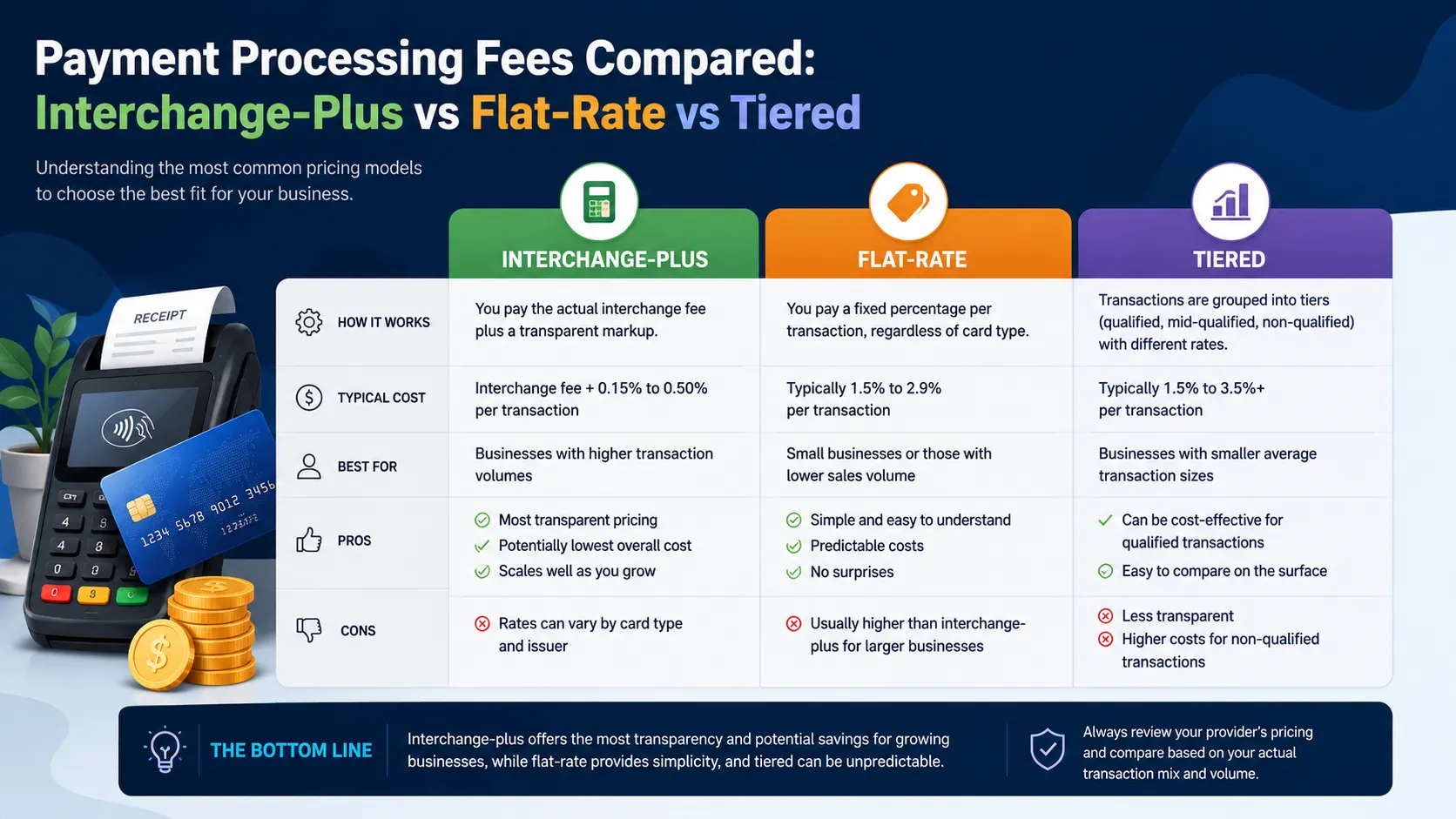
Interchange-Plus Pricing
Interchange-plus pricing (sometimes written IC+ or interchange++) itemizes each fee separately: the actual interchange rate, the assessment fee, and the processor’s own markup, shown as its own line on the statement. A typical 2026 markup for a small business runs interchange + 0.15%-0.30% + $0.08-$0.10 per transaction, with higher-volume merchants often negotiating markups closer to 0.10%-0.15%.
Advantages:
- Full transparency, merchants can see exactly what the card network charged and what the processor added
- Automatic savings on debit-heavy transaction mixes, since debit interchange is far lower than blended flat rates account for
- Markup is genuinely negotiable, unlike interchange and assessment fees
- Rate reductions from card networks pass through automatically, rather than being absorbed by the processor
Drawbacks:
- Monthly cost fluctuates with card mix, making budgeting slightly less predictable
- Statements are more complex to read and audit than a single blended rate
- Typically only available through dedicated merchant account providers, not payment aggregators
Interchange-plus tends to make the most financial sense for established businesses processing above roughly $5,000-$10,000 a month with a fairly predictable, mixed card volume.
Flat-Rate Pricing
Flat-rate pricing charges one consistent percentage plus a fixed fee on every transaction, regardless of the underlying interchange cost. This is the model used by most payment gateways built for aggregator-style onboarding, Square, Stripe, and PayPal all price this way, commonly landing around 2.6%-2.9% plus a per-transaction fee.
Advantages:
- Completely predictable, the same rate applies to every transaction, every time
- Fast onboarding with minimal underwriting, since aggregators absorb more risk into the blended rate
- Simple to understand without needing to parse interchange tables or card-mix data
Drawbacks:
- Businesses with a debit-heavy transaction mix effectively subsidize the flat rate’s protection against expensive rewards and corporate cards
- No benefit when card network interchange rates drop, since the blended rate stays fixed regardless
- Becomes measurably more expensive than interchange-plus as monthly volume grows
Flat-rate pricing is generally the better fit for new businesses, low-volume merchants under roughly $5,000/month, and anyone who values simplicity over squeezing out every percentage point of savings.
Tiered Pricing
Tiered pricing groups transactions into “qualified,” “mid-qualified,” and “non-qualified” buckets, each carrying a different rate. The advertised “as low as” rate applies only to the qualified tier, typically basic in-person debit or standard consumer credit swipes, while rewards cards, corporate cards, and card-not-present transactions routinely get pushed into the more expensive tiers.
Advantages:
- Onboarding is fast and the headline rate looks attractive to first-time business owners
- Simple three-tier structure requires no card-mix analysis to understand at a surface level
Drawbacks:
- The processor, not the merchant, decides which tier each transaction falls into
- Most real-world transactions fall outside the cheapest tier, driving the effective rate well above what’s advertised
- Statements rarely explain the classification logic clearly, making it difficult to audit or dispute
- Widely regarded across the payment processing industry as the least transparent and most expensive model over time
Tiered pricing is worth avoiding for almost any business with consistent volume, and it’s a common reason merchants eventually migrate to interchange-plus once they see their actual effective rate.
Cost Comparison at a Glance
| Factor | Interchange-Plus | Flat-Rate | Tiered |
|---|---|---|---|
| Transparency | Full line-item breakdown | Single blended rate | Opaque bucket classification |
| Typical cost at scale | Lowest for volume above $5K-$10K/month | Higher, especially for debit-heavy mix | Highest effective rate over time |
| Predictability | Fluctuates with card mix | Fully predictable | Unpredictable, processor-controlled |
| Best for | Established, higher-volume merchants | New or low-volume businesses | Rarely the best choice for anyone |
| Availability | Dedicated merchant accounts | Payment aggregators (Square, Stripe, PayPal) | Legacy and some traditional processors |
Real-world modeling consistently shows the gap widening with volume: businesses processing $25,000 or more per month commonly save several hundred dollars monthly by switching from flat-rate or tiered pricing to a well-negotiated interchange-plus arrangement.
Questions to Ask Any Processor
- What pricing model is this, specifically, interchange-plus, flat-rate, or tiered?
- Can you show me the exact interchange rates by card type on a real statement?
- What is your markup, separate from interchange and assessment fees?
- If tiered, how exactly do you determine which tier each transaction falls into?
- Can I see the full rate schedule in writing before signing anything?
A processor unwilling or unable to answer these clearly is worth walking away from, regardless of how attractive the advertised headline rate looks.
What This Means for Travel Companies
Travel businesses evaluating payment processing pricing models face an added layer of complexity most retail merchants don’t: high-risk classification already inflates the baseline cost of acceptance before pricing model even enters the conversation.
- Interchange-plus becomes more valuable, not less, for high-risk merchants: Since travel already carries a risk premium, the transparency of interchange-plus makes it easier to isolate exactly how much of the total cost is risk-based markup versus standard interchange, something a blended flat rate obscures entirely.
- Tiered pricing is particularly costly for travel’s transaction profile: Card-not-present bookings, high-value tickets, and international cards common in travel routinely fall into non-qualified tiers, and tiered structures in high-risk verticals are often built to protect the processor rather than the merchant.
- Rolling reserves interact with whichever pricing model is chosen: A travel company should evaluate reserve terms and pricing model together, since a slightly higher markup with lower reserve requirements can outperform a lower headline rate with aggressive fund holds.
- Multi-currency and cross-border payments add another variable: Travel companies serving international customers should confirm how each pricing model handles currency conversion and cross-border interchange, since these transactions often carry their own elevated rate categories.
- Merchant services partners with genuine high-risk experience matter more than the pricing label alone: A specialized high-risk payment gateway provider offering interchange-plus with clear, disclosed markup is generally a stronger fit for travel than a generalist processor’s flat-rate or tiered offer, even if the headline number looks lower.
Final Thoughts
There’s no universally “best” pricing model, interchange-plus wins on cost and transparency for established, higher-volume merchants, flat-rate wins on simplicity for smaller or newer businesses, and tiered pricing rarely wins for anyone once the real effective rate is calculated. What matters most is knowing which model you’re actually on, reading your statement well enough to verify it, and choosing a payment provider willing to show you the math rather than just the marketing rate. For travel companies and other high-risk merchants, that transparency matters even more, since pricing model and risk-based reserve terms compound together into the true cost of accepting payments.
FAQs
Which payment processing pricing model is cheapest overall?
Interchange-plus is typically the cheapest for businesses processing above roughly $5,000-$10,000 a month, since it passes through the true interchange cost rather than a padded blended rate.
Why do aggregators like Stripe and Square use flat-rate pricing?
Flat-rate simplifies onboarding and underwriting for aggregators, letting them approve merchants quickly by absorbing risk and card-mix variation into one predictable rate.
How can I tell which pricing model I’m currently on?
Check your statement: a single uniform rate on every transaction means flat-rate, categories labeled “qualified” or “non-qualified” mean tiered, and interchange shown as its own line with a separate markup means interchange-plus.
Is tiered pricing ever a good choice?
Rarely. It can look attractive to brand-new merchants due to an appealing advertised rate, but most transactions fall outside the cheapest tier, making the real effective rate higher than expected.
Does switching pricing models require switching processors?
Often yes, since interchange-plus is primarily offered through dedicated merchant account providers rather than payment aggregators, which are typically flat-rate only.
How much can a business realistically save by switching to interchange-plus?
Businesses processing $25,000 or more per month commonly save several hundred dollars monthly, with savings scaling further as volume and debit-card share increase.
Do high-risk businesses have access to interchange-plus pricing?
Yes, though it typically requires working with a processor or high-risk payment gateway provider experienced in the relevant industry, since not every processor offers interchange-plus to high-risk merchant categories.
Comments
No comments yet. Be the first to share your thoughts.
Leave a comment