
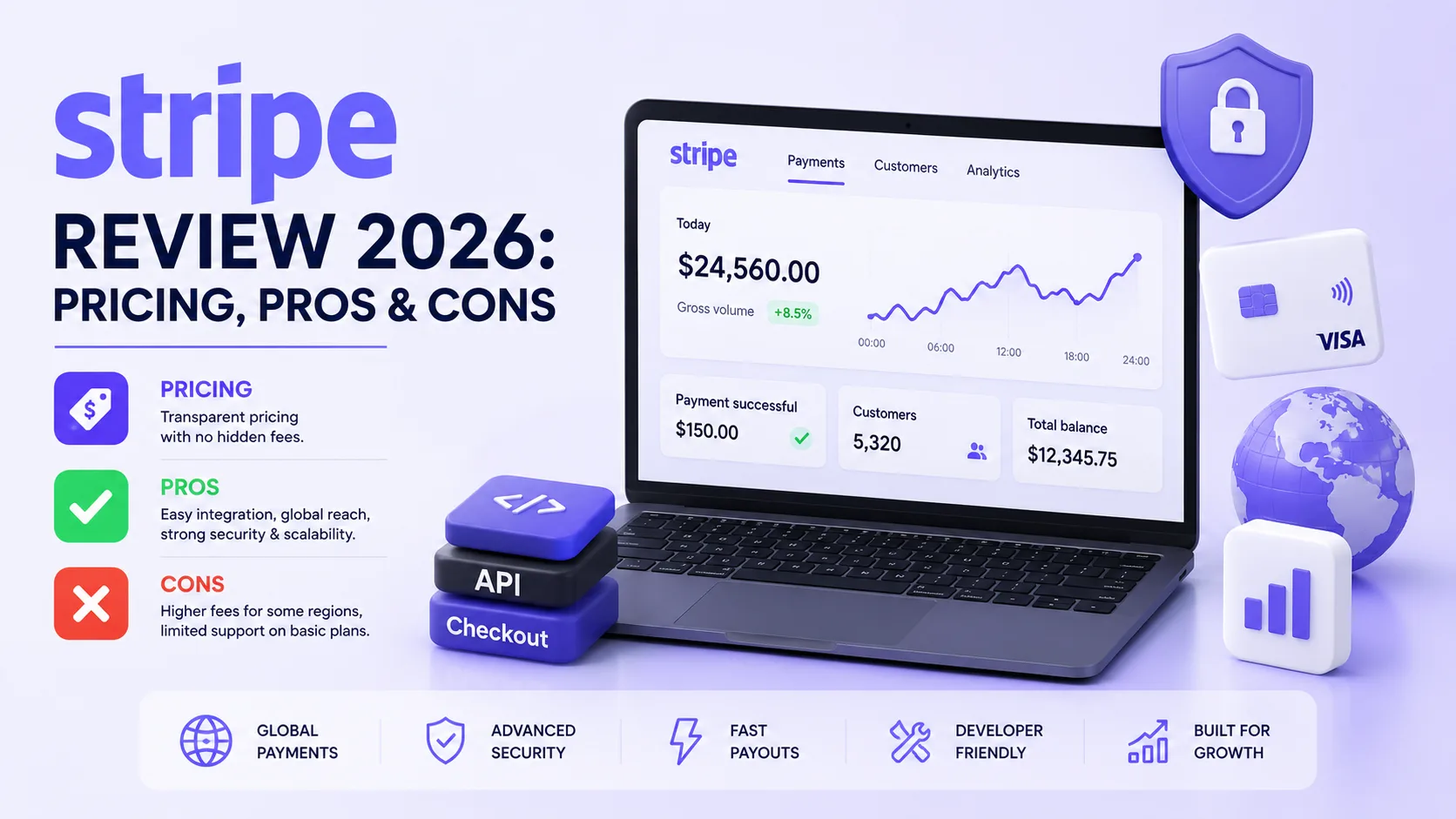
Stripe now processes more than $1.4 trillion in annual payment volume, powering everything from solo founder side projects to Amazon and Shopify. That scale makes it one of the default answers to “which payment gateway should I use”, but default doesn’t always mean best fit, and Stripe’s pricing and risk model reward some business types far more than others.
TL;DR
Stripe charges 2.9% + $0.30 per online US card transaction with no monthly or setup fees, making it a strong fit for developer-led, card-based businesses under roughly $500K in monthly volume. International cards, currency conversion, and disputes stack additional fees that can push the effective rate above 5% for global sellers. Its biggest strength is developer experience and integration breadth; its most consistent complaint is unpredictable account holds and fund freezes tied to its automated risk engine. Businesses with heavier compliance needs, high-risk classifications, or complex contract billing typically outgrow Stripe’s default toolset faster than its pricing page suggests.
Stripe Overview
Founded in 2010 by Patrick and John Collison, Stripe has grown from a simple card-processing API into a modular financial platform spanning payments, subscription billing, tax compliance, identity verification, and fraud prevention. Businesses pick and choose components rather than committing to an all-or-nothing suite, which is part of why it remains popular with technical teams building custom checkout and billing flows.
In 2026, Stripe expanded further into usage-based billing (via its acquisition of Metronome), stablecoin settlement through its Tempo chain, and an Agentic Commerce Suite built for AI-driven purchasing. These additions matter mostly for businesses with complex, usage-based, or AI-native billing models; most standard e-commerce and SaaS businesses will never touch them.
Stripe Pricing in 2026
Stripe’s core pricing is straightforward on the surface, with complexity emerging from add-ons and cross-border activity:
- Online card payments (US): 2.9% + $0.30 per successful transaction
- In-person payments (Stripe Terminal): 2.7% + $0.05 per transaction
- International cards: +1.5% on top of the base rate
- Currency conversion: +1% when settlement currency differs from the payment currency
- ACH Direct Debit: 0.8%, capped at $5 per transaction
- Manually keyed card entry: +0.5%, reflecting elevated card-not-present fraud risk
- Disputes/chargebacks: $15 per dispute, non-refundable regardless of outcome
- No setup fees, monthly fees, or cancellation fees on the standard pay-as-you-go plan
These fees stack. A US business accepting a European card paid in euros can see a combined rate near 5.4% + $0.30 once the base rate, international card fee, and currency conversion fee are all applied, a meaningful gap from the advertised headline rate that international-facing payment providers should model carefully.
Businesses processing $5 million or more annually can access Stripe’s Enterprise tier, with custom negotiated pricing. Several independent merchant advisories report that heavier-volume merchants have secured rates well below the standard 2.9% + $0.30 through direct negotiation, suggesting the advertised rate is more of a ceiling than a fixed price for serious volume.
Optional add-ons carry their own costs: Stripe Billing runs roughly 0.5%-0.8% of recurring volume for subscription businesses, Stripe Tax adds about 0.5%, and Stripe Identity verification costs $1.50 per check.
Pros
- Deep developer tooling: Stripe’s API, SDKs, and documentation are widely regarded as best-in-class, letting technical teams build highly customized checkout, billing, and online payments flows without fighting the platform.
- Broad international reach: Support for 135+ currencies and dozens of local payment methods lets businesses enter new markets without opening local bank accounts, a genuine advantage for cross-border payments.
- No monthly or setup fees on standard pricing: Businesses can start processing without upfront commitment, useful for testing a new market or product line.
- Strong built-in fraud tooling: Stripe Radar uses network-wide transaction data to score fraud risk in real time, included free on the standard plan.
- Modular product ecosystem: Billing, Tax, Identity, and Connect let growing businesses add capability without switching core payment processing providers.
- High security standard: Stripe holds PCI Service Provider Level 1 certification, the highest tier, with tokenization ensuring card data never touches a merchant’s own servers.
Cons
- Unpredictable account holds: The most consistent complaint across independent review platforms involves Stripe’s automated risk engine triggering sudden fund holds or account freezes, sometimes for 30-120 days, with limited explanation and slow resolution.
- International fees add up quickly: Combined international card and currency conversion fees can push effective rates well above domestic pricing, an issue for any business with meaningful non-domestic revenue.
- Dispute fees apply regardless of outcome: The $15 chargeback fee applies even when a merchant successfully wins the dispute, a frustration commonly raised in merchant communities.
- Reporting can feel thin for accounting purposes: Some reviewers describe Stripe’s default reporting as closer to a raw transaction log than a full merchant statement, requiring extra tooling for clean reconciliation.
- Not built for complex, high-risk, or ramped billing out of the box: Businesses with usage-based AI billing, tiered contract negotiations, or elevated risk categories often need supplementary tools or a different provider entirely.
- Support can slow during a crisis: Multiple review platforms report extended support response times during account freezes or urgent disputes, which can be costly for a business relying on Stripe as its sole payment rail.
Who Stripe Is Best For
Stripe fits most naturally for:
- US-first SaaS and e-commerce businesses with straightforward, card-based pricing under roughly $500K in monthly volume
- Marketplaces and platforms using Stripe Connect to manage payouts to multiple sub-merchants
- Technical teams that want deep API control over checkout and billing rather than a plug-and-play solution
- Businesses expanding internationally that value broad currency and payment-method support over the lowest possible processing rate
Where Stripe Falls Short
Stripe is a weaker fit for:
- Businesses needing complex, ramped, or negotiated contract billing, since Stripe doesn’t natively model tiered or ramped pricing schedules
- High-risk verticals that need dedicated underwriting relationships rather than an automated, algorithm-driven risk engine
- Businesses prioritizing predictable, itemized statements over Stripe’s more developer-oriented reporting format
- Merchants who’ve experienced, or want to avoid the risk of, a sudden account freeze disrupting cash flow with little warning
Stripe Alternatives to Consider
- Adyen: better fit for large merchants wanting a single platform combining gateway, acquiring, and processing with transparent interchange-plus pricing
- PayPal: stronger for freelancers and small sellers prioritizing customer trust and checkout familiarity over developer customization
- Airwallex: a stronger option for international-facing businesses wanting multi-currency accounts without forced conversion markups
- A dedicated high-risk payment gateway provider: necessary for businesses in travel, adult content, gambling-adjacent, or other elevated-risk categories that Stripe’s standard underwriting doesn’t comfortably support
Why Travel Companies Should Think Twice Before Defaulting to Stripe
Stripe supports a wide range of business types, but travel companies represent a particularly poor match for its standard risk model, for a few specific reasons:
- Delayed service delivery triggers Stripe’s automated risk flags: Since customers often pay months before a trip occurs, Stripe’s risk engine, built primarily around immediate-delivery e-commerce patterns, can flag this timing mismatch even when the underlying business is legitimate and well-run.
- Account freezes are especially costly for travel businesses: A held reserve or frozen account during peak booking season can disrupt supplier payments and customer refunds simultaneously, a risk travel companies are less equipped to absorb than most standard e-commerce merchants.
- Chargeback exposure runs structurally higher in travel: Cancellations and itinerary changes drive elevated dispute rates, and Stripe’s flat $15 non-refundable dispute fee, combined with standard underwriting, isn’t built around travel’s typical chargeback pattern the way a specialized high-risk payment gateway provider would be.
- Multi-currency supplier payouts need more than checkout support: Stripe handles customer-facing digital payments well, but travel businesses also need reliable, cost-effective infrastructure for paying overseas hotels, tour operators, and ground transport providers, a use case better served by dedicated merchant services or cross-border payout specialists.
For travel companies, Stripe can work reasonably well as a secondary or supplementary checkout option, but relying on it as the sole processing relationship carries real risk given its underwriting model. A provider genuinely experienced in travel, offering clearer reserve terms and dedicated chargeback support, is usually the safer primary choice.
Support and Reporting
Stripe’s support model reflects its developer-first positioning: extensive self-serve documentation, an active developer community, and email/chat support included on all plans. Dedicated account management and faster response times generally require Enterprise-tier volume. For day-to-day reconciliation, Stripe’s dashboard provides solid transaction-level visibility, though several independent reviewers note that its default reporting functions more like a detailed transaction log than a traditional merchant statement, meaning finance teams accustomed to older-style merchant accounts may need to layer on additional reporting tools for full accounting clarity.
Final Verdict
Stripe earns its reputation as one of the strongest developer-first payment providers available in 2026, with genuine strength in API flexibility, international reach, and integrated tooling. For straightforward, card-based businesses under enterprise scale, it remains one of the fastest ways to start accepting payments well. For businesses with complex billing needs, elevated risk classifications, or heavy reliance on cash flow stability, the gap between Stripe’s advertised simplicity and its real-world risk management deserves careful evaluation before committing it as a sole processing relationship.
FAQs
How much does Stripe charge per transaction?
Stripe’s standard US rate is 2.9% + $0.30 per successful online card transaction, with no setup or monthly fees on the standard plan.
Does Stripe charge extra for international customers?
Yes. International cards add 1.5%, and currency conversion adds another 1% when settlement currency differs from the payment currency, which can push combined fees above 5%.
Why do Stripe accounts sometimes get frozen?
Stripe’s automated risk engine can flag unusual transaction patterns, rapid volume changes, or business models it perceives as elevated risk, sometimes resulting in fund holds lasting 30-120 days.
Is Stripe good for high-risk businesses like travel?
Not typically as a sole processor. Travel’s delayed service delivery and elevated chargeback rates don’t align well with Stripe’s standard automated underwriting, making a dedicated high-risk payment gateway provider a safer primary choice.
Can Stripe’s rates be negotiated?
Yes, for businesses processing $5 million or more annually through Stripe’s Enterprise tier, with negotiated rates commonly below the standard 2.9% + $0.30.
Does Stripe charge a fee for lost disputes?
Yes, and also for won disputes. The $15 dispute fee applies per chargeback regardless of outcome.
What’s the main alternative to Stripe for international businesses?
Airwallex is commonly cited as a strong alternative for international-facing businesses, since it offers multi-currency accounts without the forced conversion markups Stripe applies by default.
Comments
No comments yet. Be the first to share your thoughts.
Leave a comment