
Introduction
In today’s digital economy, businesses rely heavily on electronic payments to serve customers, manage revenue, and support growth. Every card transaction processed online, through a mobile application, or at a physical point of sale passes through a sophisticated payment ecosystem involving merchants, acquiring banks, payment processors, and card networks.At the center of this ecosystem is an important yet often overlooked identifier known as the Merchant Identification Number (MID). This unique number helps payment providers identify merchants, track transaction activity, manage risk, and ensure smooth payment processing.
Although customers rarely see or interact with a MID, it plays a vital role behind the scenes. Without a Merchant Identification Number, financial institutions would struggle to process payments efficiently and maintain accurate transaction records.
As payment volumes continue to increase globally, understanding the importance of MIDs has become essential for merchants, fintech companies, payment service providers, and financial institutions.
What Is a Merchant Identification Number?
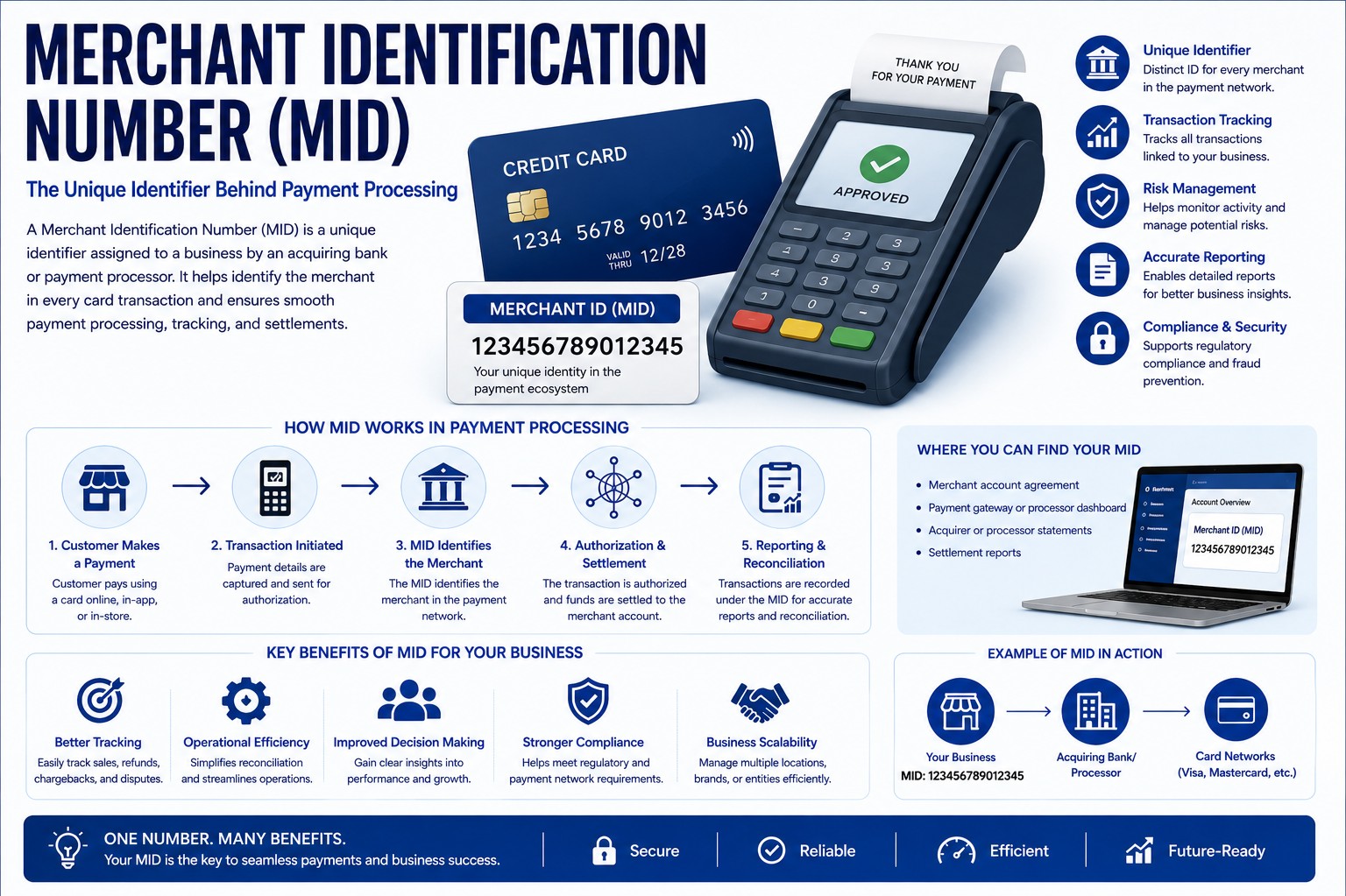
A Merchant Identification Number (MID) is a unique identifier assigned to a merchant by an acquiring bank or payment processor when a merchant account is established.
The MID acts as a reference number that links payment transactions to a specific merchant within the payment ecosystem.
Every time a customer completes a card payment, the MID helps payment networks identify which business is receiving the funds. This identifier allows acquiring banks and processors to monitor transaction activity, manage settlements, and maintain accurate records.
In simple terms, the Merchant Identification Number serves as the digital identity of a merchant within the payment processing environment.
Why Merchant Identification Numbers Matter
Modern payment systems process millions of transactions every day.
To manage this enormous volume efficiently, financial institutions require a reliable method for identifying individual merchants. The Merchant Identification Number provides this capability.
By assigning a unique identifier to each business, payment providers can track transaction histories, monitor account performance, manage disputes, and generate reports.
The MID also helps distinguish merchants that may operate under similar names or within the same industry.
Without standardized merchant identification systems, payment processing would become significantly more complex and less reliable.
How a Merchant Identification Number Is Assigned
The process typically begins when a business applies for a merchant account.
During onboarding, the acquiring bank or payment service provider reviews the merchant’s business information, ownership structure, industry classification, expected transaction volumes, and compliance documentation.
Once the application is approved, the merchant receives a Merchant Identification Number.
This MID becomes associated with the merchant account and remains an important reference point throughout the business relationship.
Some organizations operating multiple brands, business units, or locations may receive multiple Merchant Identification Numbers depending on their operational requirements.
The Role of MID in Payment Processing
The Merchant Identification Number is involved in virtually every stage of the payment lifecycle.
When a customer initiates a card transaction, payment systems use the MID to identify the merchant receiving the payment. The transaction is then routed through acquiring institutions, payment processors, and card networks using this identifier.
The MID enables accurate transaction authorization, settlement, reporting, and reconciliation.
It also helps ensure that funds are transferred to the correct merchant account after transaction settlement is completed.
Without a Merchant Identification Number, transaction routing and merchant identification would be significantly less efficient.
Supporting Transaction Tracking and Reporting
One of the most valuable functions of a Merchant Identification Number is transaction tracking.
Businesses process numerous transactions daily, making detailed reporting essential for financial management. Payment processors use the MID to organize transaction records and generate merchant-specific reports.
These reports often include sales activity, transaction volumes, chargeback data, settlement information, and payment performance metrics.
Accurate tracking enables merchants to monitor business performance, identify trends, and make informed financial decisions.
The MID provides the foundation for these reporting capabilities.
Merchant Identification Numbers and Risk Management
Risk management is a critical component of payment processing.
Financial institutions must continuously monitor merchant activity to identify unusual transaction patterns, potential fraud risks, and compliance concerns.
The Merchant Identification Number allows acquiring banks and processors to associate transactions with specific merchants and evaluate risk levels effectively.
If suspicious activity occurs, payment providers can investigate transactions linked to a particular MID and implement appropriate controls.
This capability helps protect consumers, merchants, and financial institutions from potential financial losses.
Chargeback Management and MID
Chargebacks represent one of the most important risk indicators within payment processing.
When customers dispute transactions, payment providers use the Merchant Identification Number to identify the affected merchant and manage dispute resolution processes.
Chargeback ratios are often tracked at the MID level, allowing acquiring institutions to monitor merchant performance and identify emerging issues.
Businesses with excessive chargebacks may be subject to additional monitoring, compliance reviews, or risk mitigation measures.
Effective chargeback management contributes to stronger merchant account performance and healthier payment relationships.
Merchant Identification Numbers and Compliance
Regulatory compliance has become increasingly important across the payments industry.
Financial institutions must comply with anti-money laundering regulations, know-your-customer requirements, sanctions screening obligations, and payment network rules.
The Merchant Identification Number helps support compliance efforts by creating a clear link between transactions and merchant accounts.
This transparency enables financial institutions to conduct audits, investigate suspicious activities, and satisfy reporting obligations more effectively.
As regulatory requirements continue to evolve, accurate merchant identification remains a cornerstone of payment compliance programs.
Security and Fraud Prevention
Fraud prevention relies heavily on accurate merchant identification.
Payment processors use Merchant Identification Numbers to analyze transaction behavior and detect anomalies that may indicate fraudulent activity.
Advanced monitoring systems can identify unusual transaction spikes, geographic inconsistencies, or unexpected purchasing patterns associated with specific MIDs.
By linking transactions to individual merchants, payment providers can respond more quickly to emerging threats and reduce fraud-related losses.
Strong security measures help maintain trust throughout the payment ecosystem.
Challenges Associated with Merchant Identification Numbers
While Merchant Identification Numbers are highly effective, certain challenges can arise.
Large organizations operating across multiple regions may manage numerous MIDs, creating administrative complexity.
Business acquisitions, operational restructuring, and payment provider changes may also require adjustments to merchant identification frameworks.
Additionally, merchants must ensure that payment records and reporting systems remain aligned with MID structures to maintain accurate financial data.
Proper account management and documentation are essential for addressing these challenges effectively.
The Future of Merchant Identification
The payments industry continues to evolve rapidly through technological innovation.
Artificial intelligence, embedded finance, open banking, and real-time payments are creating increasingly sophisticated payment ecosystems.
Despite these changes, merchant identification will remain fundamental to payment processing.
Future merchant identification systems may incorporate enhanced analytics, automated compliance capabilities, and deeper integration with digital payment platforms.
As transaction volumes continue to grow, the importance of reliable merchant identification mechanisms will only increase.
Conclusion
The Merchant Identification Number (MID) serves as a critical building block of modern payment processing. By providing a unique identifier for merchants, it enables transaction routing, settlement management, reporting, compliance oversight, fraud prevention, and risk management.
Although largely invisible to consumers, the MID plays an essential role in ensuring payment systems operate efficiently and securely. For businesses, understanding how Merchant Identification Numbers function can improve payment operations, strengthen compliance efforts, and support long-term growth.
As digital commerce continues expanding worldwide, the Merchant Identification Number will remain a vital component of the global payments infrastructure.
Comments
No comments yet. Be the first to share your thoughts.
Leave a comment